

There is something deeply moving about watching your child laugh on a swing in your own backyard. That sound — pure, unfiltered joy — is something every parent wants to hold onto forever. But too many families settle for clunky, plastic structures that feel out of place and fall apart in two seasons. You deserve better. Your backyard deserves better.
In 2026, modern swing sets have completely transformed. They are no longer an afterthought. They are architectural features, family investments, and design statements. Whether you have a sprawling yard or a compact urban garden, this guide will walk you through five stunning, real-world-ready ideas that blend safety, style, and lasting beauty. Let’s build a space your whole family will love for years to come.
Modern Wood Swing Set Ideas 2026 – Architectural Beauty Meets Natural Warmth
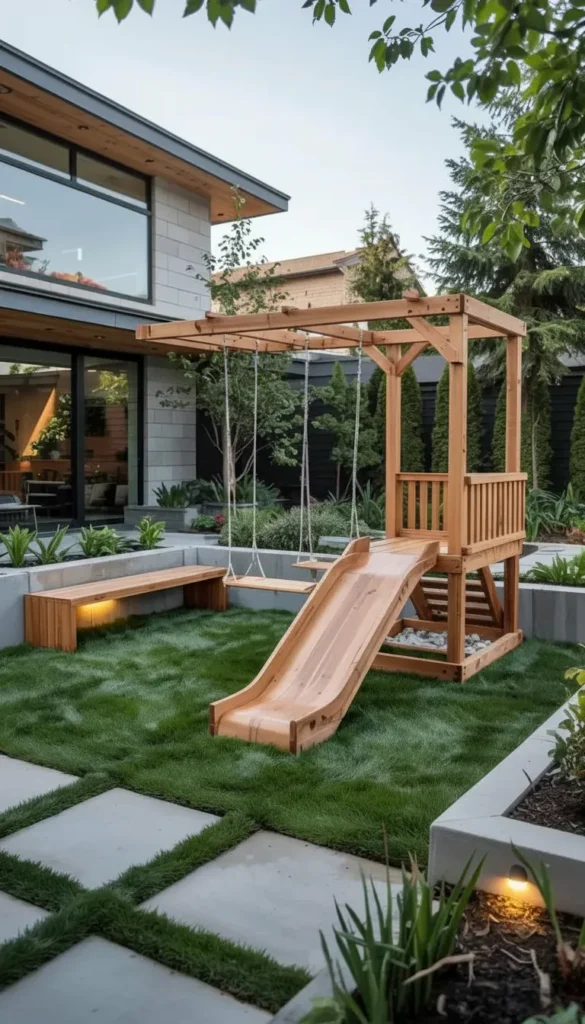
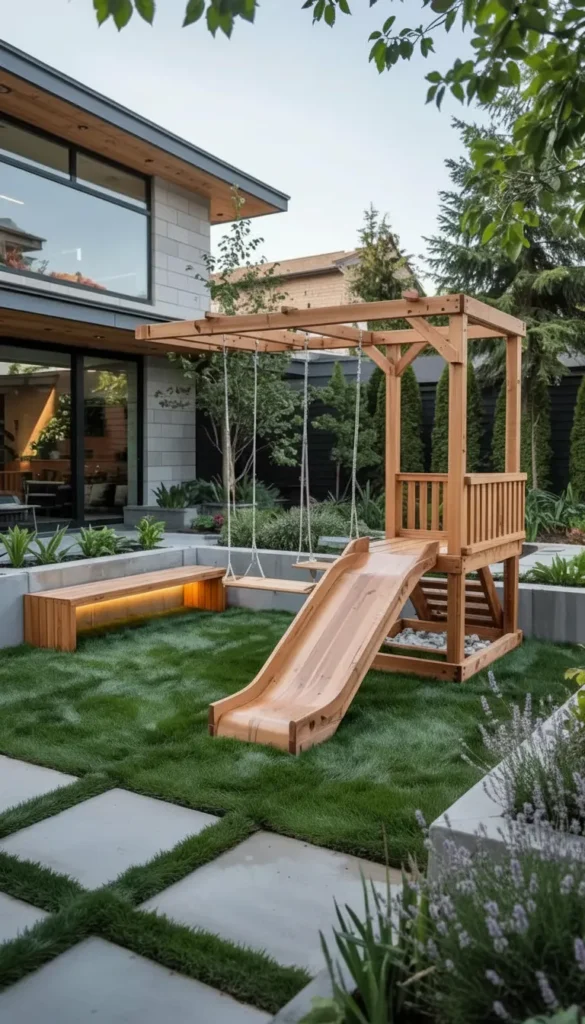
A modern wood swing set is the gold standard for families who want their backyard to look curated, not cluttered. In 2026, it is all about treated natural wood that feels alive — warm, textured, and perfectly at home in a landscaped yard. This is the swing set that guests notice and ask about. This is the one your kids will remember when they grow up.
The design philosophy here is simple: clean lines, honest materials, and structural confidence. Think less playground equipment, more outdoor sculpture.
Why Treated Wood Is the Smart Choice
Not all wood is created equal. The material you choose determines how the swing set ages, how safe it remains, and how beautiful it looks five years from now.
- Cedar is naturally rot-resistant, insect-repellent, and has a beautiful warm grain. It weathers gracefully without warping.
- Thermally modified wood (heat-treated without chemicals) is extremely dense, dimensionally stable, and holds its color longer than untreated wood.
- Pressure-treated lumber works well as a budget-conscious option but requires proper sealing to prevent surface splitting.
Always look for lumber rated for ground contact if any portion of your frame will be anchored into soil. This prevents rot at the base — the most common failure point in DIY swing sets.
The Frame Design: What Makes It Look Modern
Traditional swing sets use thick, industrial posts that feel bulky and institutional. Modern wood swing sets flip that script entirely.
- Use slim, squared-off beams (4×4 or 4×6 posts) instead of rounded poles
- Choose concealed hardware — recessed bolts and hidden brackets keep the frame looking clean
- Opt for parallel framing aligned with your fence line or home axis — this creates immediate visual order
- Paint or stain in charcoal gray, warm taupe, or natural honey tones for a contemporary finish
Why it works: When the frame mimics architectural proportions — similar to a pergola or garden gate — it reads as a design decision rather than a playground addition. The backyard feels intentional.
Pin this modern wood swing set design! 📌
Integrating Slides Without Breaking the Aesthetic
A slide does not have to scream “plastic playground.” In 2026, slides are designed with smooth profiles, muted tones, and seamless attachment points that feel native to the structure.
- Choose slides in dark gray, matte black, or warm sand tones — never primary colors if you want a modern look
- Position the slide exit over engineered turf or rubber mulch for both safety and a polished ground treatment
- Use a straight slide profile rather than wavy shapes — straight lines feel architectural and controlled
- Ensure the slide platform height does not exceed 5 feet for children under 5 (per ASTM F1148 safety guidelines)
The transition from platform to slide should feel smooth, not bolted on. When possible, integrate a short railing on the approach side using the same stainless steel finish as the swing hardware.
Built-In Seating and Planter Integration
This is the detail that separates a swing set from a backyard destination.
- Add low wooden benches (16–18 inches tall) along the perimeter of the swing zone — parents can supervise comfortably
- Incorporate planter boxes on the end posts, planted with ornamental grasses or trailing vines that soften the structure naturally
- Use the same wood species and finish for the benches and planters as the swing frame — this creates a cohesive, designed look
- Consider a built-in storage bench near the structure for balls, outdoor toys, and chalk
This approach transforms the swing area from a play zone into a family gathering space. The adults stay longer. The kids play longer. Everyone wins.
Ground Surface: Where Safety Meets Style
The surface under and around your swing set matters enormously — both for safety and aesthetics.
- Engineered wood fiber (EWF): Budget-friendly and ASTM-compliant, but needs regular replenishment
- Poured-in-place rubber: Premium option, seamless surface, zero maintenance, and color-customizable
- Artificial turf: Visually stunning, very durable, requires proper drainage base — ideal for modern designs
- Rubber mulch: Mid-range cost, soft landing, and holds its color well
Clearance rule: Allow a minimum of 6 feet of clear space on all sides of the swing arc and 3 feet around all stationary elements. This is not just a recommendation — it is a safety standard.
Save this modern wood swing set strategy! 📌
Maintenance Schedule: Protecting Your Investment
A beautiful swing set stays beautiful with a simple annual routine.
- Every spring: Inspect all hardware — tighten bolts, check for rust, replace worn swing seats and chains
- Every 2 years: Re-seal or re-stain the wood to prevent UV damage and moisture absorption
- Monthly during use season: Check anchor points, test weight loads, inspect ropes and connectors
- Apply penetrating wood oil to cedar components annually to preserve color and grain
Think of it like maintaining a deck. A small investment of time each year adds 10–15 years to the life of your structure.
Modern Swing Set Backyards – Designing Safe And Aesthetic Family Zones
Your backyard is not just a yard. It is an extension of your home — a room without walls where memories are made. When the swing set integrates into the landscape rather than fighting it, the whole outdoor space feels larger, calmer, and more intentional. This section is about designing that zone from the ground up.
The key insight here is zoning. A well-zoned backyard separates active play, quiet seating, and planted areas so each space can breathe. The swing set does not have to dominate. It just has to belong.
Start With a Scale Analysis
Before you buy a single piece of lumber or order a kit, measure your yard carefully.
- Sketch your yard to scale on graph paper (1 inch = 4 feet works well)
- Mark existing features: trees, garden beds, patios, gates, HVAC units
- Identify natural sight lines from your kitchen, living room, and patio — you want to see the kids playing
- Note sun patterns throughout the day — a swing set in full afternoon sun creates an uncomfortable play experience
Ideal placement is northeast or east-facing in most US climate zones — morning sun, afternoon shade. This keeps the metal hardware cooler and extends comfortable play hours.
Defining the Play Zone Without Fencing It Off
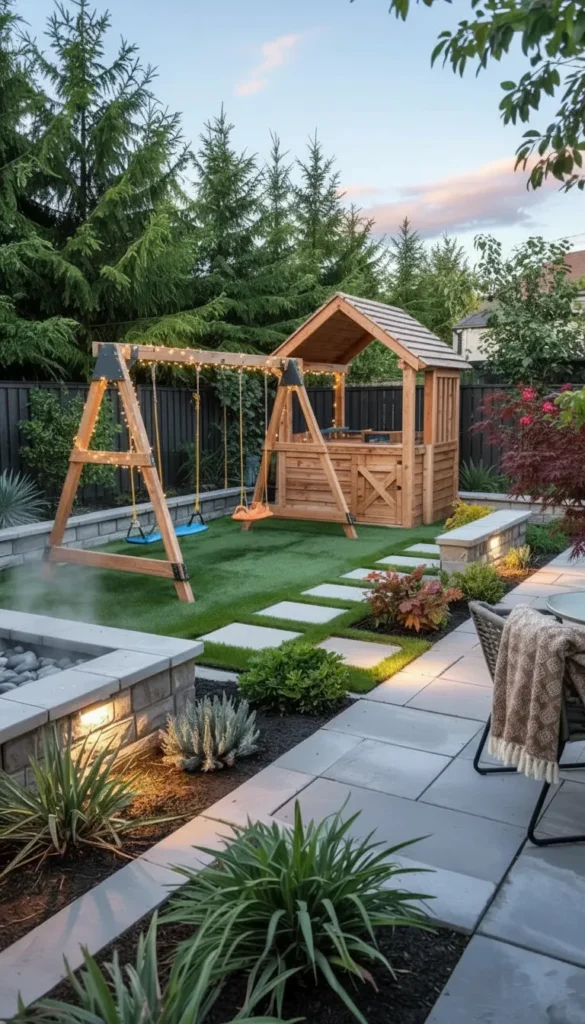
One of the most common mistakes is creating a rigid, fenced-in play area that makes the yard feel chopped up and small. Instead, use visual boundaries that feel organic.
- Low retaining walls (12–18 inches high) in brick, concrete, or natural stone define the zone without blocking views
- Ornamental grass clusters — like Karl Foerster or Blue Oat grass — create soft edges that sway beautifully in the wind
- A change in ground material (from lawn to rubber mulch or artificial turf) naturally communicates “this is the play area” without a hard boundary
- Integrated stepping stones create a clear pathway into the zone from the main patio
This approach keeps the yard open and connected while giving the play area its own identity.
Pin this backyard zoning strategy! 📌
Positioning the Swing Frame for Visual Order
Where you place the frame matters as much as what it looks like.
- Align the swing frame parallel to your fence line — this creates a natural visual anchor and prevents the structure from floating awkwardly in the middle of the yard
- Position the long axis of the frame perpendicular to the main viewing angle from the house — this gives you the best depth perspective
- Leave at least 3 feet of clearance from the fence on all sides for safety and maintenance access
- If your yard has a garden wall or raised bed, use the swing frame to create an L-shaped enclosure with that existing feature
Creating Layered Privacy and Safety
You want to see your kids. You want to feel private from neighbors. And you do not want to build a fortress.
- Layer 1 — Ground: Rubber mulch or artificial turf defines the boundary
- Layer 2 — Mid-height: Ornamental grasses and low shrubs (3–4 feet) create a soft visual screen
- Layer 3 — High: Climbing vines on a trellis panel attached to the swing frame add privacy and beauty
This layered approach is championed by landscape designers and provides the feeling of enclosure without isolation. The kids feel contained and safe. The yard feels lush and intentional.
Lighting the Play Zone for Safety and Evening Ambiance
Lighting is the most overlooked element in backyard play design. Done right, it adds safety and transforms the space into an evening gathering point.
- Install low-voltage pathway lights (solar or 12V wired) along the edges of the play zone
- Use directional spotlights mounted on fence posts to illuminate the swing structure from 8–10 feet away — this avoids glare while creating beautiful shadows
- Add string lights above the perimeter seating area for warm ambient light that parents love
- Choose warm white (2700K–3000K) bulbs — cool blue lighting feels harsh and clinical in a backyard setting
Safety note: Ensure no lighting fixtures or cables are within reach of children during play. All outdoor fixtures should carry a UL Wet Location rating.
Adding a Compact Playhouse Element
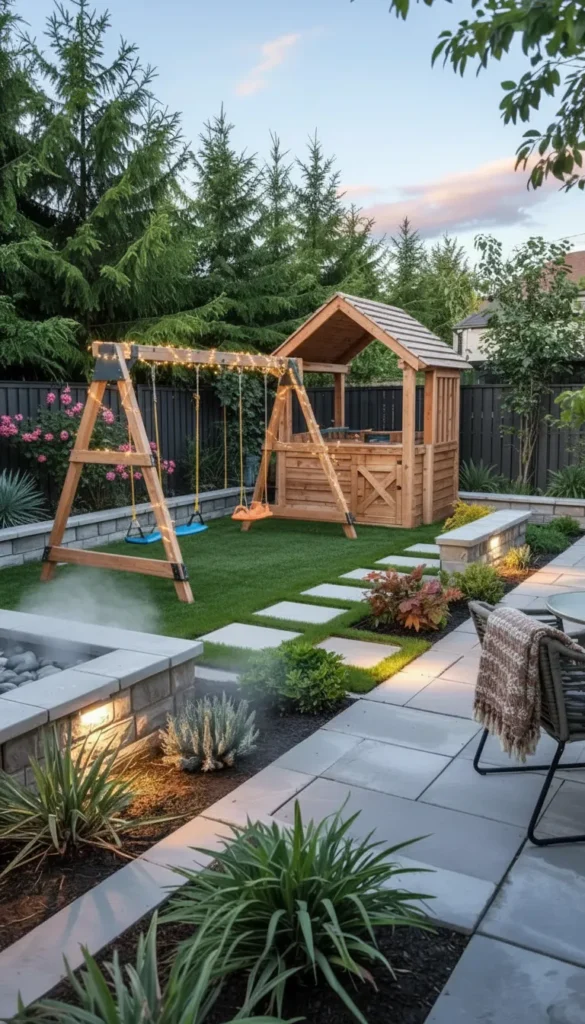
A small playhouse module attached to one end of the swing frame dramatically increases the play value without requiring more footprint.
- Size recommendation: 4×4 feet platform, 5–6 feet interior height — large enough for imaginative play, small enough to maintain yard scale
- Use the same wood species as the main frame for visual continuity
- Add a Dutch door, small window, and simple roof — these three elements trigger powerful imaginative play in children ages 3–10
- Paint the playhouse interior in a contrasting accent color — this creates a sense of discovery without disrupting the exterior palette
Save this backyard design approach! 📌
Supervision Angles: Design for the Parent
A beautifully designed play zone accounts for where adults sit, not just where kids play.
- Position a seating bench or chair area with an unobstructed sightline to the swing set
- Avoid planting tall shrubs directly in the supervision line
- Place the primary patio furniture arrangement within 20 feet of the swing zone — close enough to supervise, far enough to feel like a separate space
- A low garden wall or step between patio and play zone creates a natural adult boundary without walls
Modern Swing Set DIY – Step-By-Step Guide For A Custom Backyard Build
Building your own modern swing set is one of the most rewarding projects a homeowner can take on. You control the materials, the proportions, the finishing details — and you end up with something that looks nothing like anything from a box store. This section gives you the structured approach that separates a safe, beautiful DIY build from a wobbly afternoon project that worries you every time the kids run outside.
Start with a plan. Always.
Step 1 – Draft Your Modern Swing Set Plans
Before you touch a single board, draw your structure.
- Sketch a front elevation, side elevation, and top plan — even rough hand drawings help catch proportion problems early
- Standard A-frame swing set: 10 feet wide, 8 feet tall at peak, 5-foot leg spread is a solid starting point for 2 belt swings plus a trapeze bar
- Confirm clearance zones on paper before committing to placement — you cannot undo a concrete anchor
- Download free structural templates from sites like SwingSetPlans.com or purchase detailed plans for $15–30 — worth every dollar
Step 2 – Assess Your Soil and Choose Your Anchor Method
This is where most DIY builds cut corners — and where failures happen.
- Sandy or loamy soil: Use concrete footings — dig 18–24 inch holes and pour 60 lb bags of Quikrete around your post bases
- Clay-heavy soil: Auger holes at least 24 inches deep — clay shifts with moisture and can heave posts over time
- Hard-packed or rocky soil: Use ground anchor plates bolted to the base of your A-frame legs — these spread the load without deep digging
- All post bases should be at least 18 inches below grade in frost-prone climates to prevent heaving
Test stability before the first use: apply 250 lbs of downward force to the top beam by hand. If it flexes more than 1 inch, your anchoring is insufficient.
Pin this DIY swing set building guide! 📌
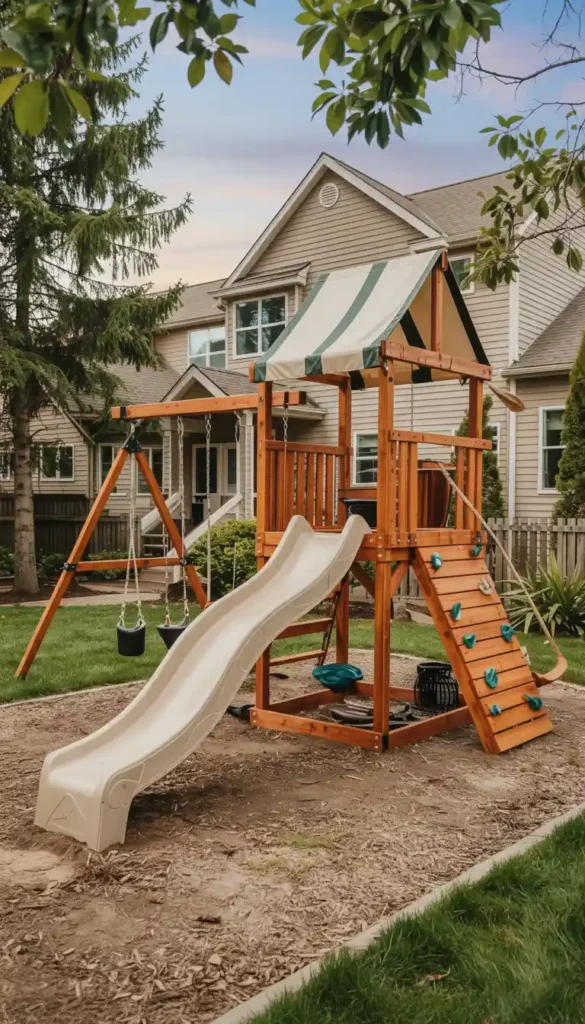
Step 3 – Selecting and Cutting Your Lumber
Precision cutting determines whether your swing set looks handcrafted or hand-cobbled.
- Buy S4S (surfaced four sides) lumber — pre-planed, smooth surfaces that do not need sanding before assembly
- Use a compound miter saw for accurate angle cuts on A-frame legs — typical leg angle is 10–15 degrees from vertical
- Cut all matching pieces at the same time using a stop block on your saw — this guarantees identical lengths
- Sand all exposed edges and corners to a 1/8-inch radius minimum — this prevents splinters and dramatically improves the finished look
Lumber quantity for a standard 2-swing set:
- 4×6 x 10′ posts: 4 pieces (legs)
- 4×6 x 12′ beam: 1 piece (top rail)
- 2×6 x 8′: 4 pieces (braces and headers)
- 1×6 x 8′: as needed for platform decking
Step 4 – Hardware Selection for a Modern Finish
The hardware makes or breaks the modern aesthetic. Do not compromise here.
- Use stainless steel carriage bolts (3/8″ diameter minimum) for all structural connections — they will not rust and they look beautiful
- Specify black powder-coated swing hangers — the dark finish reads as intentional, not industrial
- Use concealed post-cap brackets at the top beam connection to eliminate visible hardware on the primary silhouette
- All swing chains should be #2 coil chain, stainless or zinc-plated — rated for at least 400 lbs per link
Avoid galvanized hardware where it will be visible — the silver-gray tone clashes with warm wood stains and looks dated.
Step 5 – Assembly Sequence
Work in this order to avoid having to disassemble and redo sections.
- Set and anchor your A-frame legs — level, plumb, concrete-set, and let cure 24 hours minimum
- Lift and connect the top beam — use temporary diagonal braces to hold position while bolting
- Install swing hangers — measure exactly to ensure equal spacing and consistent hang height
- Add platform and playhouse elements (if included) — build from bottom deck up
- Install slide, climbing elements, and rope features last — these are easiest to fine-tune at the end
- Apply finish coat of exterior stain or sealant — do this before hanging swings to coat all surfaces evenly
Step 6 – Final Safety Check Before First Use
Before any child touches the structure, complete this checklist.
- All bolts are fully tightened and no threading is exposed beyond the nut
- No sharp edges, splinters, or protruding hardware anywhere on the structure
- Swing seats hang at 17–24 inches from ground for children — this is the ASTM-recommended height range
- Ground surface beneath swing arc is at least 9 inches deep of loose-fill safety material
- Structure does not rock, sway, or flex under 250 lb load test
Save this DIY safety checklist! 📌
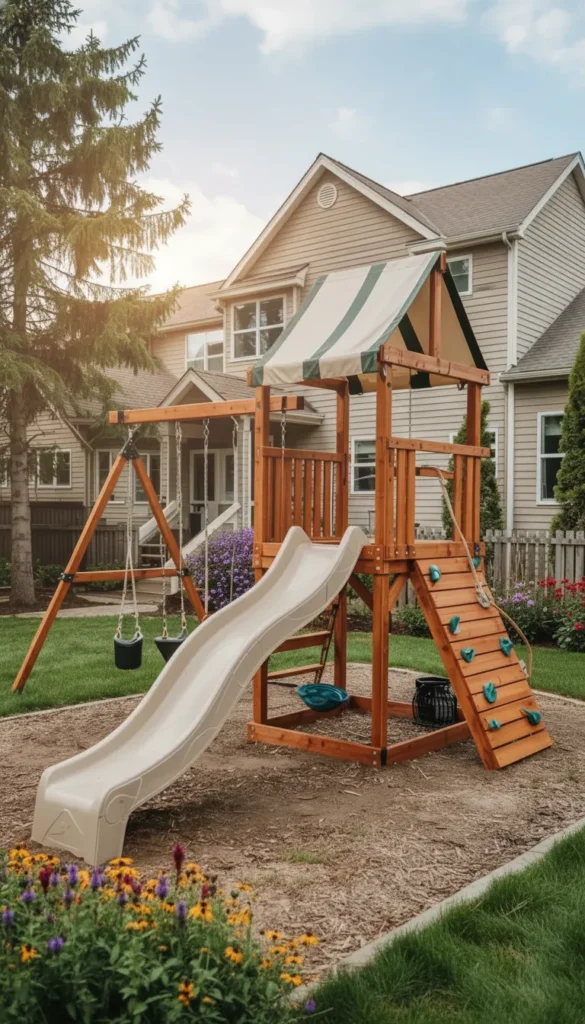
Annual Maintenance: The Non-Negotiable Routine
Your DIY build is only as good as the care you give it.
- Spring: Tighten all hardware, inspect all wood surfaces for cracks or soft spots, check swing chains for stretched links
- Summer: Check rubber grips on bars and handles monthly — UV degrades them fast
- Fall: Re-seal all wood surfaces before winter moisture sets in
- Replace immediately: Any component that shows cracking, fraying, or significant rust — never defer safety repairs
Modern Swing Set Outdoor Concepts – Weather Resistant And Trend Forward Designs
Your swing set lives outside 365 days a year. Rain, UV exposure, freeze-thaw cycles, wind, and humidity work constantly against every material you use. The most beautiful design in the world fails if it cannot survive a second winter. In 2026, weather resistance is no longer a compromise — it is built into the aesthetic itself through smarter material choices, better geometry, and intentional site planning.
This section covers the outdoor concepts that look great on day one and still look great in year seven.
The 2026 Material Palette for Outdoor Durability
The modern outdoor color palette is built around materials that age well, not materials that need to be replaced.
- Charcoal gray powder-coated steel — looks intentional, resists rust for 15+ years, pairs beautifully with warm wood
- Thermally modified wood — the heat process removes sugars that feed rot and insects, color stays truer longer
- Composite decking platforms — the wood-look composite for platform surfaces takes zero maintenance and feels solid underfoot
- UV-resistant polyethylene for grips and seats — color-stable for 8–10 years vs. 2–3 years for standard plastic
Avoid: Raw aluminum (oxidizes to a chalky white), standard pine (rots within 3 years), and bright primary-color plastics (UV-fade within one season and clash with any designed palette).
Pin this weather-resistant design concept! 📌
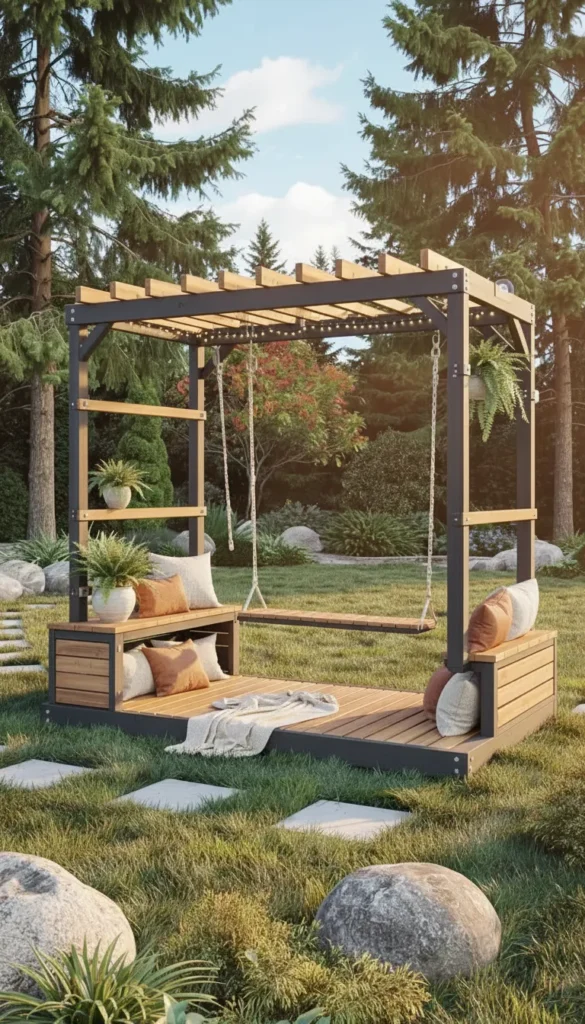
Choosing a Color Scheme That Ages Gracefully
Trendy colors fade. Considered palettes endure.
- Anchor color: Warm wood tone (cedar, teak, or honey stain) — this is your dominant visual
- Accent color: Charcoal gray or matte black hardware and frame elements — creates visual contrast and modern feel
- Softener: Natural greenery from integrated planters or surrounding landscape — this ties the structure to the garden
Why this works: The warm-dark-green combination is rooted in traditional landscape architecture. It reads as timeless rather than trendy. You will not look at it in 2029 and wince.
Positioning for Weather Protection
Where you place the swing set in the yard directly affects how it weathers.
- Avoid low-lying areas where water pools after rain — constant moisture accelerates rot and rust
- Do not place under dense tree canopy — while tempting for shade, sap, leaf matter, and bird droppings accelerate deterioration
- Orient the long axis of the structure with the prevailing wind direction in your region — this reduces load on anchor points
- Create a slight grade (2–3% slope) in the ground surface beneath the swing set — this ensures water sheds away from the structure
Drainage and Ground Surface Planning
Water management beneath the swing set is critically important and almost never discussed.
- Install a 4-inch perforated drainage pipe around the perimeter of rubber mulch or wood fiber play surfaces — this prevents pooling and keeps the fill material from compacting
- Gravel grid systems (interlocking plastic cells filled with pea gravel) provide excellent drainage and structural support for rubber mulch above
- Artificial turf with a drainage backing requires a 4-inch compacted aggregate base — do not skip this step or you will have a soggy, smelly surface within two seasons
- Grade the entire play zone so it drains away from the home foundation — this is as much about home protection as swing set protection
Shade Solutions That Look Intentional
Shade is comfort. And in 2026, shade is also a design feature.
- Sail canopy in a muted tone (gray, cream, or soft sage) — attach to the top beam and a nearby fence post or stake — provides partial shade without overwhelming the structure visually
- Pergola integration — if budget allows, extending the swing set frame into a partial pergola structure over the adjacent seating area creates a unified outdoor room
- Retractable shade panels — mounted on a simple track above the platform area — protect against afternoon sun without being permanent
- Deciduous trees planted 15 feet away provide natural dappled shade in summer and full sun in winter — the ideal long-term solution
Integrated Storage That Keeps the Yard Tidy
Clutter destroys the look of any well-designed backyard.
- Add a lockable storage bench (36 x 18 inches works well) attached to the base of the playhouse or end post — stores balls, chalk, sand toys, and spare swing seats
- Use galvanized or powder-coated hooks mounted on the side of the frame for hanging jump ropes, sports nets, and garden tools
- A small bin corral (three bins for sand, chalk, and outdoor toys) built into the base perimeter of the structure keeps the zone self-contained
Save this outdoor swing set concept! 📌
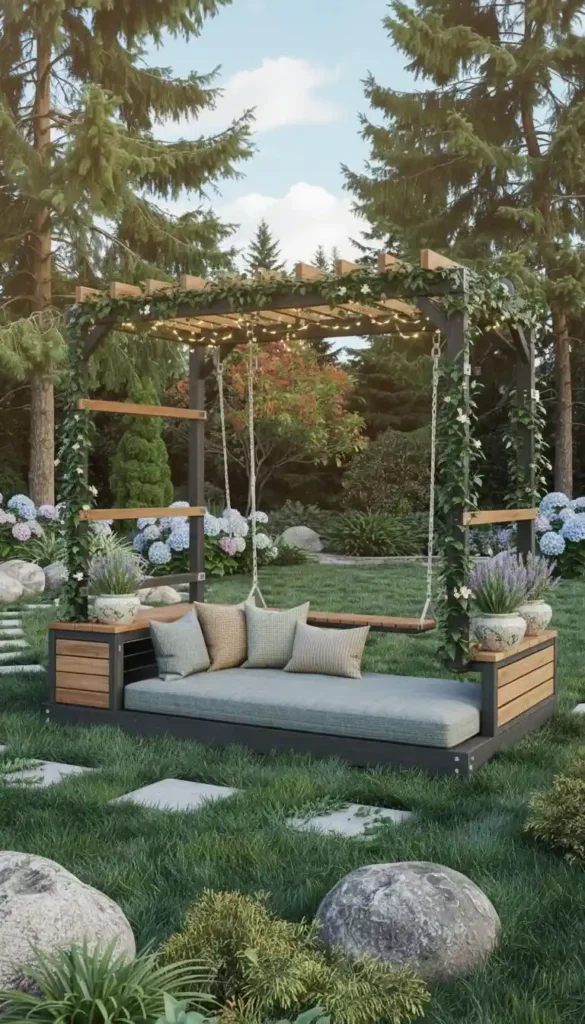
Rainwater Management for the Long Term
Think about water before, during, and after every rain event.
- Install splash guards at the base of all vertical posts — these are simple aluminum flashing strips that prevent constant wetting of the post base
- If your play zone uses loose-fill material, install edging (flexible rubber or steel landscape edging) to contain it and prevent washing
- Consider a permeable paving apron (1–2 feet wide) around the perimeter of the swing zone — this handles splashback and defines a transition zone between soft fall surface and lawn
- Keep drainage channels clear of leaf debris every fall — blocked drainage is the number one cause of premature surface deterioration
Modern Swing Sets For Contemporary Homes – Minimalist And Functional Solutions
Contemporary homes have a design language — clean facades, large windows, restrained material palettes, geometric precision. A poorly chosen swing set fights that language. A well-designed modern swing set extends it into the backyard like a natural continuation of the architecture.
This final section is for homeowners with modern or contemporary homes who want a swing set that looks like it was designed by the same person who designed the house. Not purchased at a big-box store and dropped in the yard.
Reading Your Home’s Architecture Before Choosing a Swing Set
Every contemporary home gives you design cues. Use them.
- Flat roof lines: Choose a swing set with a horizontal top beam and no peaked roof elements — echoes the roofline
- Vertical cladding or siding: Choose vertical accent elements — ladder rungs, vertical rope features — to repeat that rhythm
- Large glass walls: Position the swing set as a focal point visible from inside — it becomes part of the view, not a distraction from it
- Dark exterior finishes: Use charcoal or black hardware and dark-stained wood on the swing set to visually connect the structure to the home
This process takes 20 minutes and fundamentally improves every design decision that follows.
Pin this minimalist swing set design approach! 📌
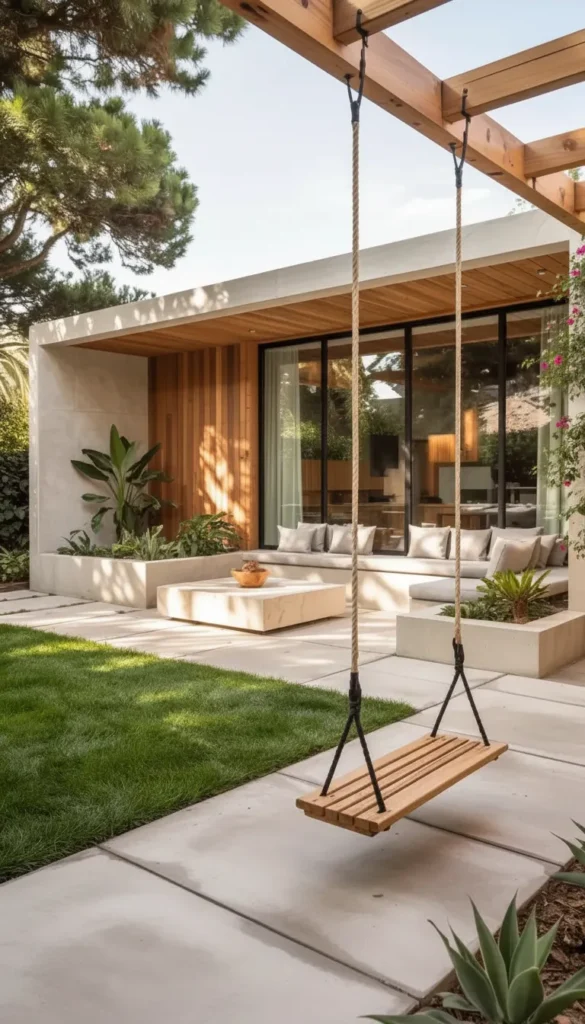
Proportions and Scale for a Minimalist Feel
Minimalism is not about doing less. It is about doing exactly enough — with precision.
- Slim beam profiles (4×4 maximum for primary visible elements) read as architectural; 6×6 reads as industrial
- Consistent post spacing — irregular spacing creates visual noise; even, measured spacing creates calm
- Limit the number of activities on the structure: 2 swings + 1 climbing element is ideal for a minimalist aesthetic — more than 4 activities and the structure begins to look cluttered
- Use negative space deliberately — an open platform with no railing on one side creates a sense of openness and visual lightness
Materials That Complement Contemporary Homes
For homes with concrete, glass, steel, and dark wood, your swing set material choices should feel related, not matching.
- Shou sugi ban (charred wood) — the Japanese technique of surface-charring wood creates a dramatic, weatherproof finish that pairs beautifully with modern architecture
- Powder-coated flat-black steel frame with wood platform accents — very contemporary, very durable, very visually intentional
- Smooth-sanded cedar with a clear matte sealant — shows the natural grain and color without looking rustic or traditional
- Brushed stainless steel hardware — for homes with brushed metal fixtures, this creates a continuous material story from indoors to outdoors
Adding a Climbing Element Without Visual Clutter
A climbing wall or rope element dramatically increases play value. The trick is integrating it without breaking the clean lines.
- Geometric climbing holds in matte black or concrete gray — avoid colorful gym-style holds that look playful but break the palette
- A single vertical rope with knots is the most minimal option — low visual impact, high play value, extremely durable
- A short bouldering panel (3–4 feet wide, 4 feet tall, 30-degree incline) integrated into one end of the structure reads more like an architectural detail than play equipment
- Use flush-mounted handholds where possible to maintain flat surfaces and avoid visual protrusions
Connecting the Swing Zone to the Main Patio
The strongest contemporary backyard designs treat the outdoor space as a sequence of connected rooms, not isolated zones.
- Use the same paving material (or a close variation) to create a visual pathway from the patio to the swing area
- Align seating furniture so that one chair or bench faces the swing set — this makes the play zone feel part of the conversation
- A planted border (low perennial planting, 12–18 inches tall) between patio and play zone creates a soft transition without a hard boundary
- Consistent lighting fixtures across both zones — matching pendant style, same color temperature — unify the outdoor space visually
Choosing Swing Seats for a Contemporary Look
The seat is the most visible detail on any swing set. Choose it thoughtfully.
- Flat plank seat in matching wood — a simple sanded cedar or walnut plank on stainless chains is the most refined option available
- Black rubber belt seat — classic profile, neutral color, pairs well with any modern frame
- Molded plastic bucket seat in dark gray or black — appropriate for toddlers; avoid bright colors
- Canvas sling seat — extremely minimal, lightweight visual profile, very contemporary feel
Avoid: Multi-color plastic, bright primary-color seats, novelty shapes (car, airplane, etc.) — these break the contemporary aesthetic immediately.
Why Simplicity Creates Longevity in Design
The final principle of contemporary swing set design is also the most important one: edited design lasts longer.
- A structure with fewer, better elements stays visually relevant longer than a structure packed with every possible feature
- Higher quality in fewer components beats average quality in many — one excellent cedar beam outlasts three average pine boards
- Children aged 2–12 will use and love a well-designed simple structure just as much as a complex multi-activity tower
- When the swing set looks like it belongs, you maintain it better, use the surrounding space more, and feel proud of your yard year after year
Save this minimalist swing set philosophy! 📌
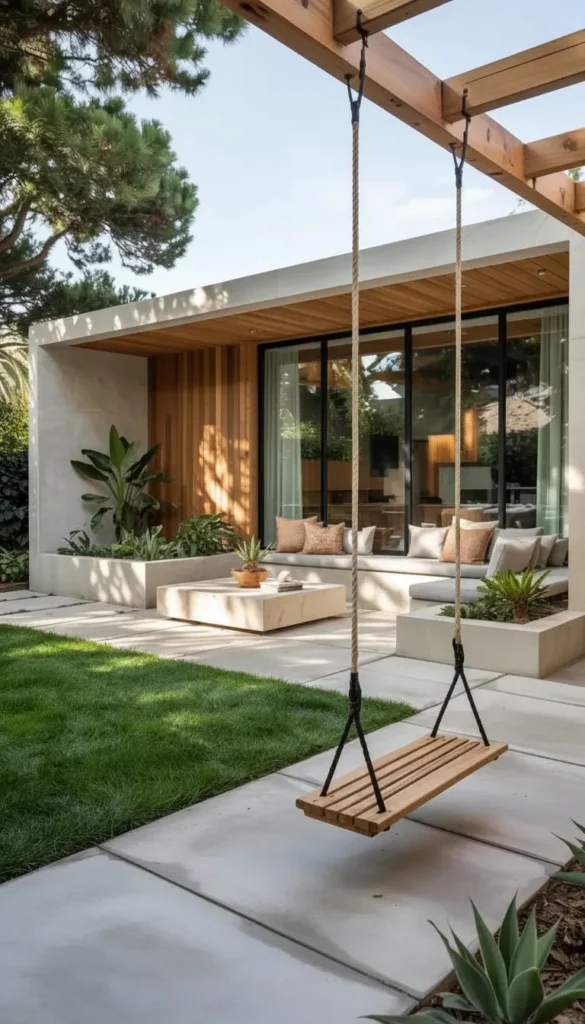
Final Coordination: Outdoor Furniture and Swing Set as One Composition
Your outdoor furniture arrangement is the last step in creating a truly cohesive backyard.
- Choose patio furniture in the same material family as the swing set — teak furniture with a cedar swing set, powder-coated steel chairs with a steel-frame swing set
- Position furniture diagonally to the swing set rather than straight-on — this creates a more dynamic, designed spatial relationship
- Add 2–3 large planters near both the furniture cluster and the swing set in the same planter material — this visually ties the two zones together
- Finish with one outdoor rug under the seating area in a tone that bridges your furniture color and swing set color — this grounds the composition
When every element of your outdoor space speaks the same visual language, the result is not just a yard. It is a home — one that extends from your front door all the way to the back fence.
Conclusion
A modern swing set is not just something you buy for your kids. It is a statement about how you value your home, your outdoor space, and the memories being made in your backyard every single day. The ideas in this guide — from warm cedar DIY builds to minimalist contemporary frames — all point toward the same truth: the best swing sets are the ones designed with intention.
Start with what your yard and your home are telling you. Choose materials that last. Build zones that invite the whole family outside. And do not be afraid to treat a swing set like the architectural feature it truly is. Your backyard is waiting — and so are the best afternoons of your family’s life.

“I share simple, beautiful and affordable home decor ideas to help you style every corner of your home with ease.