

There is something deeply satisfying about stepping outside your back door and feeling like you have arrived somewhere special. Your backyard is not just a patch of grass — it is the place where summer memories are made, where kids run barefoot, where you finally exhale after a long week. When that space is beautiful, functional, and built to last, everything feels just a little more right.
Stamped concrete is one of the most powerful ways to make that transformation happen in 2026. Whether you have a tiny townhouse backyard or a sprawling property, the right stamped concrete patio design can turn an ordinary slab into something that genuinely takes your breath away. This guide walks you through five real, practical, and stunning ideas — so you can stop dreaming and start building.
Stamped Concrete Patio Ideas Backyards For Stylish And Functional Outdoor Living
Your backyard patio should feel like an outdoor room — not an afterthought. Stamped concrete gives you the texture, style, and durability to design a space that works hard and looks incredible doing it. Whether you want a cozy corner for morning coffee or a full entertaining zone, this section covers how to make it happen with intention.
Why Stamped Concrete Works So Well In Backyards
Stamped concrete is one of the most versatile hardscape materials available today. It mimics the look of natural stone, brick, slate, or wood — at a fraction of the cost. Unlike pavers, it does not shift over time. Unlike wood decking, it does not rot or splinter.
- Durability: Properly installed stamped concrete lasts 25–30 years with basic maintenance
- Versatility: Dozens of pattern and color options to match any home style
- Low maintenance: No weeds growing between joints, no replacing individual pieces
- Cost effective: Typically 30–50% less expensive than natural stone
Choosing The Right Texture Pattern For Your Backyard
Pattern selection is where personality enters the picture. The right stamp transforms a plain slab into something that feels intentional and refined.
- Stone patterns (flagstone, ashlar slate) work beautifully in traditional and craftsman homes
- Wood plank stamps add warmth and are perfect for modern farmhouse styles
- Cobblestone or brick patterns suit colonial or cottage aesthetics
- Large format tile stamps give a clean, contemporary look for modern homes
For most backyards, ashlar slate or random stone patterns are the most universally loved because they look natural without being busy.
Creating Zones That Actually Function
A patio without zones feels chaotic. Thoughtful zoning turns your backyard into a true outdoor living space.
- Define a dining zone near the sliding door for easy access from the kitchen
- Place a lounge zone deeper into the yard for relaxation and privacy
- Use planter borders or low walls to subtly separate spaces without building fences
- Consider a fire pit zone as a third anchor point for evening gatherings
Why it works: Clear zones guide how people move through your backyard naturally. Guests know where to sit, where to eat, and where to gather — without a single sign.
📌 Pin this backyard zoning strategy! 📌
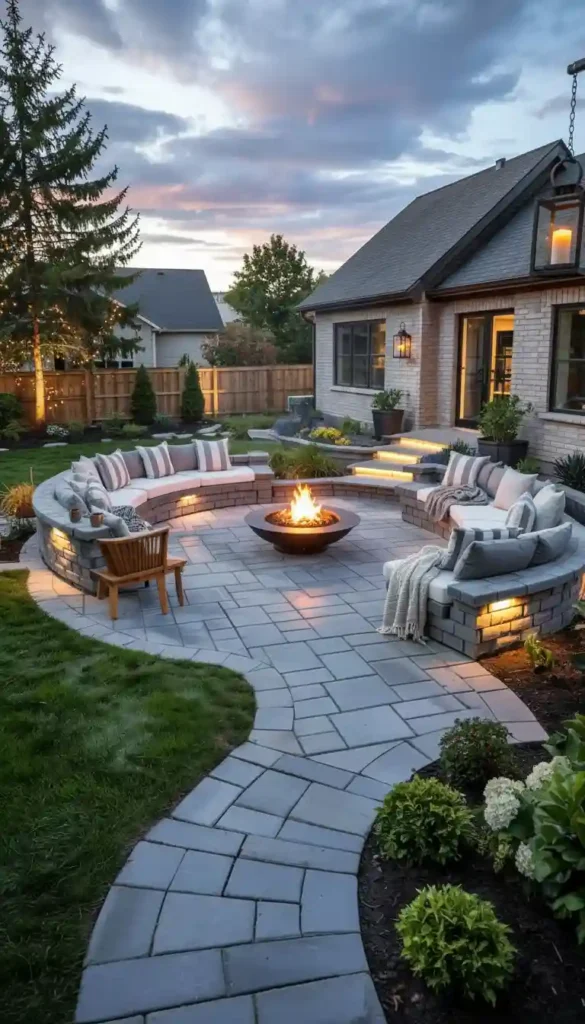
Furniture That Complements Stamped Concrete
The right furniture amplifies your patio’s design without competing with it.
- Sectional sofas in neutral tones (grey, tan, cream) sit beautifully against stamped stone patterns
- Round or curved seating arrangements soften the structured geometry of concrete
- Metal and teak combinations add contrast and texture without clashing
- Avoid overly ornate furniture on busy stamp patterns — keep it simple to let the concrete shine
Adding Lighting For Evening Use
Lighting takes your patio from daytime to magical. It is one of the most underrated upgrades in any outdoor design.
- Recessed step lights provide safety and drama along stairs and level changes
- String lights overhead create instant warmth and ambiance
- Path lighting along backyard walkways guides guests safely
- Up-lighting on planters or architectural features adds dimension at night
Plan your lighting during the design phase — not after the concrete is poured. Running conduit under the slab while it is being installed saves significant money and hassle.
Integrating Planters And Built-In Benches
Built-in features make a patio feel custom and complete.
- Built-in concrete benches along perimeter walls double as additional seating without using floor space
- Raised planters in matching concrete add greenery and privacy
- Corner planters anchor the edges and create a sense of enclosure
- Use trailing plants and ornamental grasses to soften hard edges naturally
📌 Save this outdoor living design guide! 📌
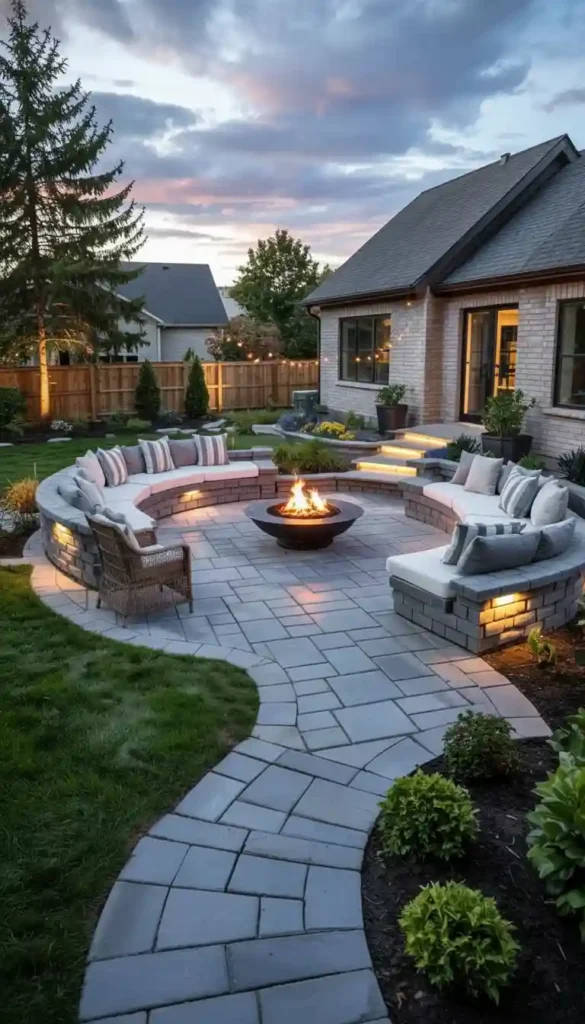
The Finishing Principle
The best backyard patios are not the most expensive — they are the most intentional. Every choice, from pattern to planter placement, should serve both beauty and function. When you design with purpose, the result feels polished rather than random.
Stamped Concrete Patio Layout Ideas That Maximize Space And Flow
Layout is the foundation of every great patio. Get the layout right, and even a small backyard feels generous. Get it wrong, and even a large space feels cramped and awkward. This section breaks down exactly how to plan a stamped concrete layout that maximizes every square foot.
Start With Traffic Flow Analysis
Before you choose a single pattern or color, map out how people actually move through your yard.
- Where does the back door open, and where do people naturally walk first?
- Is there a gate, pool, or garden path that draws foot traffic?
- Are there any obstacles — trees, HVAC units, utility boxes — that dictate the shape?
- How wide do walking paths need to be? (Minimum 36 inches for one person; 48–60 inches for two)
Understanding natural traffic patterns prevents you from designing a beautiful patio that nobody can comfortably use.
Small Backyard Layout Strategies
Small backyards demand clean, geometric thinking. Complexity works against you in tight spaces.
- Use square or rectangular slabs with simple borders — they read as larger than organic shapes
- Diagonal stamp patterns create the optical illusion of more space
- Avoid breaking a small patio into too many zones — one or two defined areas is enough
- Extend the patio to the property line where possible to maximize usable surface
A 12×16 foot stamped concrete patio can feel like a proper outdoor room when the layout is clean and furniture is properly scaled.
📌 Pin this small backyard layout strategy! 📌
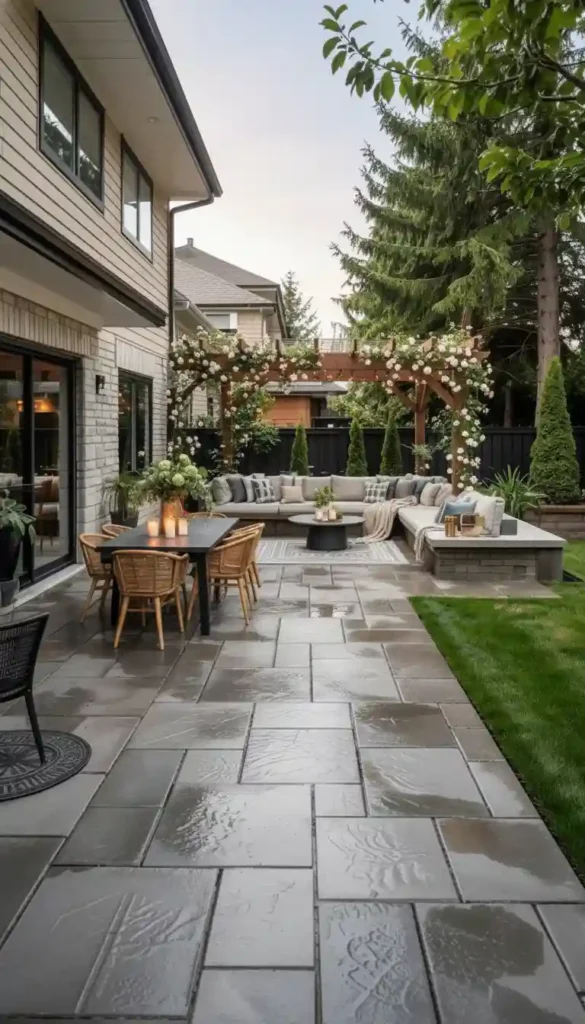
Large Backyard Layout Opportunities
A large yard is an opportunity to create genuine outdoor living architecture.
- Design multi-level zones using steps and grade changes to add visual interest
- Create a main entertaining patio near the house and a secondary relaxation zone further out
- Use curved edges and organic shapes to soften large expanses of concrete
- Include planted islands or raised beds to break up the hardscape and add softness
Large patios often benefit from accent borders in a contrasting color to visually define zones without physical barriers.
Matching Layout To Home Architecture
Your patio layout should feel like it grew from the house — not dropped beside it.
- Ranch-style homes respond beautifully to symmetrical, horizontal layouts that echo the home’s low profile
- Contemporary homes suit asymmetrical, angular patios with clean geometric lines
- Craftsman and cottage homes look best with irregular flagstone-style layouts and soft curved edges
- Colonial and traditional homes benefit from formal rectangular layouts with defined borders
When the patio architecture echoes the home’s architecture, the result feels effortless and cohesive.
Using Furniture Footprints To Plan Before Pouring
This is one of the most practical tips professionals use — and most homeowners skip it.
- Mark out furniture footprints with spray paint or chalk on the ground before finalizing the layout
- Ensure a dining table with chairs pulled out fits comfortably — allow 36 inches of clearance on all sides
- A 6-person sectional typically requires at least a 14×16 foot zone to breathe properly
- Check that traffic paths remain clear around all furniture zones
Pouring concrete before testing furniture placement is one of the most common (and expensive) patio mistakes.
Incorporating Shade Structures In The Layout
A pergola, shade sail, or covered roof should be part of the layout plan from day one.
- Pergola posts need to land on solid concrete or footings — plan their location before pouring
- Shade sails require anchor points at the perimeter — include hardware installation in early planning
- Leave electrical conduit running under the slab for ceiling fans or lighting if a roof structure is planned
- Allow for proper drainage under covered sections where rain runoff concentrates
📌 Save this patio layout planning guide! 📌
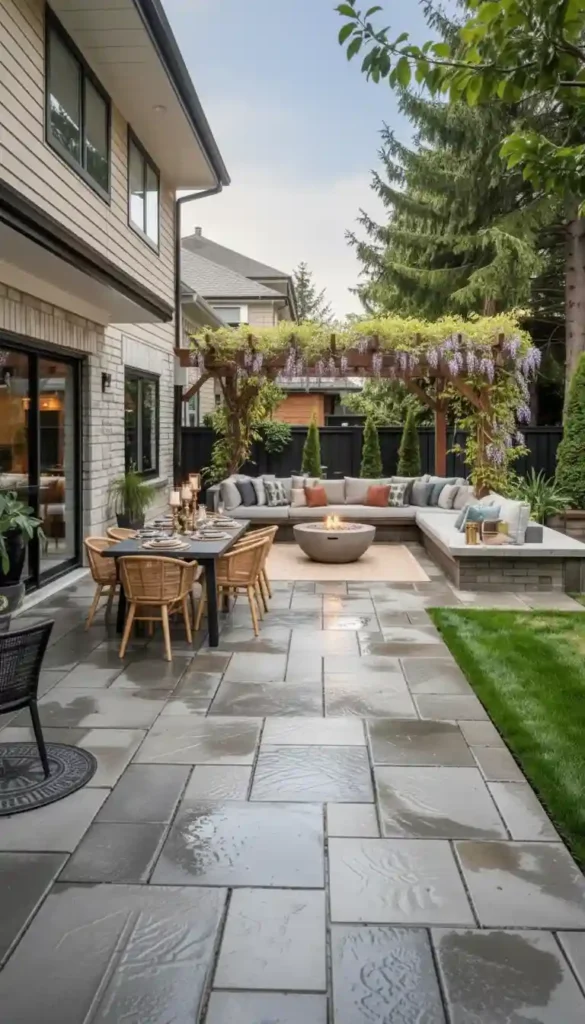
The Layout Principle
A great layout is invisible — you only notice it when it is wrong. When the layout is right, the space feels easy, natural, and generous. Plan the layout as carefully as you plan the pattern, and your patio will reward you for decades.
Stamped Concrete Patio Color Ideas To Transform Your Outdoor Design
Color is where stamped concrete moves from impressive to extraordinary. The right color palette can make your patio feel like it has always belonged — a natural extension of your home and landscape. The wrong choice makes it look like a grey parking lot. This section helps you choose with confidence.
Understanding How Color Works In Stamped Concrete
Stamped concrete color comes from two sources: integral color (mixed into the concrete) and color hardener (applied to the surface). Many installations use both for depth and dimension.
- Integral color provides base tone throughout the slab — so chips and cracks do not show white
- Color hardener adds surface richness and enhances the stamped pattern definition
- Antiquing release agents create the aged, multi-tonal look that mimics real stone
- Combining all three produces the most realistic, natural-looking results
Understanding this process helps you communicate clearly with your contractor and avoid surprises.
Trending Color Palettes For 2026
In 2026, the strongest trend in stamped concrete color is grounded naturalism — tones that feel pulled from the earth and landscape.
- Cool grey and charcoal remain the most popular for modern and contemporary homes
- Warm taupe and sandstone are surging in popularity for transitional and farmhouse styles
- Terracotta and rust undertones are making a strong comeback for Mediterranean-inspired designs
- Buff and cream tones stay perennially popular because they pair with almost any landscaping
Avoid extremely saturated or trendy colors. They date quickly and fade unevenly in UV exposure.
Choosing Colors That Complement Your Home
Your home’s exterior is the dominant visual element — your patio color should support it, not compete.
- Match your patio’s base tone to your home’s trim or siding undertones for a seamless look
- If your home has warm brick or stone, choose warm taupes and buffs
- If your home has cool grey or white siding, lean toward cool grey or charcoal concrete
- Use your roof shingle color as a subtle guide — concrete and shingles rarely clash when they share undertones
📌 Pin this patio color selection strategy! 📌
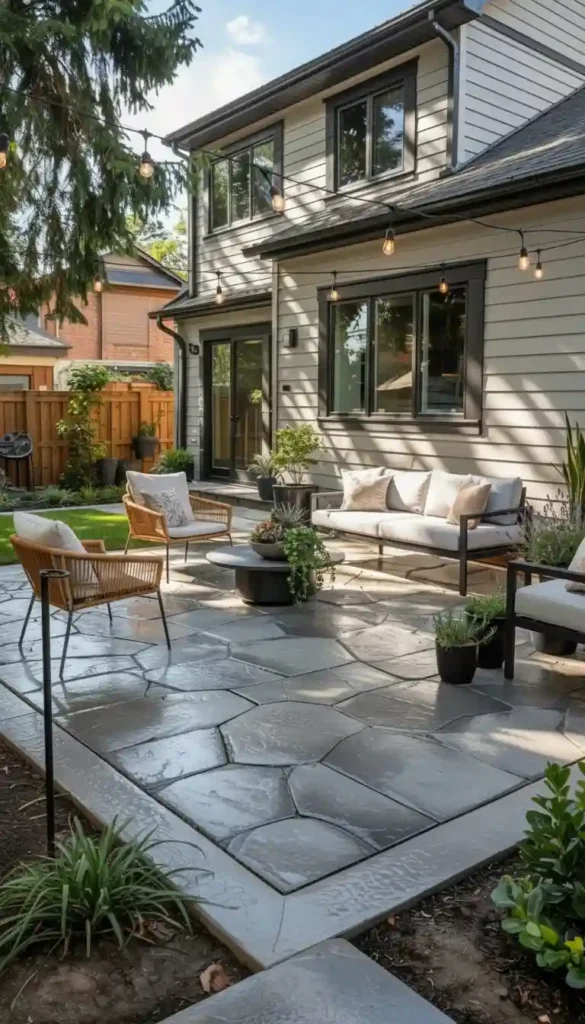
How Color Affects Perceived Space
Color is one of the simplest ways to change how your backyard feels — without changing its actual size.
- Lighter colors make small patios feel larger and more open — great for compact backyards
- Darker colors anchor large patios and give them a grounded, sophisticated feel
- High contrast borders in a darker shade visually define the patio edge and add architectural detail
- Subtle two-tone patterns using integral color plus antiquing add visual depth and prevent flatness
A single-color slab almost always looks cheaper than a multi-tone finish, even if the stamp pattern is identical.
Using Accent Borders Effectively
Borders are one of the most underused tools in stamped concrete design.
- A contrasting border (4–8 inches wide) around the perimeter immediately elevates the look
- Use the border to define zone transitions — dining to lounge, patio to pool deck
- Banding patterns (alternating color strips) add visual rhythm and movement
- Keep border colors within two shades of the field color for a cohesive result
Think of the border as the frame on a painting. It completes the composition.
Testing Colors Before You Commit
Color looks dramatically different in a sample card versus poured concrete in direct sunlight.
- Request poured sample panels from your contractor — at least 12×12 inches
- View samples in morning light, afternoon sun, and overcast conditions
- Factor in how the color will look wet after rain — some tones shift dramatically
- Ask your contractor about sealer sheen — matte sealers read cooler, gloss sealers read warmer and richer
📌 Save this color testing approach! 📌
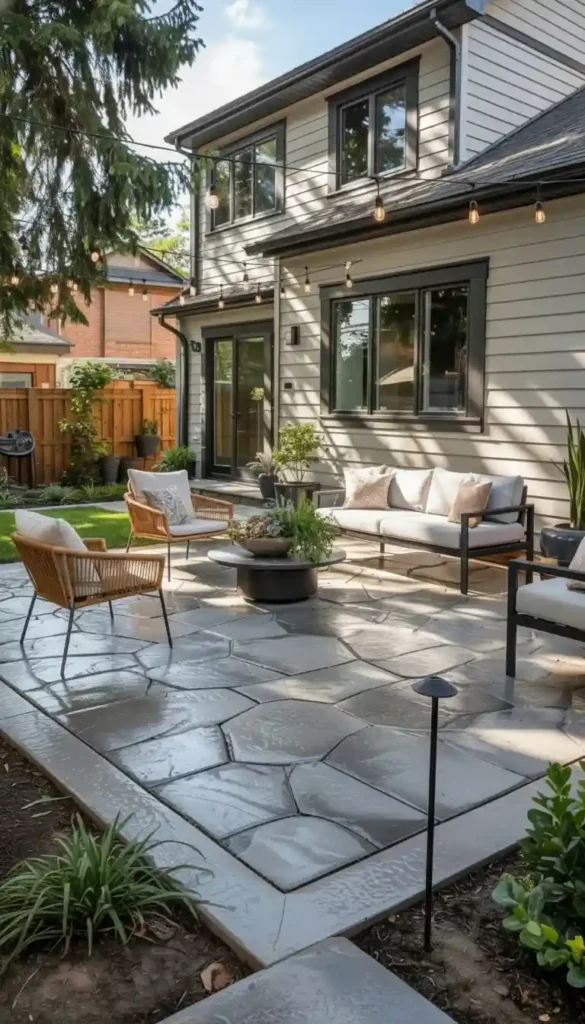
The Color Principle
Timeless always beats trendy in stamped concrete. Natural palettes — greys, taupes, buffs, and warm earth tones — perform best over time. They maintain resale value, age gracefully, and complement nearly any landscaping update you make in the years ahead.
Stamped Concrete Pool Deck Ideas With Slip-Resistant Finishes
A pool deck is the most demanding stamped concrete application in residential design. It has to look beautiful, stay safe when wet, stay cool underfoot in summer, and resist constant moisture exposure. When done right, a stamped concrete pool deck becomes the crown jewel of your backyard. This section covers how to achieve all of it.
Why Stamped Concrete Works Around Pools
Many homeowners assume pavers or natural stone are the only premium option for pool surrounds. Stamped concrete actually outperforms both in several key areas.
- No joint gaps mean no weeds, no individual pieces to resettle, and easier cleaning
- Seamless integration with steps, walls, and walkways for a unified look
- Custom shapes follow the pool’s contour precisely — pavers cannot do this as cleanly
- Cost advantage over natural stone is typically 40–60% at comparable quality
The key is proper installation with the right texture, drainage, and sealer specified from the start.
Prioritizing Slip Resistance Above Everything Else
Around water, slip resistance is non-negotiable. Every other design decision comes second.
- Specify a broom finish texture or light exposed aggregate overlay in high traffic wet zones
- Avoid heavy polish or high-gloss sealers anywhere on the pool deck — they become dangerously slick when wet
- Request non-slip additives (aluminum oxide or polymer grit) mixed into the sealer
- Test the texture by walking on a wet sample panel before approving the finish
Why it matters: A slip and fall on a pool deck is one of the most common residential injury events in the US. Good texture is not a design upgrade — it is a safety requirement.
📌 Pin this pool deck safety and design guide! 📌
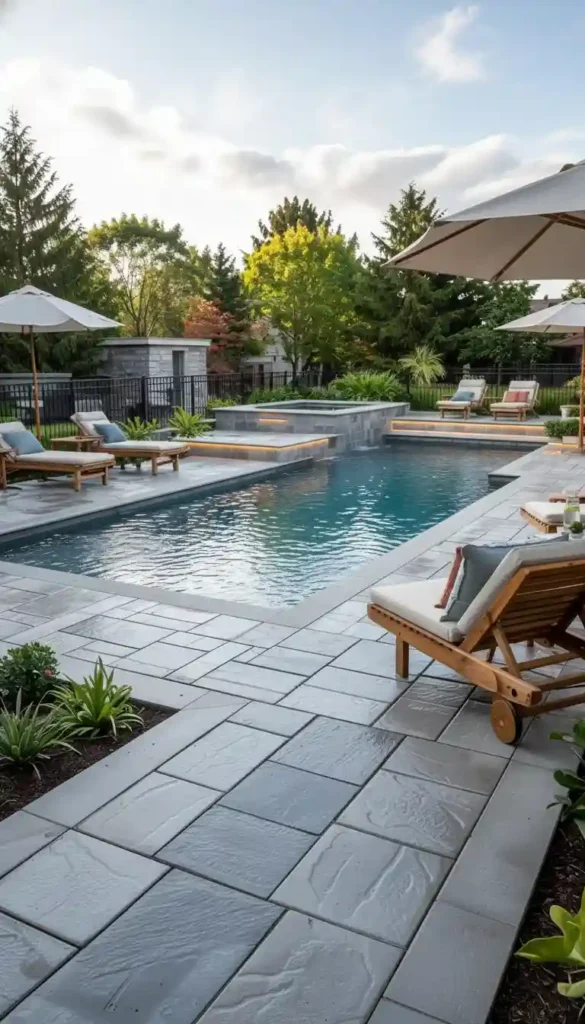
Choosing Patterns That Work Around Water
Not every stamp pattern suits a pool environment. Some become slippery, some collect debris, and some look wrong at pool scale.
- Lightly textured stone patterns (travertine, limestone look) are the gold standard for pool surrounds
- Large format slate or tile stamps work well for contemporary pools
- Avoid deeply grooved patterns that collect water and algae in the grooves
- Brick or cobble patterns can work with proper sealing but require more maintenance
Travertine-look stamps are the most requested for pool decks in 2026 because they mimic the resort aesthetic at a fraction of natural travertine’s cost.
Color Choices That Keep The Surface Cooler
Concrete in direct summer sun absorbs heat. Smart color choices reduce surface temperature significantly.
- Lighter colors (buff, cream, light grey) reflect sunlight and stay 15–20°F cooler than dark concrete
- Avoid charcoal or dark brown on sun-exposed pool decks — they become painful to walk on barefoot
- Medium tones (warm tan, sandstone) balance aesthetics and thermal comfort
- White or near-white finishes are increasingly popular for resort-style pool designs in hot climates
In a Karachi-style summer climate or anywhere in the US Sun Belt, light color is not just an aesthetic preference — it is practical comfort.
Planning Drainage And Slope Correctly
Water management is critical on pool decks. Poor drainage leads to standing water, algae, and surface degradation.
- Minimum 1/8 inch per foot slope away from the pool edge and toward drains
- Avoid low spots — even small depressions collect water and create slip hazards
- Install channel drains or slot drains along patio edges adjacent to lawn or planting areas
- Ensure expansion joints are placed every 10–12 feet to prevent cracking
This is where experienced contractors earn their fee. Drainage planning requires real expertise.
Integrating Hot Tubs And Water Features
Many pool decks include a hot tub, fountain, or water feature. These require additional planning.
- Hot tub slabs need 4–6 inches of reinforced concrete minimum — a standard 4-inch slab is insufficient
- Allow 24 inches of clear walking space around all sides of the hot tub for access and safety
- Waterproof electrical conduit must be run during concrete installation — never after
- Plan for equipment pad placement (pump and heater) at the design stage to hide mechanicals cleanly
📌 Save this pool deck planning checklist! 📌
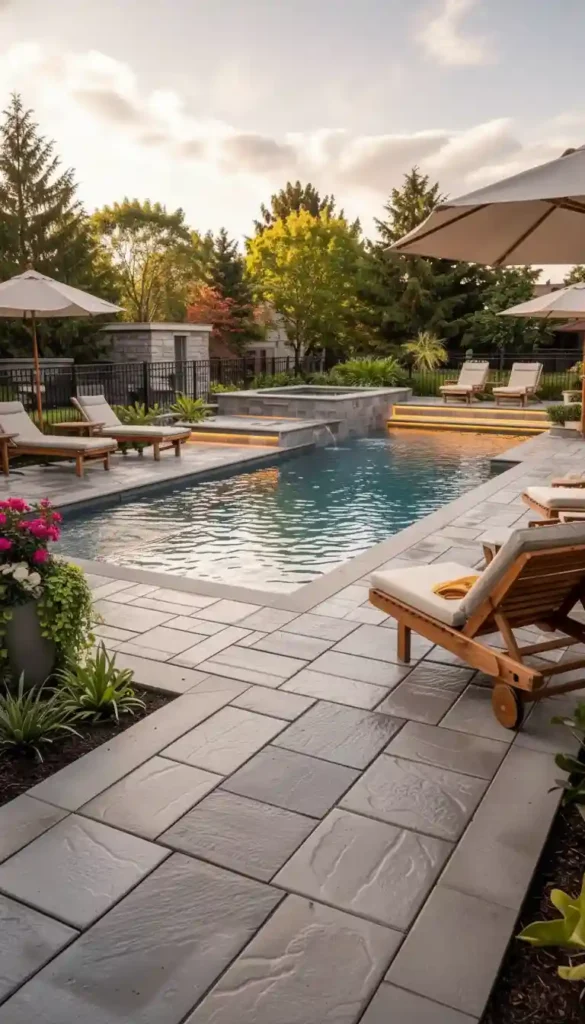
Maintenance That Protects Your Investment
A pool deck takes more abuse than any other concrete surface. Maintenance matters here more than anywhere.
- Reseal every 2–3 years — pool chemicals, sun, and heavy foot traffic accelerate sealer wear
- Use pH-neutral cleaners — acidic cleaners strip sealers and etch the surface over time
- Pressure wash gently (below 1500 PSI) to clean without damaging texture
- Address cracks immediately — small cracks near water become large cracks quickly due to moisture cycling
The maintenance commitment is minimal compared to the lifespan you protect. A well-maintained stamped concrete pool deck easily lasts 30+ years.
Stamped Concrete Patio Steps Ideas For Seamless Elevation Changes
Steps are often the last thing homeowners think about — and the first thing visitors notice. Well-designed stamped concrete steps tie your entire outdoor space together. They handle the practical job of moving between levels while adding architectural character that elevates the whole design. This section shows you how to design steps that do both beautifully.
Why Steps Deserve Serious Design Attention
Steps are not just functional transitions. They are architectural opportunities.
- Steps set the visual tone for the entire outdoor space — they are often the first thing you see
- Proportion matters enormously — steps that are too steep or too narrow feel dangerous; too shallow and they feel awkward
- Pattern continuity across steps and patio creates a seamless, professionally finished look
- Lighting on steps adds drama at night and critical safety year-round
Think of steps the way a good designer thinks of a staircase inside a home — as a design feature, not just a necessity.
Standard Step Dimensions That Feel Right
Getting the dimensions right is the foundation of comfortable, safe steps.
- Riser height: 6–7.5 inches is the ideal range — 7 inches is the most universally comfortable
- Tread depth: 11–14 inches minimum — deeper treads feel more generous and welcoming
- Width: Match or exceed the patio width they serve — narrow steps feel pinched and cheap
- Nosing overhang: 1–1.5 inch overhang on the tread edge adds shadow definition and a finished look
These numbers are not arbitrary — they are based on ergonomic research and building codes across most US states.
Extending The Stamp Pattern Across Treads And Risers
Visual continuity between the patio and steps is what separates good stamped concrete from great stamped concrete.
- Use the same stamp pattern on treads as the main patio surface — this creates seamless flow
- Apply matching or complementary color to risers — a slightly darker shade on risers adds depth
- Use contrasting edge bands (a different color strip at the front edge of each tread) for visibility and style
- Seal steps with the same product as the patio to ensure consistent sheen and color over time
When the pattern flows uninterrupted from patio to steps to walkway, the entire space feels designed rather than assembled.
📌 Pin this stamped concrete steps design guide! 📌
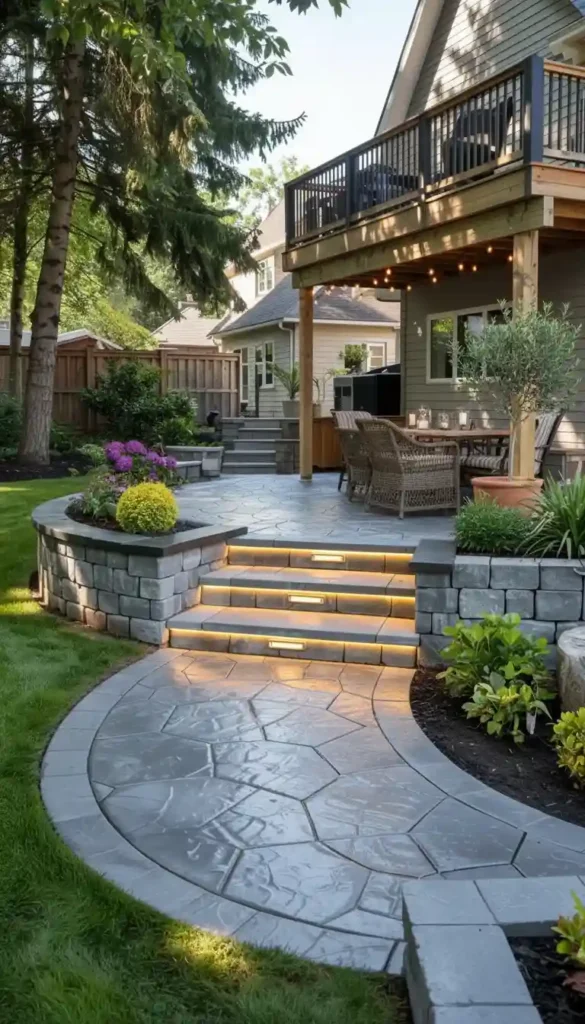
Curved Steps For A Welcoming Entry
Curved steps are one of the most powerful design moves in outdoor architecture.
- Curved or fanned steps dramatically soften the rigid geometry of a rectangular patio
- They create an inviting, open-arm feeling at the patio entrance — welcoming guests naturally
- Radius curves work particularly well when transitioning from patio to lawn or garden
- Curved steps photograph beautifully — important if you care about curb appeal or resale value
The extra forming work for curved steps typically adds only 10–20% to step costs while transforming the entire look.
Integrating Lighting Into Steps
Step lighting is one of the highest-impact, lowest-cost upgrades in outdoor design.
- Recessed riser lights (mounted into the vertical face of each step) cast a dramatic, low-glare glow
- 12-volt LED systems are energy efficient and last 25,000+ hours with minimal maintenance
- Position lights every other riser for a clean, rhythmic look — lighting every step can feel excessive
- Consider warm white (2700–3000K) for an inviting ambiance versus cool white which feels institutional
Run all conduit during concrete installation. Cutting channels into finished concrete costs 3–5 times more.
Adding Handrails That Match The Design
Handrails are required by code on most steps of three risers or more — but they do not have to look like an afterthought.
- Powder-coated steel railings in black or bronze integrate cleanly with almost any concrete color
- Cable railings (horizontal stainless cables) give a contemporary, open feel without blocking sightlines
- Concrete or stone-cap railings built integrally with the structure offer the most seamless look
- Avoid painted wood railings against stamped concrete — they require frequent maintenance and rarely look proportional
Match railing material to your home’s exterior hardware and fixtures for a coordinated result.
Anti-Slip Treatments On Step Edges
Step edges are the highest-risk zone in any outdoor space — especially in rain.
- Apply anti-slip strip inserts or broadcast non-slip aggregate into the sealer on tread edges
- Contrasting color bands on step edges serve double duty — they improve visibility and can incorporate texture
- Reapply anti-slip treatments when resealing the surface — they wear at the same rate as the sealer
- Inspect step edges annually for wear, chipping, or sealer failure — address issues before they become hazards
📌 Save this steps safety and design checklist! 📌
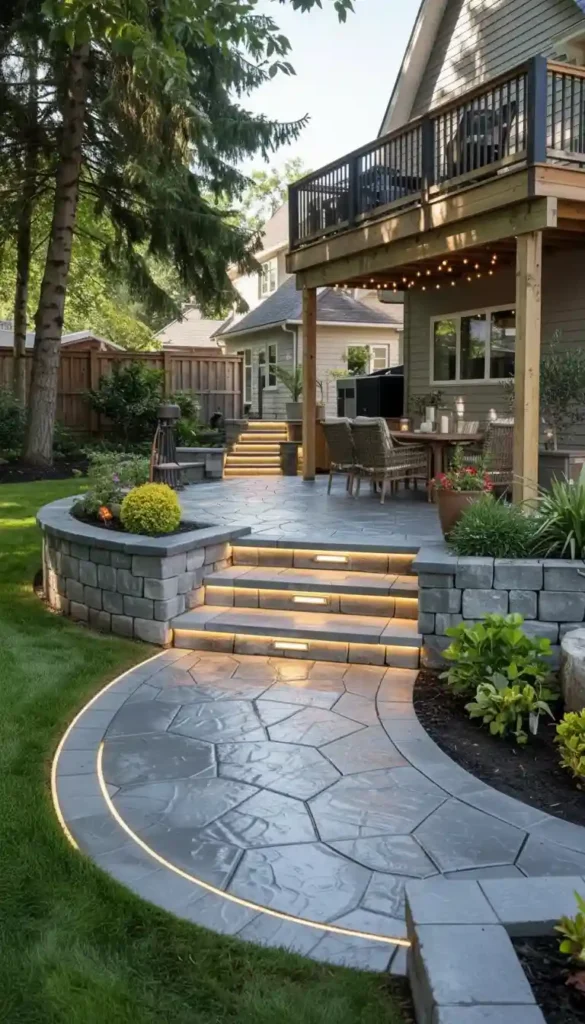
Reinforcement And Foundation Planning For Steps
Steps are exposed on three sides and subject to freeze-thaw cycles, soil movement, and constant impact. They need proper engineering.
- Use minimum 3,500 PSI concrete for steps — the same or stronger than the patio itself
- Include rebar reinforcement in both the slab below and the step structure itself
- Pour steps monolithically with the patio where possible — separate pours create joints that can separate over time
- In cold climates, ensure footings extend below the frost line to prevent heaving
Cutting corners on step construction is where most patio failures begin. Proper reinforcement adds minimal cost but protects decades of investment.
The Step Design Principle
Steps should never look like they were added to solve a problem. When designed from the start as an integral part of the patio — matching in pattern, color, proportion, and lighting — they become one of the most admired features of the entire outdoor space.
Conclusion
Stamped concrete is not just a building material — it is a creative tool that turns an ordinary backyard into something you genuinely love coming home to. Whether you are transforming a small urban space or designing a full outdoor living environment on a larger property, the five ideas in this guide give you a real, practical path forward.
Start with layout and let everything else follow — color, texture, steps, pool deck, and lighting should all serve the spatial foundation you create first. When every decision connects back to how people will actually live and move in the space, the result is a patio that feels both beautiful and completely right. Your backyard deserves that. In 2026, there has never been a better time to make it happen.

“I share simple, beautiful and affordable home decor ideas to help you style every corner of your home with ease.