

There is something quietly powerful about stepping into a garden that feels like it was made just for you. The kind of space where the air smells like jasmine, the light falls warm and golden, and everything around you says slow down, breathe, you are home. If you have been dreaming about transforming your backyard into that kind of sanctuary, you are in the right place.
This guide is for the dreamers who scroll through outdoor inspiration at midnight, the homeowners who stare at their bare backyard and see potential, and the creatives who want every corner of their life to feel intentional. Whether your style is modern and minimal or whimsical and full of color, these five garden aesthetic ideas for 2026 will give you the roadmap you have been waiting for. Let’s build your dream outdoor escape — one beautiful detail at a time.
Modern Wooden Bed Design Ideas For 2026 Bedrooms
Modern garden aesthetics in 2026 are deeply rooted in the idea that your outdoor space should feel as polished and intentional as your indoor rooms. This section explores how layered textures, thoughtful color choices, and carefully curated elements come together to create a backyard that feels like a true sanctuary. Think of it as designing a living room — but under the open sky.
The Foundation: Layering Textures for Visual Depth
The secret to a stunning modern garden is texture layering. A flat, one-dimensional garden feels forgettable. A layered one feels alive.
- Combine soft grass with rough stone pathways for contrast
- Add flowing ornamental grasses beside structured hedges
- Use smooth concrete planters against rough wooden fencing
- Introduce woven fabrics through outdoor cushions and throws
This contrast is what makes the eye move and the mind feel engaged. It is the difference between a garden that looks good in photos and one that feels good in person.
Soft Color Palettes That Calm the Mind
Color is one of the most powerful design tools available, and the best modern gardens use it with restraint.
- Stick to 3 to 4 core colors across all elements — furniture, plants, and accessories
- Choose muted greens, dusty blues, warm terracottas, and soft whites
- Avoid neon or overly bright tones that feel jarring outdoors
- Use pops of deep burgundy or blush through seasonal flowers
Why it works: Soft palettes create visual harmony. They make the space feel like a cohesive whole rather than a collection of unrelated pieces.
Warm Ambient Lighting for Evening Magic
A garden that looks beautiful at noon but goes dark and lifeless at sunset is missing half its potential.
- String globe lights overhead to create a canopy effect
- Use low-voltage path lights along stone walkways
- Add lanterns at seated areas for intimate, focused warmth
- Try solar stake lights along garden borders for easy installation
Pro tip: Warm white bulbs (2700K to 3000K) feel the most natural and flattering outdoors. Avoid cool white or blue-toned lighting — it feels clinical in a garden setting.
Pin this modern garden lighting guide! 📌
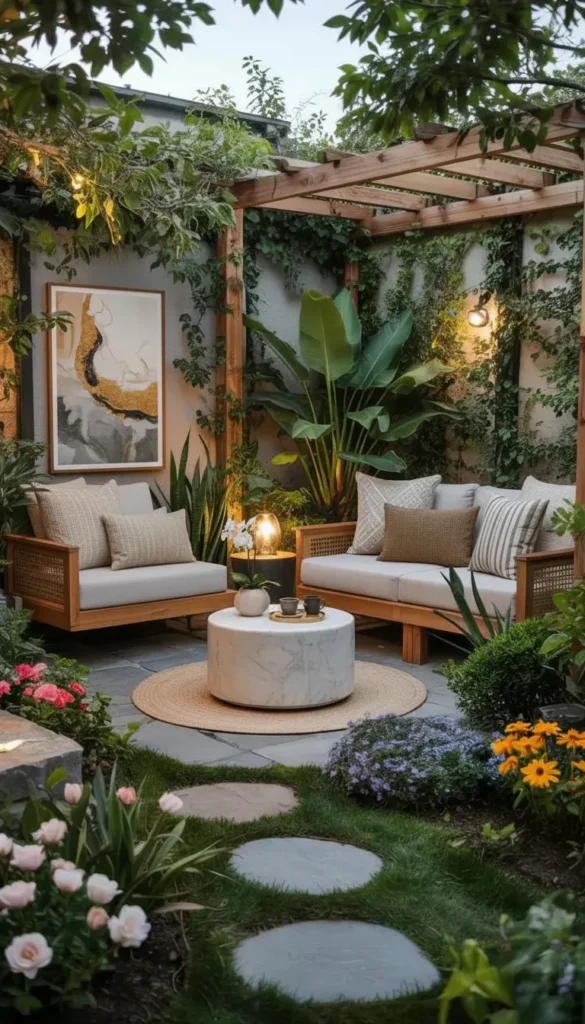
Low Seating That Invites You to Stay
Seating in a modern aesthetic garden should feel grounded, relaxed, and natural.
- Choose wooden benches with clean lines over ornate carved styles
- Add rattan or wicker chairs with removable cushion covers for easy cleaning
- Layer lightweight throws in neutral linen or cotton for cozy texture
- Keep seating low to the ground — it creates a more intimate, lounge-like atmosphere
A simple wooden bench with a linen cushion says more about good taste than an expensive ornate piece ever could.
Water Features That Add Sound and Movement
Water is one of the most overlooked elements in garden design, and it is transformative.
- A minimalist wall fountain adds movement without taking up floor space
- Small freestanding bowls with a recirculating pump create subtle ripple effects
- Birdbaths double as sculpture and attract wildlife
- Narrow rill channels along a pathway create a contemporary, architectural feel
The sound of moving water naturally lowers stress. It is not just aesthetic — it is genuinely therapeutic.
Natural Materials That Age Beautifully
Modern aesthetics in 2026 favor materials that improve with age rather than fighting against time.
- Reclaimed wood for raised beds, benches, and decorative features
- Clay and terracotta pots that develop a beautiful patina
- Linen and cotton textiles that soften and fade gracefully
- Stone paving that weathers into natural variation over seasons
Avoid plastic wherever possible. Not just for environmental reasons — plastic simply does not age well, and it undercuts the authentic feel you are building.
Negative Space: The Art of Leaving Room
Many homeowners try to fill every inch of their garden. The best designers know that what you leave empty is just as important as what you place.
- Leave open stretches of lawn or gravel between planting beds
- Do not crowd a focal point — give it room to breathe
- Use a single statement tree rather than six competing shrubs
- Let pathways be wide enough to feel welcoming, not cramped
One strong focal point — a sculptural tree, a fire pit, a statement planter — anchors the entire space.
Save this modern garden design strategy! 📌
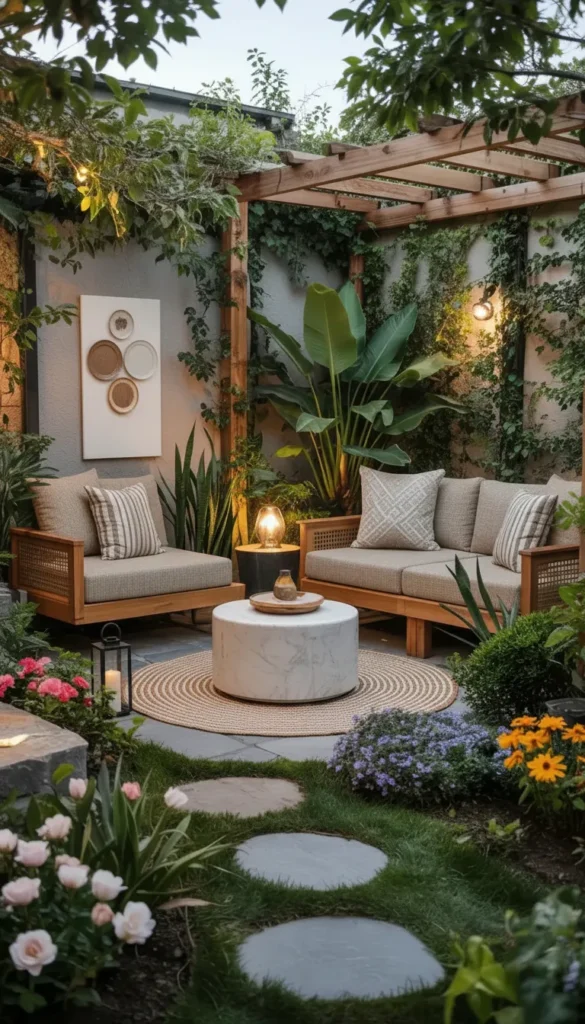
Tall Grasses and Delicate Flower Arrangements
Planting in layers is what separates a professional-looking garden from a flat, uninspired one.
- Tall ornamental grasses like Miscanthus or Pennisetum form the back layer at 1.5m or more
- Mid-height perennials like Echinacea, Salvia, and Rudbeckia fill the middle tier
- Low edging plants like Nepeta, Alchemilla, or Sedum soften the border edges
- Delicate flower arrangements in terracotta pots add detail at seating level
This layered planting creates depth and movement. The tall grasses catch the breeze. The flowers attract pollinators. The whole bed comes alive.
Fragrance: The Invisible Layer of Garden Design
Most garden designers focus entirely on what you can see. The best ones also think about what you can smell.
- Lavender along a sunny border releases fragrance when brushed past
- Jasmine trained over an arch creates a scented entrance in late spring and summer
- Wisteria on a pergola fills the space with heavy, intoxicating perfume in May
- Herbs like rosemary, thyme, and mint planted near seating release oils when touched
Fragrance creates emotional memory. A garden that smells extraordinary becomes a place people want to return to again and again.
Seasonal Adaptability: Design for All Year
A garden that only looks good in summer is a missed opportunity. Build in adaptability from the start.
- Use interchangeable textile covers so you can swap palettes with the seasons
- Plant a mix of early spring bulbs, summer perennials, and autumn-blooming plants
- Add fragrant elements like lavender for spring, roses for summer, and witch hazel for winter
- Jasmine and wisteria provide seasonal fragrance without permanent maintenance
The goal is a garden that feels intentional in every month — not just during peak bloom season.
Unique Wooden Bed Design Ideas That Define Character
A garden with character is one that tells a story. It reflects the personality of the people who live there. This section is about the front-of-house aesthetic — the first thing visitors and passersby see — and how to make it unforgettable without being over the top. Your front garden is the cover of the book. Make it worth a second glance.
First Impressions: The Power of Symmetry
Symmetry is the fastest way to make a front garden feel polished and intentional.
- Mirror planters on either side of your front door
- Use matching hedges or topiaries to frame the entrance
- Align pathway stones evenly from gate to door
- Balance window boxes left and right with identical plantings
Symmetry does not mean boring — it means confident. It signals that someone who knows what they are doing designed this space.
Pathways That Guide the Eye and the Foot
A pathway is not just a functional element. It is a design statement.
- Stone or porcelain paving feels premium and ages well
- Gravel paths with steel edging give a clean, contemporary look
- Stepping stones through low ground cover create charm and discovery
- Mix materials — gravel between large format pavers, for example — for visual interest
Aim for a path width of at least 90 cm. Anything narrower feels cramped and uninviting.
Statement Planters That Do the Heavy Lifting
You do not need a garden renovation to transform your front yard. A few well-chosen planters can do it all.
- Use large format planters in pairs flanking the entrance
- Choose materials that echo your home’s architecture — concrete for modern homes, terracotta for Mediterranean styles, zinc for industrial looks
- Plant tall, structural plants like phormium, olive trees, or clipped bay
- Add trailing plants at the base for softness and layering
Pin this front garden planter guide! 📌
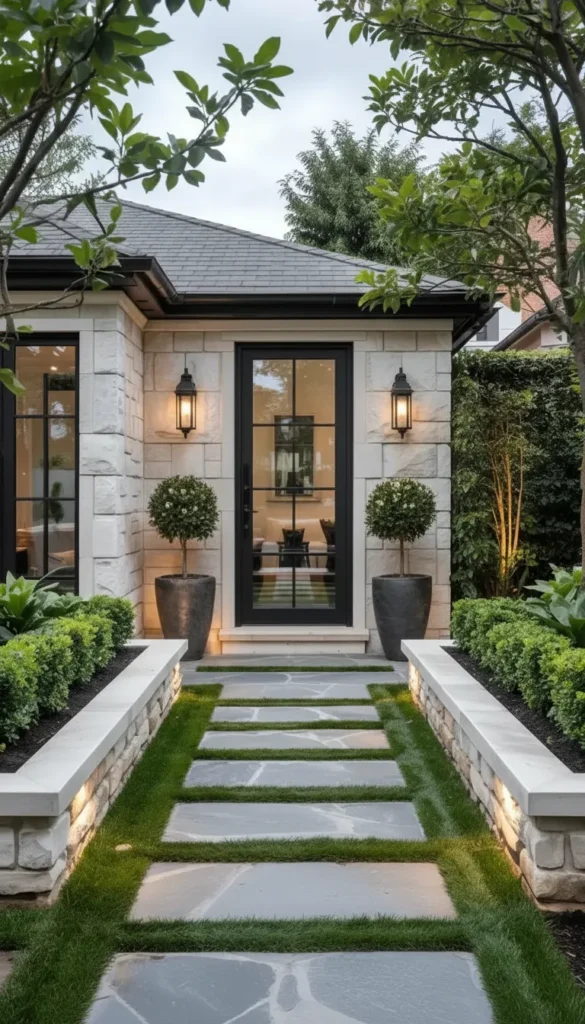
Trimmed Hedges for Structure and Privacy
Hedges are the backbone of a well-designed front garden.
- Box (Buxus) hedging creates crisp, defined lines
- Yew hedges grow denser and offer excellent privacy
- Lavender hedges bring fragrance and softness to formal edges
- Keep cuts clean and level — an uneven hedge undermines the whole aesthetic
Trim hedges at least twice a year — once in spring and once in late summer — for that consistently polished look.
Vertical Elements: Creating Height Variation
A flat front garden lacks dynamism. Introducing vertical elements adds drama and depth.
- Install a simple timber or wrought iron trellis against the front fence
- Train climbing roses, clematis, or jasmine up a wall or arch
- Use tall ornamental grasses in the corners for soft, swaying height
- A well-positioned standard tree adds instant architectural presence
Height variation is what transforms a flat planting scheme into something that feels truly designed.
Subtle Lighting Fixtures That Elevate After Dark
Your front garden does not stop mattering at sunset.
- Use recessed path lights for a clean, architectural look
- Install uplighters at the base of statement trees or feature walls
- Choose fittings in brushed brass or matte black to match door hardware
- Wall lanterns either side of the front door create symmetry and warmth
Consistency matters: pick one metal finish and stick to it across all hardware — door handles, lighting, letterbox, and house numbers.
Smart Lighting Systems for the Modern Front Garden
Technology has made front garden lighting easier and more impressive than ever before.
- Smart outdoor lighting connected to a home app lets you adjust brightness and color temperature
- Motion sensors activate path lights when someone approaches — both practical and welcoming
- Programmable timers ensure lights come on at sunset and off at midnight without manual input
- Solar-powered uplighters require no wiring and have improved dramatically in brightness and reliability
A well-lit front garden signals safety, pride in ownership, and design sophistication — all from the pavement.
Low-Maintenance Plant Choices for Busy Homeowners
A beautiful front garden that requires hours of maintenance every week is not a joy — it is a chore. Design for the life you actually live.
- Ornamental grasses like Stipa or Miscanthus require cutting back just once a year
- Lavender needs only an annual trim after flowering and thrives on neglect
- Box hedging, once established, needs trimming twice annually and little else
- Evergreen groundcovers like Pachysandra or Vinca suppress weeds and stay green year-round
Low-maintenance does not mean low-impact. Many of the most beautiful plants are also the most forgiving.
Seasonal Color: Keeping It Fresh Year-Round
A front garden that looks the same in January as it does in July is a missed opportunity.
- Plant spring bulbs (tulips, alliums, narcissus) in autumn for March and April color
- Follow with summer annuals like cosmos, salvias, and echinacea
- Use evergreen structural plants as the constant backdrop
- Swap window box plantings seasonally for an easy refresh
Small seasonal updates signal care and attention. They make your home look loved.
Save this front garden seasonal strategy! 📌
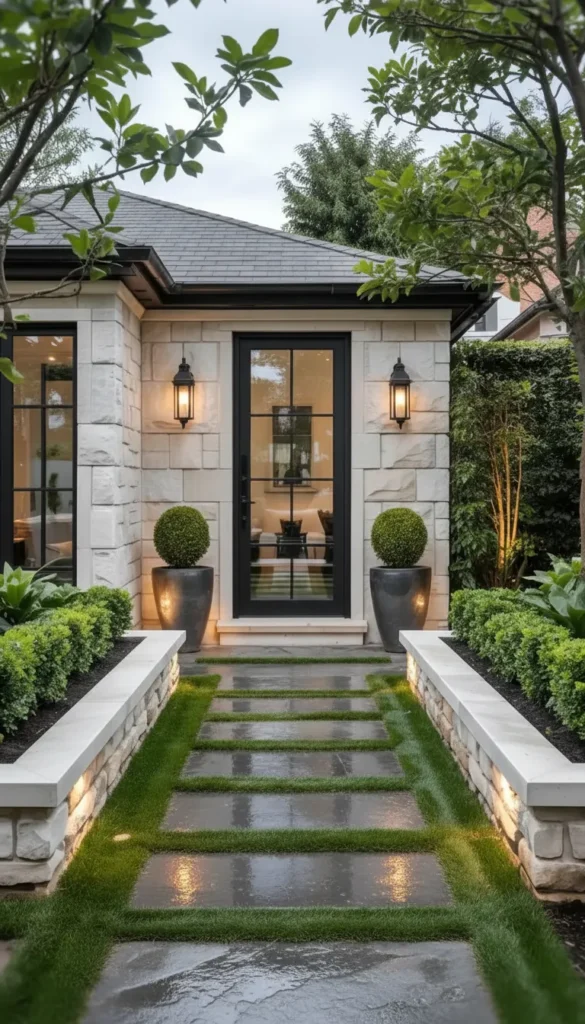
Consistency: The Most Important Design Rule
If there is one principle to remember from this entire section, it is this: everything must feel like it belongs together.
- Match your planting palette to your front door color
- Echo the materials in your pathway in your planter choice
- Take cues from your home’s architectural style — do not fight it
- Limit your palette to three materials maximum
A front garden that tries to do everything ends up saying nothing. Choose your style, commit to it, and execute it with confidence.
Simple Wooden Bed Design Ideas For Minimal Homes
The whimsical garden aesthetic is one of the most joyful design directions available to homeowners in 2026. Inspired by fantasy game worlds like Pony Town — with their curved paths, vibrant colors, and sense of playful discovery — this approach invites you to treat your garden as a canvas for storytelling and imagination. This section shows you how to create a space that feels magical without becoming chaotic.
Embracing Curves: Paths That Invite Exploration
Straight paths are efficient. Curved paths are enchanting.
- Replace rigid straight lines with gently winding gravel or stone paths
- Use curved lawn edges around planting beds for a soft, organic feel
- Add a hidden corner at the end of a path — a small seating nook or a garden sculpture
- Plant low-growing flowers along path edges to blur the boundaries
Why it works: Curved paths create a sense of journey and discovery. They slow you down and make a small garden feel larger than it is.
Vibrant Color: Going Bold With Intention
The whimsical aesthetic is not afraid of color — but it is not reckless with it either.
- Choose 3 to 5 bold colors and repeat them throughout the space
- Use bright planters in complementary tones — cobalt blue, sunshine yellow, coral red
- Plant bold-colored flowers like dahlias, zinnias, and echinacea in clusters
- Paint a fence panel or wall in a deep, saturated tone as a backdrop
The key is repetition. A color used once looks random. A color used three times looks designed.
Pin this whimsical garden color strategy! 📌
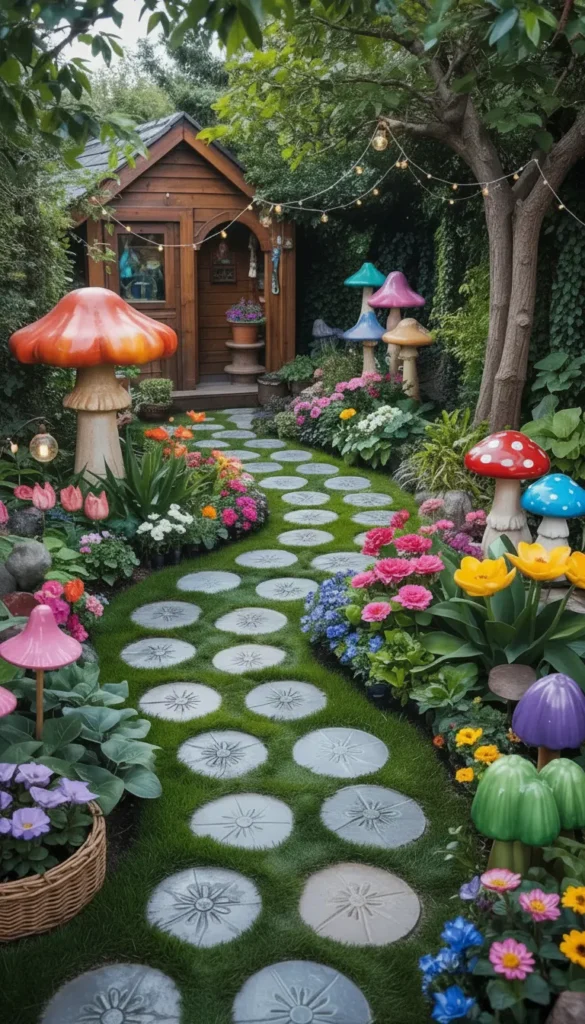
Decorative Mushrooms and Fantasy Garden Ornaments
Themed ornaments are what give a whimsical garden its personality and narrative.
- Ceramic mushrooms in varying sizes tucked among low-growing plants
- Stone toadstools used as natural-looking garden borders
- Fairy doors placed at the base of large trees
- Hand-painted stepping stones with quotes, patterns, or illustrations
These details invite people to look closely and smile. They make your garden feel like it has stories embedded in it.
Small Bridges and Painted Stones
Even a garden without a stream can have a bridge — and it will always be the most photographed element.
- Use a small arched timber bridge over a dry riverbed or raised garden bed
- Create a dry riverbed using smooth pebbles and rounded river stones
- Paint large flat stones with botanical illustrations or geometric patterns
- Use painted stones as markers for herb gardens or planting zones
These elements bring the fantasy aesthetic to life without requiring a large budget or major construction.
Cozy Corners With Color and Comfort
A whimsical garden is not just beautiful — it is deeply usable.
- Create a hammock corner with colorful bolster cushions and a side table
- Use a brightly painted bistro set tucked into a planted alcove
- Hang a swing from a mature tree — adults and children both love it
- Add a reading nook under a pergola draped with fairy lights and climbing plants
Function follows fantasy here. Every cozy corner should be both visually stunning and genuinely comfortable to sit in for an hour.
DIY and Customizable Elements
The best whimsical gardens evolve over time. Build that adaptability in from the start.
- Create custom garden art from reclaimed wood, mosaic tiles, or painted metal
- Use interchangeable pot covers so you can refresh colors seasonally
- Build a small DIY plant stand from timber offcuts for a handcrafted feel
- Try a painted mural on a side fence wall — it is bold and entirely reversible
The garden should grow with you. Leaving room for new discoveries and personal additions keeps it feeling alive.
Save this whimsical garden DIY approach! 📌
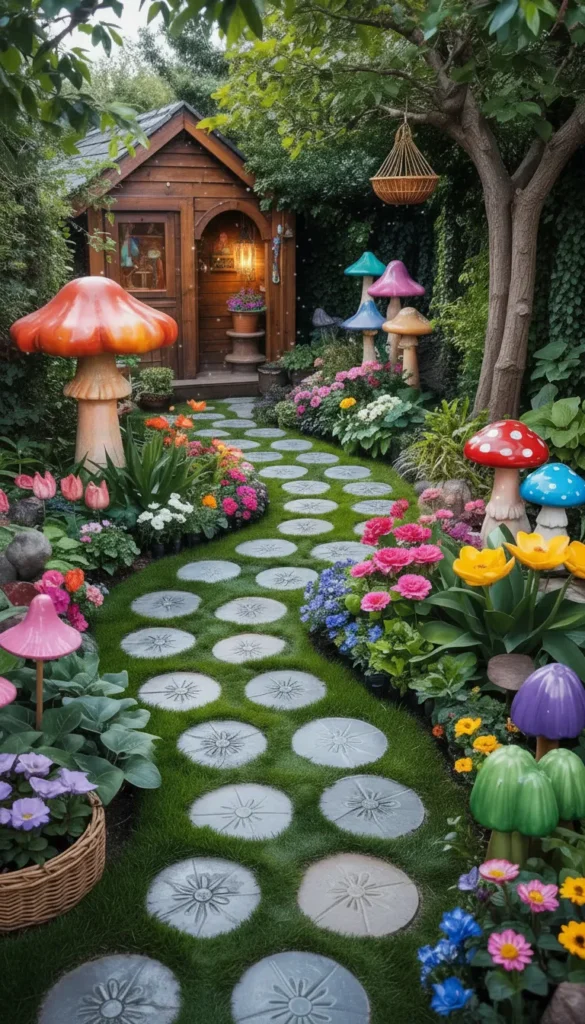
Interactive Features for Engaged, Living Gardens
A whimsical garden rewards participation — it is not just something you look at, it is something you inhabit.
- Build a chalkboard fence panel using exterior blackboard paint for drawing and messages
- Create a sensory planting strip with plants of different textures — fuzzy lamb’s ear, spiky sea holly, silky fountain grass
- Install a simple DIY wind chime station made from reclaimed wood and found objects
- Use a tiered water feature with hand-painted ceramic tiles for a bespoke, artisan feel
The more interactive a garden is, the more time people spend in it. That is the ultimate design success metric.
Committing to the Theme: The Most Common Mistake
The biggest mistake people make with whimsical gardens is going halfway. They add one or two playful elements and then surround them with overly minimal or neutral design — and the magic disappears.
- Fully commit to the color palette you choose — do not pull back at the last moment
- Repeat themed elements in at least 3 different areas of the garden
- Mix scales — large statement pieces alongside tiny hidden details
- Trust your instincts — whimsical gardens reward boldness
This style works best when it is fully inhabited. Half-hearted whimsy just looks confused.
Luxury Modern Wooden Bed Design Ideas For Premium Interiors
The cozy minimal garden aesthetic — inspired by the calm, warm visual world of Tsuki Odyssey — is one of the most liveable and enduringly beautiful directions in 2026 garden design. It strips back the noise and lets each carefully chosen element breathe. This is the garden for introverts, for meditators, for anyone who wants their outdoor space to feel like a deep exhale.
Defining Cozy Minimalism: Less, But Better
Cozy minimalism is not about austerity. It is about intentionality.
- Every element earns its place — nothing is decorative without also being purposeful
- Materials are warm, tactile, and natural rather than cold or synthetic
- The palette is neutral — warm whites, soft greys, aged wood tones, muted greens
- The feeling is intimate and sheltered, even in an open outdoor space
Think of a Japanese tea garden or a Scandinavian woodland retreat. Serene, purposeful, deeply calming.
Wooden Furniture With Simple, Honest Lines
The furniture in a cozy minimal garden sets the entire tone.
- Choose solid timber benches or chairs with clean, undecorated lines
- Opt for natural wood finishes — oiled or waxed rather than painted or varnished
- Low coffee tables in teak or acacia work beautifully at floor level
- Avoid furniture with intricate carving or ornate hardware — simplicity is the luxury
Why it works: Natural wood is honest. It does not try to be anything other than what it is, and that authenticity is deeply calming to be around.
Pin this cozy minimal furniture guide! 📌
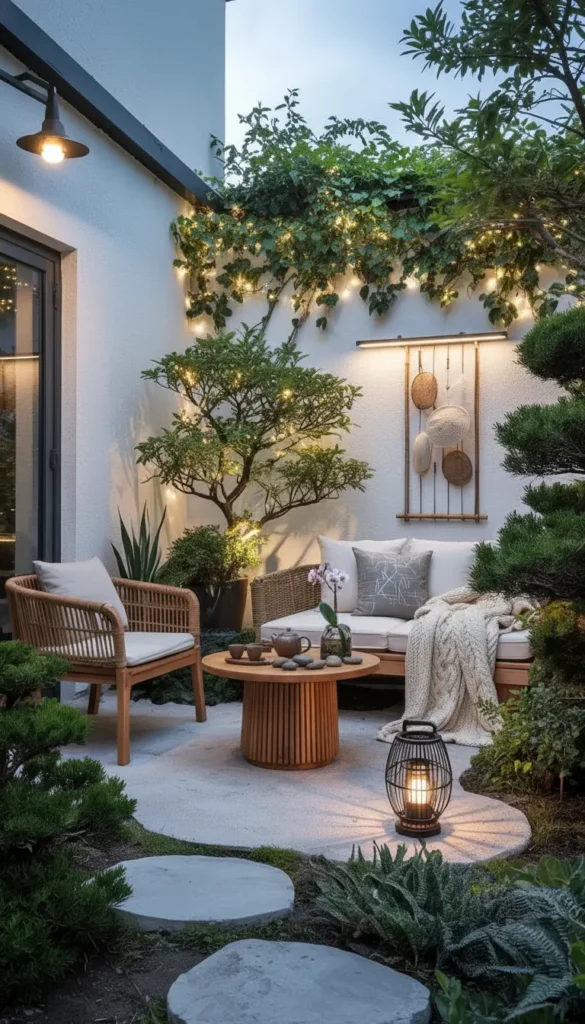
Small Lanterns and Soft Lighting
In a minimal garden, lighting should feel like candlelight — intimate and soft.
- Use Japanese-style stone lanterns for a grounded, architectural glow
- Hang paper or rattan pendant lanterns above a seating area
- Place tea light holders along pathways for flickering warmth
- Avoid floodlights or overly bright spotlights — they break the calm entirely
A single well-placed lantern does more for a minimal garden than ten poorly placed spotlights.
Simple Planters and Compact Greenery
The planting in a cozy minimal garden is carefully chosen and never overwhelming.
- Use bonsai trees or clipped dwarf shrubs for architectural greenery
- Group planters in odd numbers (3 or 5) for visual rhythm
- Choose plain terracotta, matte concrete, or unglazed ceramic pots
- Low-growing moss or baby tears as ground cover creates lush texture without clutter
Every plant should either provide structure, fragrance, or sensory texture. If it does none of these, reconsider it.
Compact Seating That Feels Intimate
Scale matters enormously in a minimal garden. Too much furniture overwhelms — too little feels cold.
- A single two-person bench with a small side table creates the perfect retreat
- Low floor cushions on a timber deck for casual, relaxed seating
- A single hammock chair hung from a pergola frame is both minimal and deeply inviting
- Small folding stools can be stored away and brought out as needed
The seating area should feel like a room — enclosed on at least one side, sheltered overhead, intimate in scale.
Textures: Woven Fabrics and Natural Surfaces
In a minimal space, texture carries all the visual interest. Do not underestimate it.
- Use woven linen throws and cushions in oatmeal, sage, and warm stone tones
- Introduce a natural jute or sisal rug to define the seating area
- Combine smooth pebble surfaces with rough stone walling
- Use raked gravel in the Japanese tradition to create calm, ordered patterns
These tactile elements give the eye something to explore without adding visual noise.
Save this cozy minimal texture approach! 📌
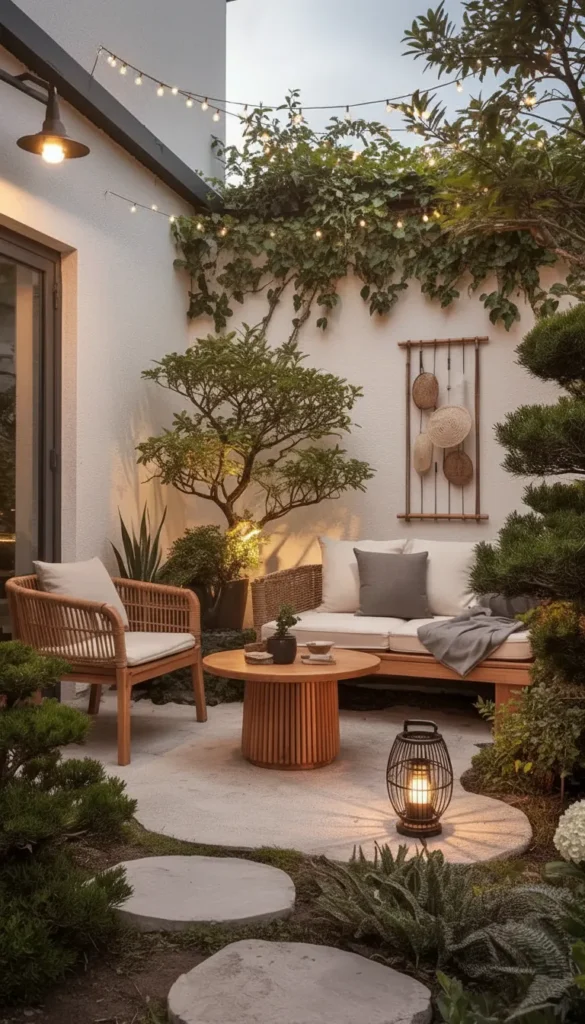
Small Terrace Extensions for Expanded Usability
One of the most impactful upgrades in a minimal garden is a simple terrace addition.
- Extend an existing patio by 2 to 3 metres using the same material for continuity
- Use large format porcelain or natural stone for a clean, seamless look
- Add a step change in level — even a single step adds architectural interest
- Keep the terrace material consistent with interior flooring where possible for flow
A terrace extension does not need to be large to be transformative. Even a modest expansion dramatically increases usability.
Fragrance in the Minimal Garden: Subtle and Intentional
Even a minimal garden benefits from carefully chosen fragrant plants — the key is restraint.
- A single wisteria trained along a fence provides intense, brief seasonal fragrance
- Daphne odora is compact, evergreen, and produces extraordinary winter fragrance
- Japanese sweet box (Sarcococca) flowers in winter and fills cold air with honey-like scent
- One well-placed pot of gardenia near a seating area creates impact without clutter
In a minimal garden, one fragrant plant is a considered choice. Six is a crowd.
The Principle of Restraint
If you take one thing from this entire section, let it be this: restraint is the ultimate luxury.
- Resist the urge to fill every planting bed to capacity
- Do not add a feature simply because you have the space for it
- Edit ruthlessly — remove anything that does not contribute meaningfully
- Sit in the garden at different times of day before making final decisions
A great minimal garden is not built in a day. It is refined over time, edited down to its most essential and beautiful self.
White Wooden Bed Design Ideas For Bright Spaces
The Toca Boca inspired garden aesthetic is a riot of joy. It is unapologetically colorful, playful, and energetic — and it works beautifully for families, for people who love bold design, and for anyone who refuses to be boring. This final section shows you how to bring the vibrant, cartoon-bright energy of playful design into a real outdoor space without sacrificing cohesion or sophistication.
Understanding the Playful Garden Aesthetic
This is not about buying the most colorful furniture you can find and hoping for the best. Playful design has rules — they are just more fun than other styles.
- Bold color is the foundation — embrace it fully rather than hedging with neutrals
- Shapes can be unexpected — circular lawns, zigzag borders, asymmetric planting beds
- Layers of pattern, texture, and color should feel energetic without being chaotic
- Every element should bring either joy, function, or both
Think of it as curated chaos. There is a method to the madness.
Colorful Furniture That Makes a Statement
Furniture in a playful garden does not hide. It shouts — joyfully and confidently.
- Use powder-coated metal chairs and tables in primary and secondary colors
- Mix and match — cobalt chairs with a yellow table, coral loungers with a mint side table
- Outdoor sofas in bold pattern fabrics bring indoor energy outside
- Painted wooden furniture in deep emerald, burnt orange, or cobalt makes every piece a feature
The furniture should feel like it is having a good time. That energy is contagious.
Pin this playful outdoor furniture guide! 📌
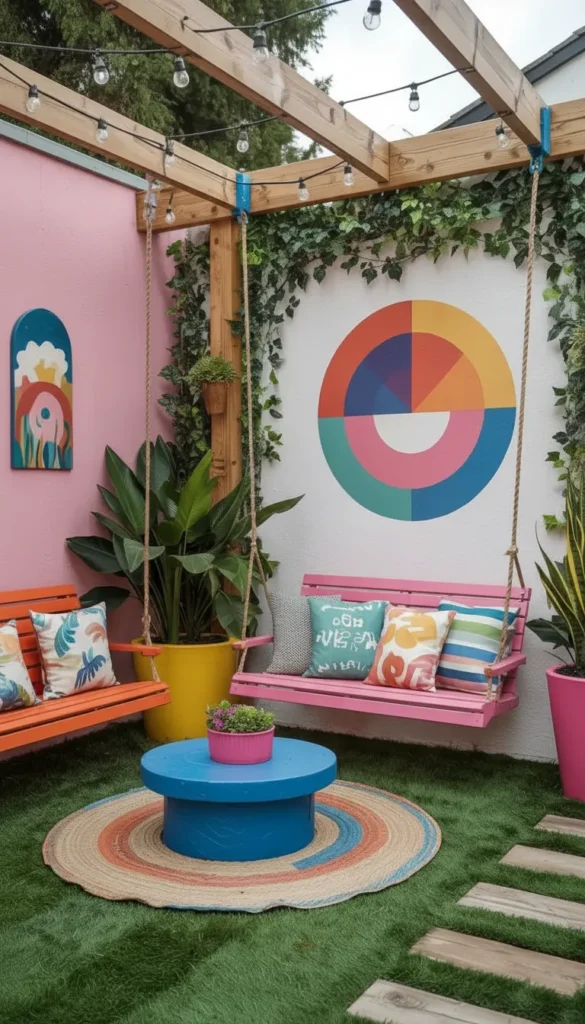
Patterned Rugs and Layered Textiles
An outdoor rug is one of the single most transformative investments you can make in a playful garden.
- Choose bold geometric or botanical patterns in weather-resistant polypropylene
- Layer a smaller rug over a larger one for depth and dimension
- Add outdoor cushions in clashing but complementary prints
- Use tasseled or fringed edges for extra personality
Make sure all textiles are rated for outdoor use — UV-resistant, water-repellent, and quick-drying.
Swings, Sculptures, and Interactive Features
A playful garden should be interactive, not just visual.
- Install a timber or rope swing hung from a mature tree or pergola beam
- Add sculptural pieces — abstract shapes in bold colors, painted concrete animals
- Chalk walls (sealed exterior blackboard paint on a fence panel) invite creativity
- Creative zones with a small table, storage, and supplies encourage extended outdoor time
Why it works: When a garden offers things to do as well as things to see, people spend more time in it. That is the ultimate goal of any outdoor design.
Bright Planters and Unique Garden Accessories
Your planters and accessories are the punctuation marks of a playful garden — and they should be exclamation points.
- Use glazed ceramic pots in jewel tones — cobalt, ruby, emerald, amber
- Paint terracotta pots in geometric patterns for a DIY project with high impact
- Add unexpected accessories — a vintage watering can in coral, a painted wheelbarrow as a planter
- Use garden signs, tiles, and custom plaques to add words and personality
Accessories at this level of detail show that the design was thought through to its edges.
Layered Lighting for Dynamic Evening Energy
A playful garden after dark should feel like a celebration.
- Mix string lights with festoon lights for layered overhead canopy effect
- Add colored solar lanterns along pathways for playful nighttime color
- Use flameless pillar candles in bright holders on tables
- Install spotlights in bold metals — brass, copper, or matte color to maintain the theme
Avoid white or neutral lighting. In a bold-color garden, warm amber and soft colored lights carry the daytime energy into the evening.
Save this playful garden lighting strategy! 📌
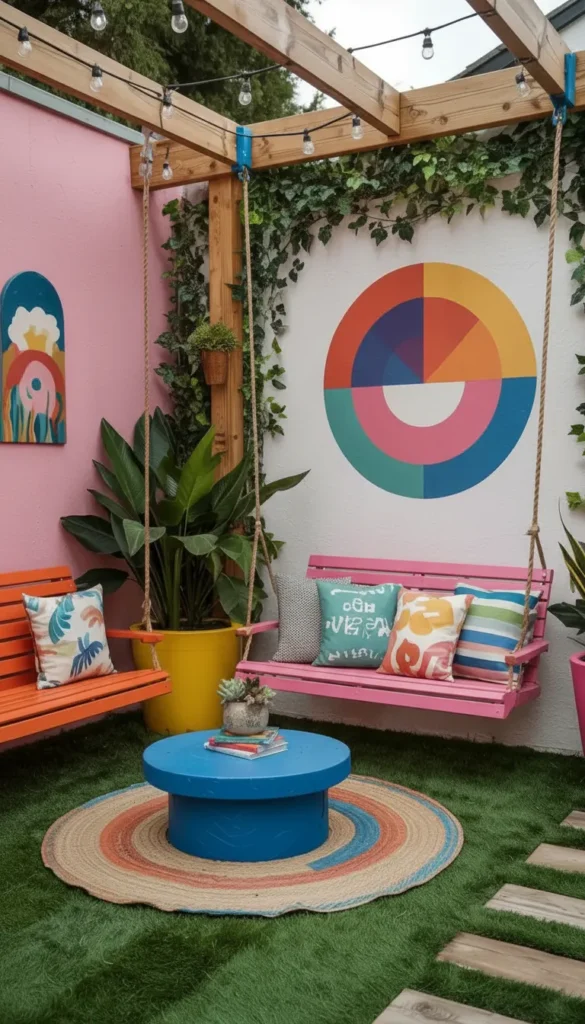
Choosing a Color Palette and Sticking to It
The most common failure in playful garden design is going too broad with color. More is not always more.
- Choose one primary hue as the dominant color (your furniture, main planter, or fence)
- Add two supporting colors that complement or contrast the primary
- Use neutrals — white, warm grey, or natural wood — to balance and ground the palette
- Repeat each color at least twice across different elements and areas
A color used consistently is a design decision. A color used randomly is just noise.
Creative Zones for Play and Making
A truly playful garden sets aside dedicated space for creative activity — not just for children, but for anyone who loves to make things.
- Define a creative corner with weather-resistant storage for supplies — chalk, paint, clay
- Install a small potting bench as both a workspace and a decorative feature
- Use a chalkboard fence panel painted in exterior blackboard paint for sketching and messages
- Add a low table and stools as a crafting station that doubles as an outdoor dining spot for children
Creative zones make a garden feel lived-in and purposeful rather than purely decorative.
Modular Furniture for a Garden That Adapts
One of the most practical upgrades in a playful garden is modular outdoor furniture.
- Choose sofas and seats that can be rearranged into different configurations
- Use stackable chairs and folding tables for flexible entertaining setups
- Add storage ottomans that serve as seating, tables, and toy/cushion storage simultaneously
- Look for weather-resistant upholstery with removable zip covers for easy cleaning
A garden that adapts to different occasions — morning coffee for two, afternoon birthday party for twenty — gets used more. And a garden that gets used more is a garden that is doing its job perfectly.
Conclusion
Your garden is more than a patch of land behind your home. It is an extension of who you are — your taste, your values, your idea of beauty and rest. Whether you are drawn to the clean calm of a minimal garden, the joyful chaos of a playful design, the dreamy whimsy of a fantasy-inspired space, or the polished confidence of a modern aesthetic, the most important thing is that the space feels like you. Do not copy someone else’s dream garden — build your own version of it.
Start with one section. Choose the ideas that genuinely excite you rather than the ones that look impressive in photos. Layer in the details over time — the right lantern here, the perfect bench there, a climbing rose that takes three years to bloom but will be worth every single day of waiting. Remember: the most beautiful gardens in the world were not designed in a weekend. They were tended, adjusted, and loved into existence over many seasons. The best gardens are never truly finished. They are always becoming, always evolving with the seasons, with your life, and with who you are turning into. And that, honestly, is the most beautiful thing about them. Go outside. Start today.

“I share simple, beautiful and affordable home decor ideas to help you style every corner of your home with ease.