

There’s something quietly heartbreaking about walking into your apartment after a long day and feeling nothing. No warmth. No exhale. Just four walls that don’t quite feel like yours. You deserve better than that. You deserve a space that wraps around you like a deep breath — soft, intentional, and completely alive with personality. That feeling isn’t reserved for big homes or big budgets. It starts with knowing what to bring in, what to let go of, and how to make every corner count.
This year, apartment living rooms are being transformed in the most beautiful ways. The trends of 2026 are all about softness, warmth, and designs that make small spaces feel generous and full of soul. Whether you’re starting from scratch or just looking for that one change that pulls everything together, these five living room ideas were made for you. Read every one carefully — because somewhere in here is the room you’ve been picturing without even realizing it.
Soft Cream & Linen Apartment Lounge
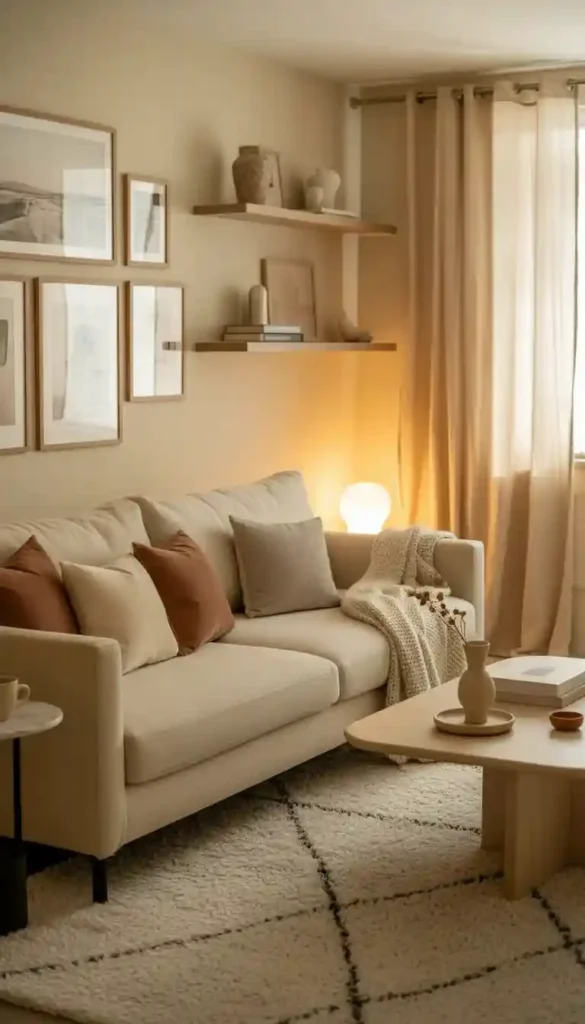
There is a reason cream and linen never go out of style. They carry a kind of quiet confidence — nothing loud, nothing forced, just a gentle warmth that makes a room feel like it was always meant to be lived in. This design is for people who love calm spaces that still feel layered, personal, and deeply comfortable.
The Power of a Neutral Base
Building your living room around a soft cream palette is one of the smartest moves you can make in a small apartment. Neutral tones reflect light naturally, making the room feel more open without any structural changes.
- Cream and linen tones bounce daylight around the room, brightening even darker apartments
- A neutral base lets you swap accent pieces seasonally without redecorating the entire space
- The palette works with virtually every wood tone, metal finish, and textile
Why it works: Light neutrals create the illusion of more square footage. It’s one of the oldest tricks in interior design, and it still performs better than almost any other color strategy in compact spaces.
Choosing the Right Linen Sofa
The sofa is the anchor of this look, and linen is the fabric that carries it perfectly. It’s breathable, textural, and ages beautifully with minimal care.
- Look for sofas in oatmeal, warm white, or undyed linen tones
- Choose low-profile frames — they keep the room feeling open and airy
- Loose cushion backs feel more relaxed and inviting than tight, structured ones
Pin this linen sofa guide! 📌
Avoid stiff, boxy silhouettes. The goal is softness in every direction — the fabric, the shape, and the way it sits in the room.
Letting the Light Do the Work
Sunlight is your most powerful decorating tool, and this design leans into it fully. Airy, sheer curtains are non-negotiable here.
- Choose curtains in white, ivory, or pale flax — nothing that blocks or dulls natural light
- Hang curtains as high and as wide as possible to maximize the sense of height and space
- Layer sheers over slightly heavier linen panels for evening warmth without sacrificing daytime glow
The way light filters through soft curtains mid-morning creates a visual softness that no lamp can fully replicate. It’s free, effortless, and genuinely beautiful.
Light Wood Furniture That Warms Without Weighing Down
Heavy furniture crushes small spaces. Light oak and blonde wood do the opposite — they add natural warmth while keeping the visual weight low and the energy open.
- Opt for slim-legged coffee tables and side tables that let the floor breathe
- A light oak console or entertainment unit ties the room’s warm tones together seamlessly
- Mix matte and natural finishes to avoid a flat, showroom look
Practical tip: If your floor is dark, light wood furniture creates a beautiful tonal contrast that actually helps define zones within an open-plan space.
Floating Shelves as Curated Display Spaces
Floating shelves are one of the most functional and visually appealing storage solutions for apartment living rooms. Done right, they feel intentional and expressive — not cluttered.
- Keep shelves minimal: one or two decorative objects per shelf, maximum
- Mix heights — a tall vase next to a short candle next to a small book stack creates rhythm
- Stick to the cream and natural wood palette even on shelves to maintain cohesion
Avoid the urge to fill every inch. Empty space on a shelf is not wasted — it’s breathing room, and it makes the pieces you do display feel more deliberate and special.
Layered Rugs for Texture Without Clutter
A single flat rug is functional. Layered rugs are an experience. In a cream and linen room, this technique adds the textural depth the palette needs to avoid feeling one-dimensional.
- Start with a larger, low-pile rug in jute or sisal as the base layer
- Layer a smaller, softer rug on top — a cream Moroccan or boucle works beautifully
- Keep both rugs within the same warm neutral family to maintain harmony
The layered rug technique visually anchors the seating area, making the living room feel defined even in a completely open floor plan.
Save this layered rug strategy! 📌
The Closing Principle
A soft cream and linen apartment lounge isn’t about perfection. It’s about creating a space that feels considered and calm — where every piece has a reason to be there, and the overall effect is one of quiet, effortless warmth. Build slowly, choose thoughtfully, and let the softness speak for itself.
Natural Light Oak Apartment Setting
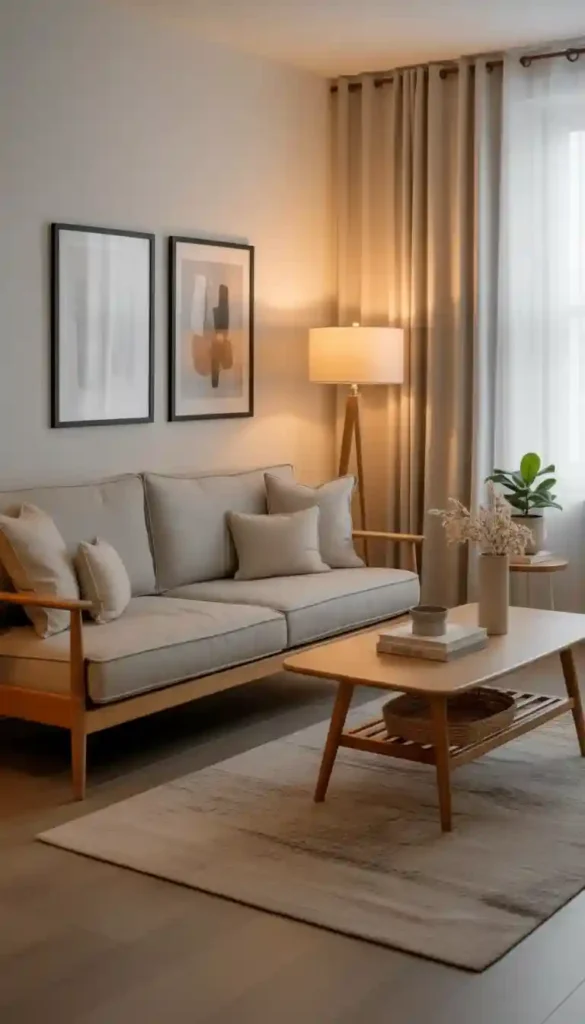
Light oak is having a genuine moment in 2026, and it deserves every bit of it. This design centers around the natural warmth of wood tones, balancing them with soft gray upholstery and clean, minimal lines. The result is a living room that feels both contemporary and deeply human — not cold, not overdone, just right.
Why Oak Tones Transform Small Rooms
Wood has an innate ability to make spaces feel warm and lived-in without requiring much else from you. Light oak specifically works in small apartments because it adds richness without darkening the room.
- Light oak reflects warm light tones, keeping the space feeling bright throughout the day
- It pairs naturally with gray, cream, and sage — three of the most versatile palette choices for 2026
- Oak furniture grounds a minimal space without making it feel sparse or sterile
The key insight: When walls and floors stay light, introducing oak through furniture adds warmth in exactly the right doses — enough to feel cozy, not so much that the room shrinks.
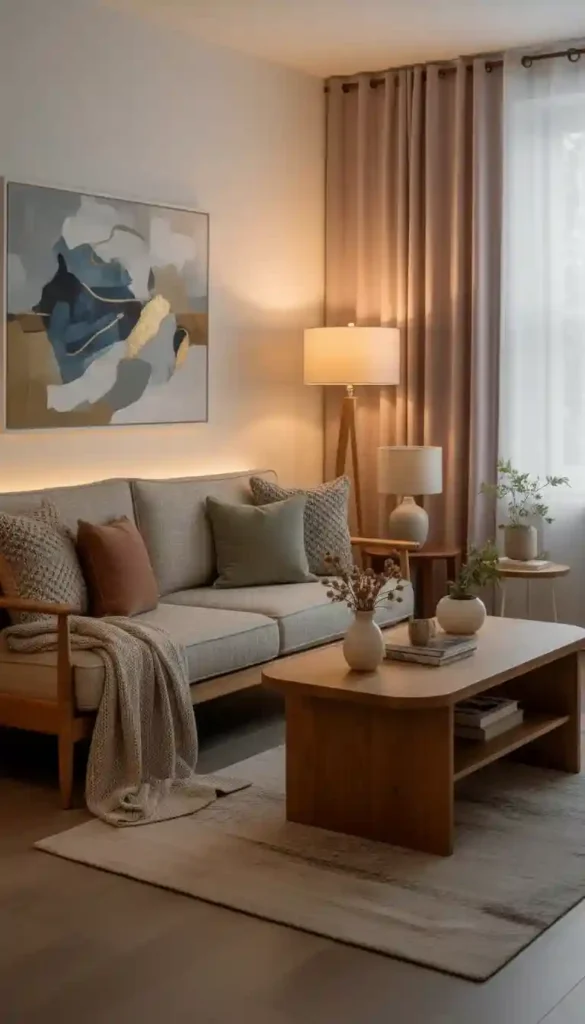
The Gray Sofa: Soft Balance in a Warm Room
Gray is the quiet mediator of interior design. It doesn’t compete with warm wood tones — it complements them, providing visual balance that keeps the room feeling settled and composed.
- Choose a sofa in light to mid-gray — charcoal reads too heavy for small apartments
- Textured gray upholstery (boucle, soft velvet, or brushed cotton) adds depth without adding visual weight
- Add one or two warm-toned cushions in terracotta, soft rust, or dusty blush to bridge the gray and the oak
Pin this gray sofa pairing guide! 📌
A gray sofa also has the practical advantage of being incredibly forgiving — it hides everyday wear far better than cream or white, making it ideal for daily living.
Artwork and Décor That Breathes
In a room built around natural materials and clean lines, artwork should feel like punctuation — present, meaningful, but not overpowering.
- Choose one or two pieces maximum and give them generous wall space around them
- Abstract line art, botanical prints, or soft landscape photography all work beautifully
- Frame in light oak, thin black, or raw wood to complement the room’s existing tones
Avoid gallery walls in small spaces. One strong piece at the right scale says more than fifteen crowded frames.
Layering Natural and Artificial Light
This design is built on the relationship between natural daylight and warm lamp light. Getting both right is what gives the room its signature glow.
- Position a floor lamp beside or just behind the sofa — angled light creates dimension
- Choose bulbs with a warm color temperature (2700K–3000K) for evening softness
- In daytime, keep curtains open fully to let oak tones absorb and reflect natural light beautifully
Why it matters: Harsh overhead lighting flattens a room and strips out the warmth that oak tones are designed to provide. Layered lighting — one ambient source, one floor lamp, one table lamp — is the formula that makes this design sing.
Plants and Cotton: Staying Rooted in Comfort
Greenery is the easiest way to bring life into a neutral, minimal space. In this design, plants work alongside soft cotton textures to create a room that feels refreshed and grounded.
- Choose low-maintenance plants: pothos, snake plants, or olive trees in terracotta pots
- Keep plant scales varied — a tall floor plant plus one or two smaller table plants adds visual interest
- Use cotton throw blankets in cream or oatmeal, draped loosely over the sofa arm
Save this plant and texture layering technique! 📌
Cotton and greenery together introduce organic imperfection into what could otherwise feel too polished. They make the space feel genuinely inhabited — and that’s exactly the goal.
Floating Décor That Defines the Space
Floating shelves and wall-mounted décor serve a specific purpose in this design: they keep surfaces clear while still giving the room character and dimension.
- Mount one floating shelf at eye level for a curated display of books, small plants, and one decorative object
- A single framed print above the console keeps the wall from feeling empty without crowding it
- Maintain negative space — resist filling every surface
Practical tip: In apartments where floor space is limited, moving décor to the walls creates breathing room below while still making the space feel layered and designed.
The Closing Principle
The natural light oak apartment setting is built on restraint and warmth. Every element earns its place. Nothing is decorative for decoration’s sake. Wood, light, texture, and a single well-chosen sofa come together to create a room that feels genuinely beautiful — not because it’s perfect, but because it’s honest.
Warm Beige Glow Apartment Living Room
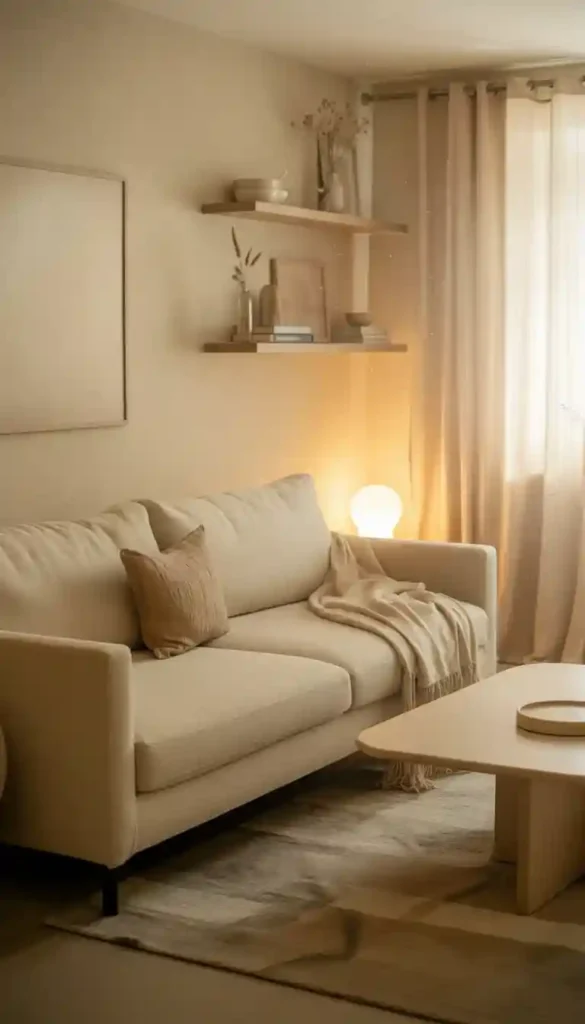
Beige has been completely reimagined for 2026. This is not the flat, tired beige of outdated apartments — this is warm, layered, and gently luminous. This design uses a cohesive cream and beige palette to create a living room that wraps around you, lit from within by soft, golden light that makes even the smallest space feel like a sanctuary.
Building a Cohesive Beige Palette
The secret to making beige work is understanding that it is not one color — it’s a family. Layering different shades within the same warm neutral family is what creates depth and visual interest.
- Combine warm white walls with oatmeal upholstery and deeper caramel accents
- Use texture — woven fabrics, matte ceramics, linen, and jute — to create variation within the palette
- Avoid cool or gray-beige tones — they read as dull. Stick with warm, yellow-based or pink-based neutrals
Why it works: A tonal palette where everything belongs to the same warm family creates a sense of harmony that feels intentional without being matchy-matchy.
The Woven Ottoman: Texture as a Design Choice
In this room, the ottoman is not just functional — it’s a textural statement. A woven or rattan ottoman adds tactile richness that a flat surface simply cannot.
- Use the ottoman as a coffee table alternative — top it with a tray to hold books, a candle, and a small plant
- Choose a woven ottoman in natural, honey, or warm brown tones
- Round shapes soften the room and work better in smaller floor plans than rectangular alternatives
Pin this woven ottoman styling tip! 📌
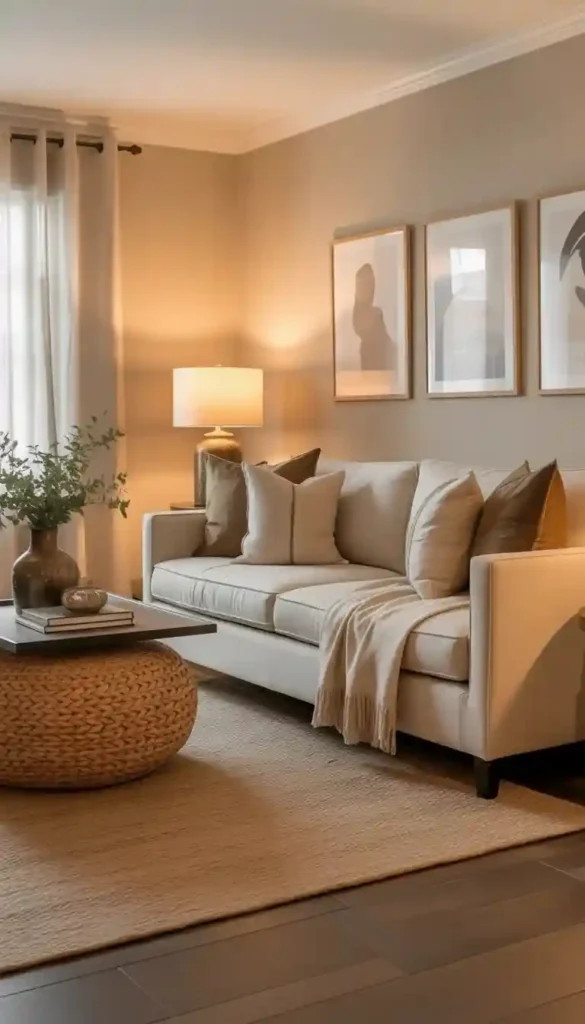
The tactile contrast between a soft linen sofa and a woven ottoman creates exactly the kind of sensory layering that makes a room feel curated and complete.
The Framed Art Trio: Decorating With Intention
A trio of framed artworks introduces a modern decorative moment without disrupting the calm of the palette. Done correctly, it’s one of the most visually satisfying arrangements in a neutral room.
- Choose three pieces in the same frame style and size for a clean, cohesive look
- Keep the subject matter simple — abstract shapes, botanical prints, or soft textures in warm tones
- Hang them in a tight row or stacked formation at eye level above the sofa
Spacing matters: Leave equal space between each frame and between the frames and the sofa back. Precision here is what separates a thoughtful arrangement from a random collection.
Soft Curtains and Natural Rugs as Grounding Elements
Every room needs an anchor — something that brings the eye down and makes the space feel settled. In this design, that role belongs to the curtains and the rug together.
- Choose curtains in soft ivory or warm linen that puddle slightly at the floor for an elegant, generous effect
- Select a natural fiber rug — jute, sisal, or wool — in a tone two or three shades deeper than the walls
- The combination of vertical curtains and horizontal rug lines creates natural spatial balance
Save this curtain and rug pairing approach! 📌
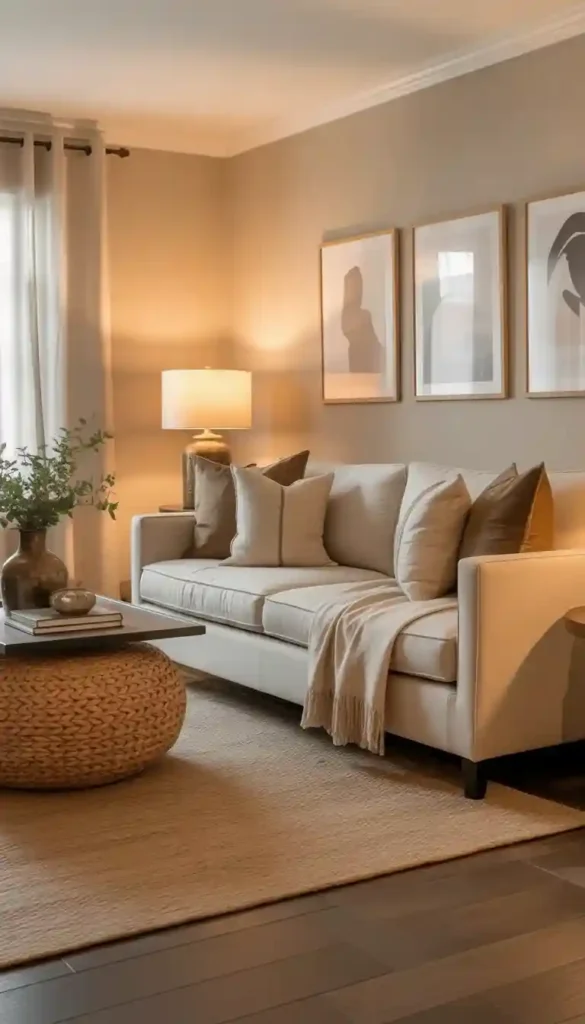
Together, these elements frame the room — curtains draw the eye up, rugs pull it back down, and the space between them is where your whole living room unfolds.
Layered Pillows That Amplify Coziness
Pillows are the fastest and most affordable way to add softness, depth, and personality to a neutral sofa. In this beige room, they serve as the primary vehicle for texture variation.
- Combine at least three textures: smooth cotton, ribbed knit, and woven boucle
- Stay within the warm neutral palette — add one very subtle accent in dusty rose or sage if you want a hint of color
- Mix sizes: two large back cushions, two medium accent pillows, one small lumbar cushion
The formula: The more texture you introduce through pillows, the richer the room feels — without adding a single new piece of furniture.
Warm Lighting as the Room’s Final Layer
Lighting is where this design truly comes alive. The warm beige glow in the room’s name is not an accident — it’s engineered through deliberate lighting choices.
- Use warm-toned bulbs exclusively — 2700K or lower for a genuinely golden ambiance
- Layer a table lamp, a floor lamp, and candles for maximum warmth and dimension in the evening
- Avoid overhead fluorescents entirely — they destroy the palette and strip out all warmth
In a beige room, warm lighting doesn’t just illuminate — it activates the palette, deepening tones and softening shadows in ways that make the whole room feel like it’s glowing from within.
The Closing Principle
The warm beige glow apartment living room is proof that a single palette, executed with depth and intention, can create a space that feels both stunning and completely livable. Layer your textures, warm your lighting, and trust the power of restraint.
Pale Sage Apartment Sitting Area
Pale sage is the color of 2026 in residential design — and for genuinely good reason. It carries the calm of nature, the freshness of green, and the restraint of a true neutral all at once. This design uses sage as a quiet backdrop that makes a white sofa glow and a small apartment feel surprisingly spacious and serene.
Why Pale Sage Works in Small Apartments
Not every color can carry a small space without closing it in. Pale sage is one of the few that genuinely opens a room rather than compressing it.
- Its muted, gray-green undertones read as a soft neutral in most lighting conditions
- It adds color without demanding attention, letting furniture and textures take center stage
- Sage works equally well in north-facing rooms (where it reads blue-green) and south-facing rooms (where it reads warm and golden)
The practical case for sage: It requires almost no coordination effort. It pairs naturally with white, cream, oak, rattan, and brass — which are collectively the backbone of almost every popular 2026 interior aesthetic.
The White Sofa: Bold but Balanced
A white sofa sounds risky, but in a sage room it is genuinely the right move. The contrast between the fresh green wall and the crisp white sofa creates a relationship that feels clean, intentional, and quietly striking.
- Choose a sofa with slightly rounded edges — sharp lines feel too clinical in this soft palette
- Velvet or boucle in warm white or ivory adds texture that stops the sofa from reading as flat
- Add one sage or dusty green cushion to create a gentle echo between the sofa and the wall
Pin this sage and white pairing strategy! 📌
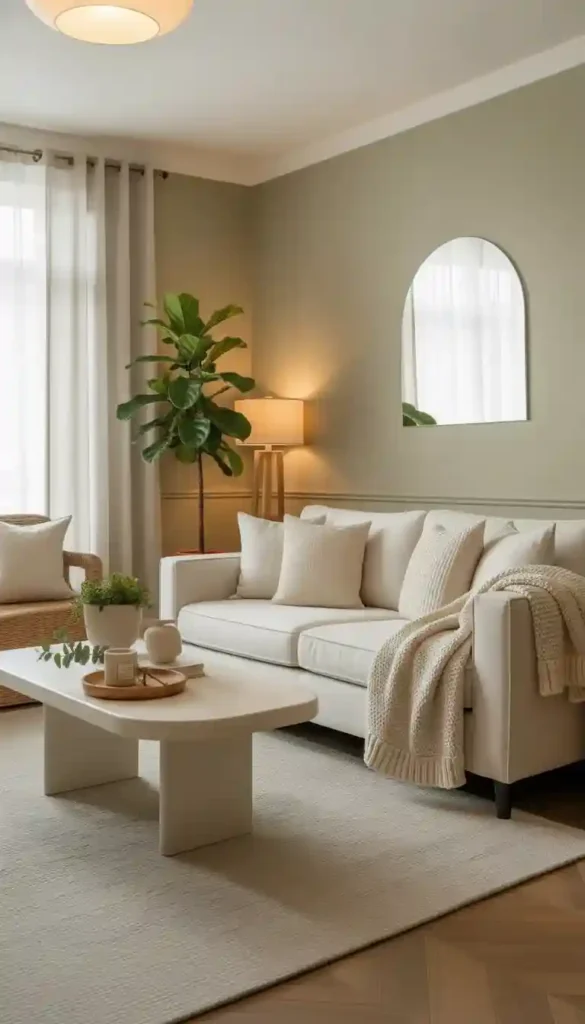
White furniture works in daily life more easily than most people expect, especially when upholstered in performance fabrics that clean easily and age gracefully.
Rounded Furniture for a Softer, More Spacious Feel
Sharp corners make small rooms feel more contained. Rounded furniture does the opposite — it softens the spatial boundaries and makes a room feel more generous and relaxed.
- A round coffee table with tapered legs keeps the floor visible and the room feeling open
- Curved armchairs or tub chairs add sculptural softness without taking up much floor space
- Even small details — rounded lamp bases, curved shelving — contribute to the overall effect
Why it works: Our eyes move more freely around curved surfaces, which creates a subconscious sense of spaciousness. In an apartment, this is a powerful and completely free upgrade.
Natural Light and Linen Curtains: The Airy Quality
Sage is at its most beautiful in natural light. This is the palette where your curtain choice makes or breaks the entire room.
- Use sheer linen curtains in white or pale flax — they filter light without reducing it
- Hang curtains from ceiling height, not from the window frame — this adds perceived height to the room
- In darker apartments, consider two layers: a sheer for daytime softness and a slightly heavier linen for evening privacy
Save this curtain hanging technique! 📌
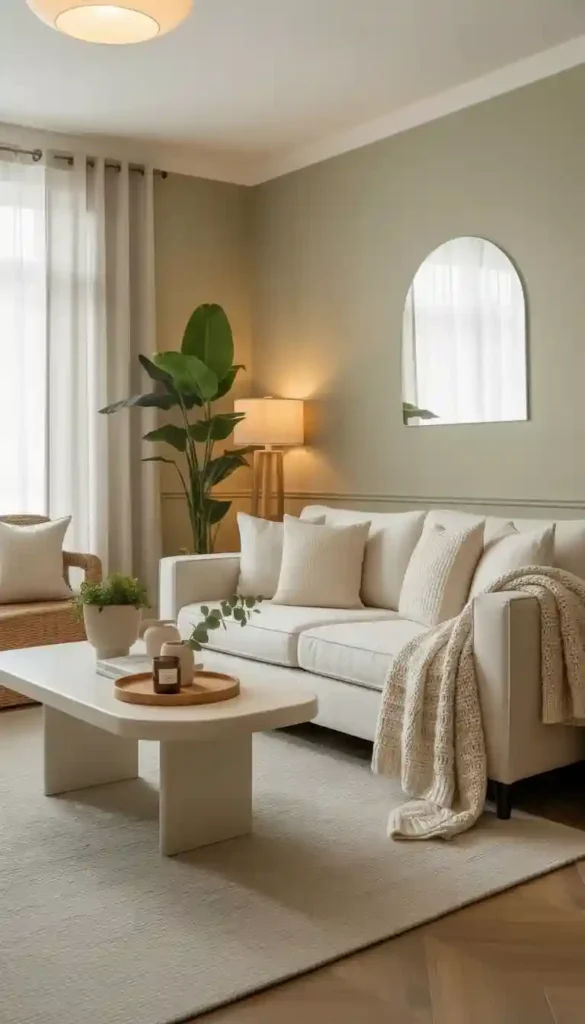
The goal is a room that always feels bathed in gentle, diffused light — the kind of light that makes you want to sit down and stay.
The Wall Mirror: Making Space Where There Is None
A mirror is the most effective space-expanding tool in apartment design. In this sage sitting area, it serves double duty: reflecting light and creating the illusion of depth.
- Choose a large, arched or round mirror — these shapes complement the soft aesthetic of the room
- Position it opposite a window to maximize light reflection
- A slim, light-toned frame (brass, wood, or matte white) keeps it feeling elegant rather than heavy
Sizing rule: The mirror should be at least 24 inches in its smallest dimension. Anything smaller loses impact in a full-size room.
Evening Coziness Through Warm Lighting
Sage rooms have a remarkable quality at night — when lit with warm, golden light, the green tones deepen and shift toward something almost amber. It’s genuinely one of the most beautiful evening atmospheres in interior design.
- Position a floor lamp with a warm Edison bulb in the corner behind the sofa
- Use a table lamp on a side table in a warm brass or honey-toned ceramic base
- Add pillar candles in holders on the coffee table for the final layer of warmth
The evening version of this room is entirely different from its daytime self — and that’s the mark of a genuinely well-designed space. It transforms with the light, always beautiful, always inviting.
The Closing Principle
Pale sage works because it doesn’t try to be dramatic. It creates a backdrop that makes everything else in the room feel considered and calm. If you’re looking for the one color change that can genuinely transform a small apartment, this is it.
Soft Cocoa Apartment Living Space
There is a particular kind of richness that comes from a deeper, warmer palette — not dark, not heavy, but genuinely enveloping. This cocoa-toned living room is that experience. It uses warm brown tones on the walls as a backdrop for cream upholstery and soft, layered textures to create a space that feels simultaneously sophisticated and deeply, genuinely cozy.
The Cocoa Wall: Depth Without Darkness
Choosing a deeper wall color in a small apartment feels counterintuitive — but cocoa and warm brown tones actually defy the usual rules in the most satisfying way.
- Warm brown tones absorb light softly, creating a wrapped, enveloping quality that neutrals cannot replicate
- They eliminate the harsh contrast between walls and furniture, making the room feel more unified
- Unlike cool dark colors (navy, charcoal), cocoa tones retain warmth even in low light
The confidence principle: A deeper wall color makes a small room feel intentional rather than limited. It says the designer chose this — and that shift in perception changes everything about how the space reads.
Cream Sofa Against Cocoa Walls: The Contrast That Works
This is the core relationship of the entire design — and it works because the two tones are warm and from the same color family, just at opposite ends of the scale.
- A cream or off-white sofa pops beautifully against a cocoa wall without feeling stark
- The contrast creates a focal point that makes the room feel designed and purposeful
- Choose upholstery in warm white or ivory rather than cool white — cool tones clash with warm cocoa walls
Pin this sofa-wall contrast technique! 📌
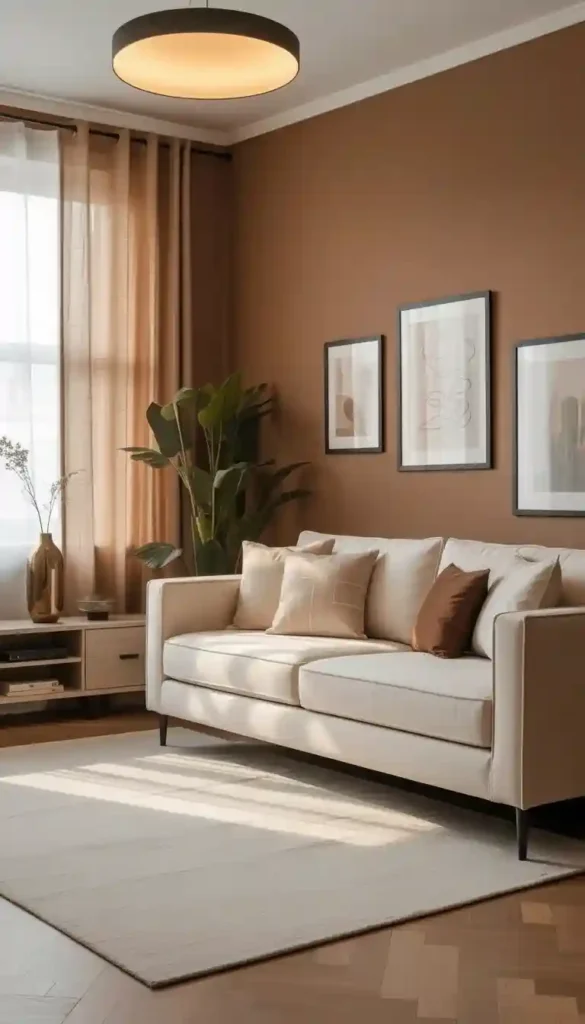
This pairing is elegant in a way that takes almost no effort to achieve. The colors do the work — you simply have to commit to the palette and let it unfold.
Accent Cushions That Blend and Bridge
In a cocoa and cream room, accent cushions serve a specific purpose: they bridge the two dominant tones and add the textural softness the palette needs.
- Choose cushions in caramel, dusty terracotta, warm rust, or muted gold — all tones that belong to the cocoa family
- Mix textures: velvet, woven cotton, and boucle add dimension without disrupting the color harmony
- Avoid cool accent tones (blue, gray, green) — they interrupt the warmth the room is built on
Cushion count: In a standard three-seat sofa, five cushions is the ideal number — two large, two medium, one lumbar. It’s generous without looking overstuffed.
Layered Curtains for Window Dimension
This design uses the windows as a secondary design feature, not just a functional opening. Layered curtains create depth and elegance that a single panel simply cannot.
- Use a sheer ivory layer as the base, allowing soft light to filter through during the day
- Add a heavier linen or velvet panel in warm cream or sandy beige for evening layering
- Hang both panels from the same high rod for a unified, architectural look
Save this curtain layering method! 📌
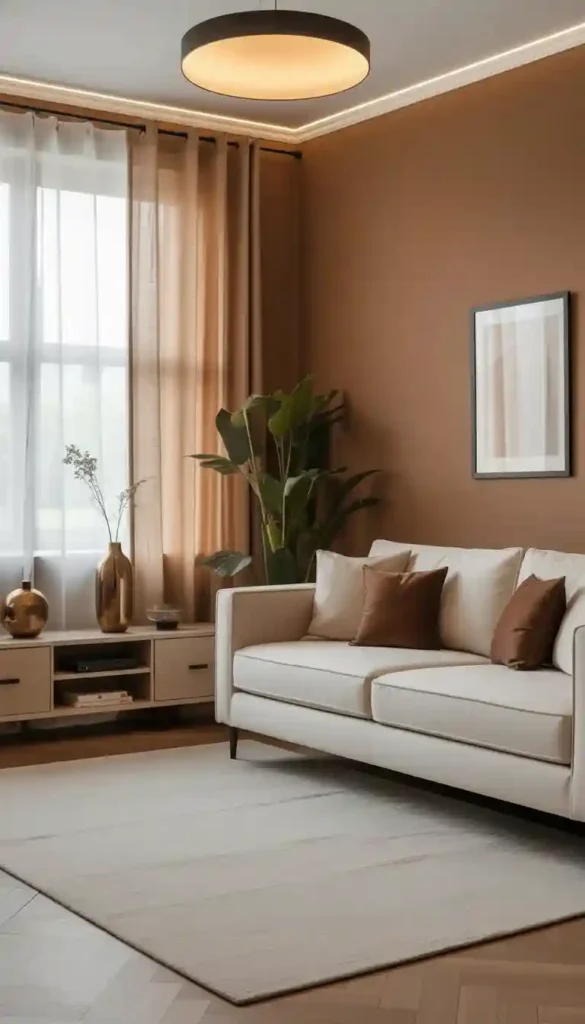
Layered curtains add an instant sense of luxury to an apartment window — the kind of detail that makes a room photograph beautifully and feel even better in person.
The Rug: Subtle Pattern in a Warm Room
In a room with this much warmth in the palette, the rug is the place to introduce the only hint of pattern. Subtle is the operative word.
- Choose a rug with a quiet geometric or tonal pattern in cream, sand, and caramel tones
- Low-pile or flat-weave rugs work best under a styled coffee table area
- Size matters: the rug should be large enough that at least the front legs of all seating pieces rest on it
The grounding rule: A rug that’s too small makes the furniture look like it’s floating. Go larger than you think you need — in small spaces, a generous rug actually makes the room feel bigger by defining the seating zone clearly.
Minimalist Décor and Warm Lighting as the Final Edit
This is where the design is completed — not by adding more, but by being precise about what stays.
- Keep surfaces nearly clear: one or two objects on the coffee table, a single plant on a side table
- Choose warm metallic accents — brushed brass, aged gold, or warm copper — for any hardware or decorative objects
- Warm lighting (2700K bulbs in a floor lamp and one table lamp) draws out the richness of the cocoa walls beautifully at night
In a deeper-toned room, lighting doesn’t just add ambiance — it reveals the depth and complexity of the palette. The right bulb temperature makes cocoa walls look like they’re lit from within.
The Closing Principle
The soft cocoa apartment living space is for people who want their home to feel like an arrival — rich, warm, and completely theirs. It takes courage to choose a deeper palette in a small space. But once you do, you won’t look back. The warmth, the depth, the sense of being truly held by a room — that’s what cocoa delivers, and it delivers it every single time.
Conclusion
Your apartment is not just a place to sleep between obligations. It’s the space where you exhale, where you reset, where you become yourself again at the end of a long day. The five designs in this guide — cream linen, light oak, warm beige, pale sage, and soft cocoa — each offer a different way to make that space feel completely, genuinely yours. None of them require a large budget. All of them require intention.
Start with one idea. One color, one texture, one piece of furniture that moves you toward the room you’ve always imagined. Small changes compound into something remarkable when they’re chosen carefully and built with care. Your apartment is ready. The only question is which version of beautiful you’re ready to bring home.

“I share simple, beautiful and affordable home decor ideas to help you style every corner of your home with ease.