

There is something deeply personal about finding a quiet corner in your own backyard. A place where the noise of the day fades, where the breeze moves through the trees, and where you finally feel like you can breathe again. A hammock garden is not just a design choice — it is an emotional one. It says: this space belongs to me, and I deserve to rest in it.
If you have been dreaming about transforming your outdoor space into something truly special in 2026, you are in the right place. Whether your backyard is a sprawling landscape or a tight urban patch, these five hammock garden ideas will show you exactly how to create a space that feels both beautiful and deeply your own. Let’s build something that makes you never want to go back inside.
Hammock Garden Ideas 2026 – Creating The Perfect Outdoor Escape
A hammock garden done right feels less like a backyard and more like a private resort. The secret is not expensive furniture or a massive yard — it is intentional design. When every element has a purpose and a place, the space transforms into a true escape.
In 2026, the best hammock garden ideas focus on blending nature, comfort, and smart layout. The result is an outdoor space that pulls you in the moment you step outside.
Start With a Clear Vision
Before you buy a single thing, stand in your backyard and ask yourself: where does the light feel best? Where is the natural shade? Where would I actually want to sit and do nothing?
- Map your space by sketching a rough layout, even a simple drawing on paper
- Identify anchor points — trees, fence posts, or wall sections that could support a hammock
- Note sun and wind patterns throughout the day to find the most comfortable zone
- Choose one focal area rather than trying to redesign the entire yard at once
Starting with clarity saves time, money, and regret.
Choose the Right Hammock for Your Space
Not all hammocks are created equal. The style you choose will define the entire feel of your garden retreat.
- Rope hammocks with an open net structure create a classic, airy look — great for warm climates
- Fabric hammocks in breathable cotton or polyester offer more body support and comfort
- Neutral tones like white, sand, or sage green blend into natural settings effortlessly
- Boho-style woven hammocks with subtle fringe add texture without overwhelming the space
For most backyards, a spreader bar hammock (the kind that stays flat and open) works best for both looks and usability.
Build a Surrounding Environment That Supports Rest
The hammock is the centerpiece, but the surrounding environment creates the feeling.
- Place low wooden lounge chairs nearby for guests who prefer seating
- Add a compact side table within arm’s reach — coffee, a book, sunscreen
- Layer outdoor rugs in natural jute or cotton to define the zone and add warmth underfoot
- Use solar lanterns or LED string lights for soft evening ambiance that does not overpower the natural setting
Keep the furniture low and relaxed. Height creates formality. Low creates calm.
Pin this Outdoor Escape Design! 📌
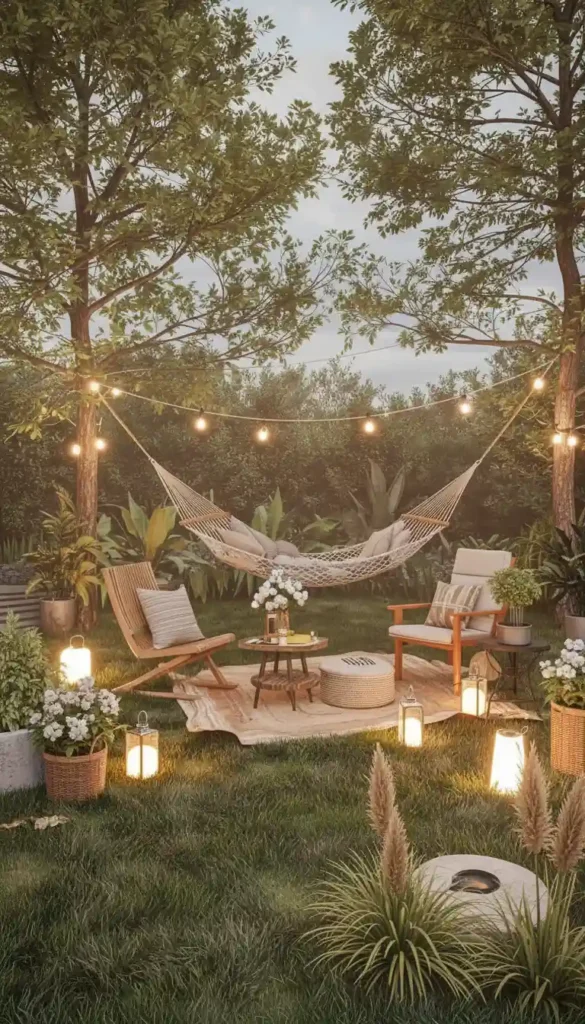
Add Potted Greenery to Frame the Space
Plants do the heavy lifting in any hammock garden. They soften hard edges, add oxygen, and make the space feel alive.
- Ornamental grasses sway in the breeze and add movement to the space
- Potted tropical plants like birds of paradise or elephant ears create a lush, resort-like feel
- Lavender or rosemary near the hammock adds gentle fragrance without being overwhelming
- Trailing vines on a nearby fence or post create a natural curtain effect
Group plants in odd numbers — threes and fives feel more natural than pairs or fours.
Plan for Weather and Durability
A beautiful hammock garden should last more than one season. Material choices matter enormously.
- Choose weather-resistant hammock fabric rated for UV exposure and moisture
- Use stainless steel or galvanized hardware for hanging points to prevent rust
- Store cushions and textiles in a weatherproof bin or bench when not in use
- Apply teak oil or outdoor sealant to any wooden furniture at the start of each season
Building durability into your plan from day one saves a lot of frustration later.
Lighting Strategy for Evening Use
The right lighting extends your hammock garden from a daytime retreat into an all-evening sanctuary.
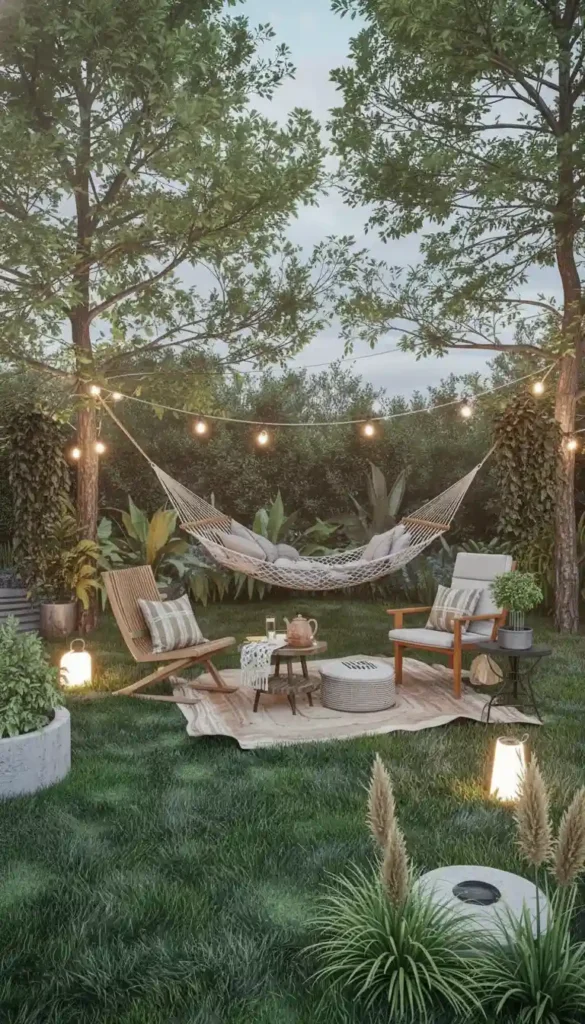
- String lights draped overhead create a canopy effect that feels magical
- Ground-level lanterns along pathways add safety and warmth
- Solar-powered spotlights can highlight a favorite plant or tree without wiring
- Avoid bright white or cool-toned lights — warm amber tones (2700K–3000K) create the most relaxing atmosphere
Good lighting is felt more than seen. It should make you sigh, not squint.
Save this Outdoor Retreat Strategy! 📌
Closing Principle
The perfect outdoor escape does not happen by accident. It happens because someone decided their rest was worth designing for. Keep it simple, keep it intentional, and let the hammock be the heart of the space.
Hammock Garden Aesthetic Trends For Modern Outdoor Living
Aesthetics are not about following trends. It is about creating a visual feeling that matches your inner world. In 2026, the strongest hammock garden aesthetics share one quality: they feel curated but not overdone.
The goal is a space that looks like it evolved naturally — not like a showroom. Here is how to achieve that.
Understand the Core Aesthetic Directions in 2026
Three major styles dominate hammock garden design this year:
- Minimalist Natural — clean lines, raw wood, white textiles, and abundant negative space
- Boho Layered — woven textures, warm earth tones, rattan, clay, and collected objects
- Modern Resort — structured symmetry, lush tropical planting, neutral tones, and premium materials
You do not need to pick just one, but you should lean toward one. A space that tries to be everything ends up feeling like nothing.
Color Palette Selection
Color sets the emotional tone of the entire space. Choose deliberately.
- Neutral anchors: white, sand, warm gray, linen — these never compete with nature
- Earthy accents: terracotta, rust, olive green, muted gold — warm and grounded
- Cool retreats: slate blue, sage, dusty mauve — calming and modern
- Limit your palette to two to three colors across all textiles and accessories
The most timeless hammock gardens use one bold color as an accent against a largely neutral backdrop.
Textile Layering: The Secret to a Finished Look
Textiles transform a hammock garden from functional to beautiful.
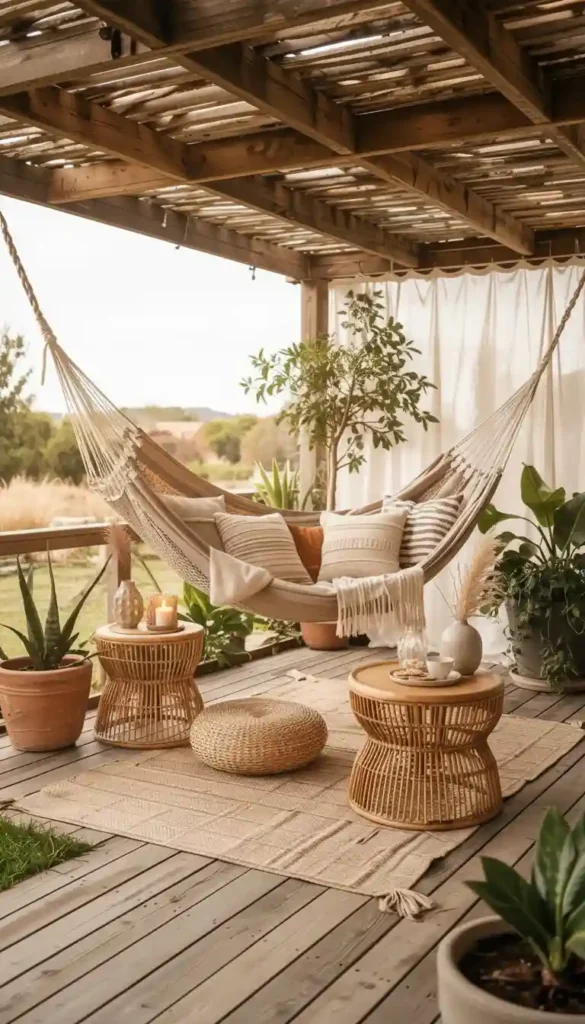
- Start with a base hammock in a neutral tone — this is your canvas
- Layer with one or two throw pillows in a complementary pattern or texture
- Add a lightweight throw blanket draped casually across one end
- Place an outdoor rug underneath to anchor the space visually
Every textile should feel like it belongs together, even if they were not purchased as a set.
Pin this Aesthetic Layering Guide! 📌
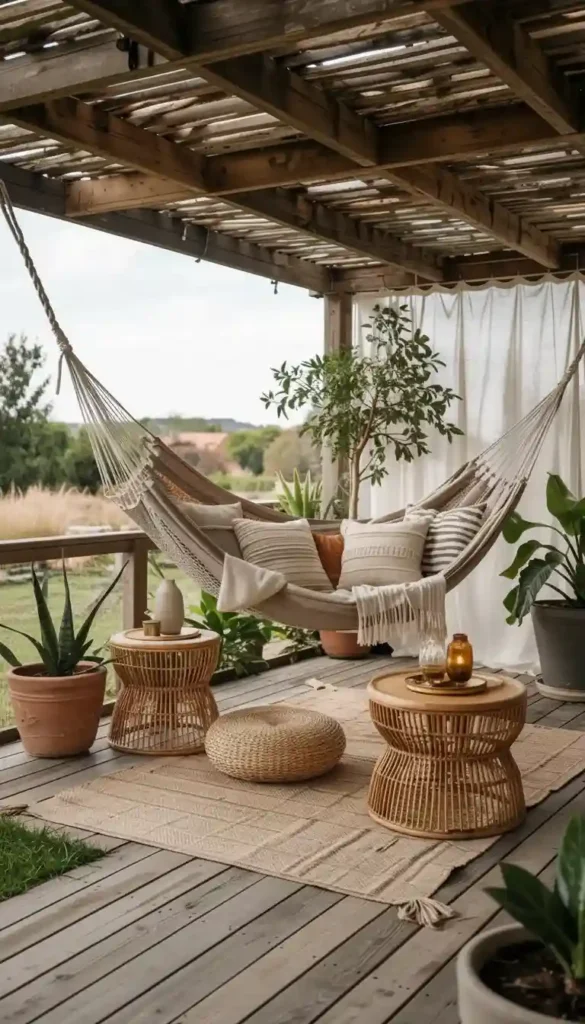
Decorative Accents That Actually Add Value
Accessories are where most people over-invest. Less is almost always more.
- Clay or terracotta planters in varying heights add organic warmth
- Rattan stools or side tables introduce natural texture without bulk
- Lightweight outdoor curtains on a pergola or between posts add softness and privacy
- One statement object — a large lantern, a sculptural plant stand, a carved wooden bowl — grounds the space
Ask yourself: does this item make me feel calmer when I look at it? If yes, keep it. If not, leave it out.
Proportions and Scale: Why They Matter
Even the most beautiful individual pieces can ruin a space if the proportions are wrong.
- The hammock should not dominate more than 40% of the visual field when viewed from the house
- Surrounding furniture should be lower than the hammock height to maintain hierarchy
- Plants should vary in height — ground level, mid-height, and tall — to create visual rhythm
- Avoid matching sets — slight variation in wood tones and textures feels more natural and lived-in
Scale creates harmony. Harmony creates calm.
Seasonal Styling Updates
The best hammock gardens look great year-round because they are designed to evolve.
- Spring/Summer: Light linens, bright greens, open textures, pastel accents
- Fall: Deep terracotta, rust throws, dried grasses, warm lanterns
- Winter (in mild climates): Chunky knit blankets, evergreen plants, warm string lights
Swapping two to three textiles is usually enough to completely shift the seasonal feel without a full redesign.
Save this Seasonal Aesthetic Strategy! 📌
Closing Principle
A hammock garden aesthetic should feel personal, not perfect. The spaces that stay beautiful for years are the ones where every choice was made with both heart and intention.
Hammock Garden Design Plans For Stylish And Functional Spaces
A beautiful hammock garden that is not functional is just a pretty problem waiting to happen. The best designs balance visual appeal with real-world usability — safe anchor points, good drainage, comfortable circulation, and smart storage.
Here is how to plan a hammock garden that works as beautifully as it looks.
Start With a Site Assessment
Before finalizing any design, evaluate the actual conditions of your space.
- Sun exposure: How many hours of direct sun does the area receive? Is afternoon shade available?
- Wind direction: Identify the prevailing wind direction — you want a gentle breeze, not a constant blast
- Proximity to the house: Close enough for easy access, far enough for a sense of escape
- Ground condition: Flat ground is easiest, but slight slopes can be managed with leveling and drainage planning
A 10-minute site assessment saves months of frustration after installation.
Structural Support Options
The hammock is only as good as what holds it up. Choose your support system before anything else.
- Mature trees (at least 6–8 inches in diameter) are the most natural and aesthetically pleasing option
- Free-standing hammock frames work in any space and require no trees — great for patios
- Wooden posts set in concrete provide a custom, permanent solution
- Pergolas double as a structural support and a design feature, adding shade and framing simultaneously
For DIY installation, always use a lag bolt rated for at least 4 times the expected load weight.
Optimal Hammock Placement Dimensions
Getting the spacing right makes the difference between comfortable and frustrating.
- Distance between anchor points: 13–15 feet for a standard hammock; 10–12 feet for a smaller one
- Hanging height: Attach points at 4.5–5 feet off the ground for a comfortable resting height of 18–24 inches
- Clearance on all sides: Allow at least 3 feet of open space around the hammock perimeter for safe entry and exit
- Diagonal placement in smaller spaces can make the area feel larger while fitting the hammock comfortably
These measurements ensure comfort and safety without guesswork.
Pin this Hammock Design Plan! 📌
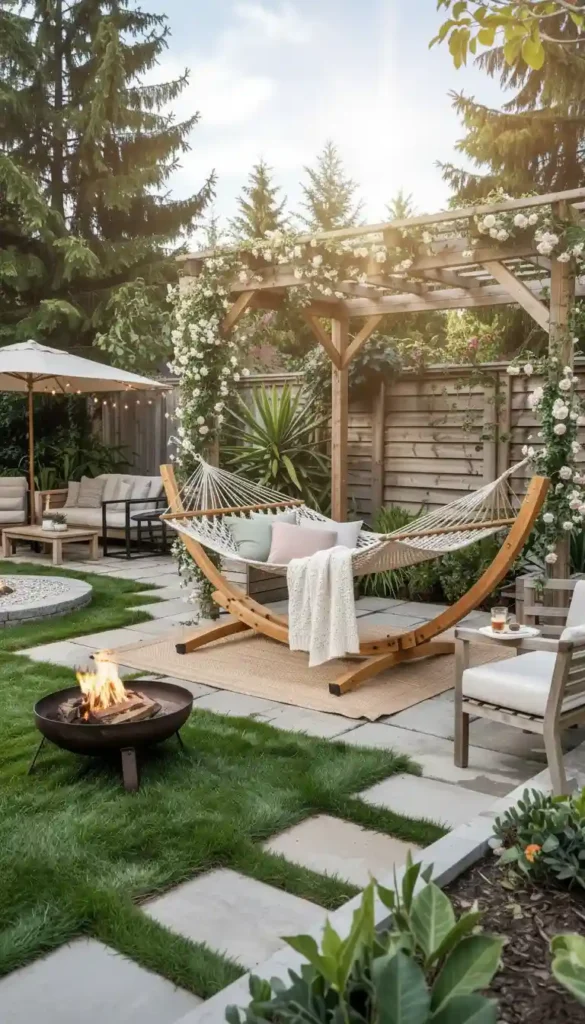
Zoning for Multi-Use Spaces
Larger backyards benefit from intentional zoning — separating the hammock garden from other activity areas.
- Use low hedges, ornamental grasses, or planting beds to define the hammock zone without full enclosure
- Stepping stone pathways lead the eye (and the feet) naturally into the hammock area
- Position the hammock zone away from high-traffic play or dining areas to protect the sense of quiet
- A small fire pit positioned 6–8 feet from the hammock extends the space into a full evening retreat
Zoning creates experience. Each zone tells you what you are there to do.
Drainage and Ground Preparation
Neglecting the ground beneath the hammock is one of the most common planning mistakes.
- Level the ground beneath and around the hammock area before adding any surface material
- Use decomposed granite, pea gravel, or mulch as ground cover — both drain well and look natural
- Avoid solid concrete directly beneath — it creates heat, glare, and discomfort underfoot
- Install a simple French drain if the area sits in a low spot prone to standing water
Good drainage keeps the space usable after rain and prevents long-term damage to wooden elements.
Adding Comfort Amenities
Once the structure is solid, add the elements that make people want to stay.
- A retractable canopy or shade sail provides instant sun protection without permanent construction
- Weather-resistant storage benches keep cushions, throws, and accessories organized and protected
- An outdoor side table large enough for drinks, a book, and a phone — approximately 18–24 inches in diameter
- Integrated planting along the perimeter softens the hardscape and connects the design to the broader landscape
Every amenity should earn its place. If it does not add comfort or function, leave it out.
Save this Functional Design Strategy! 📌
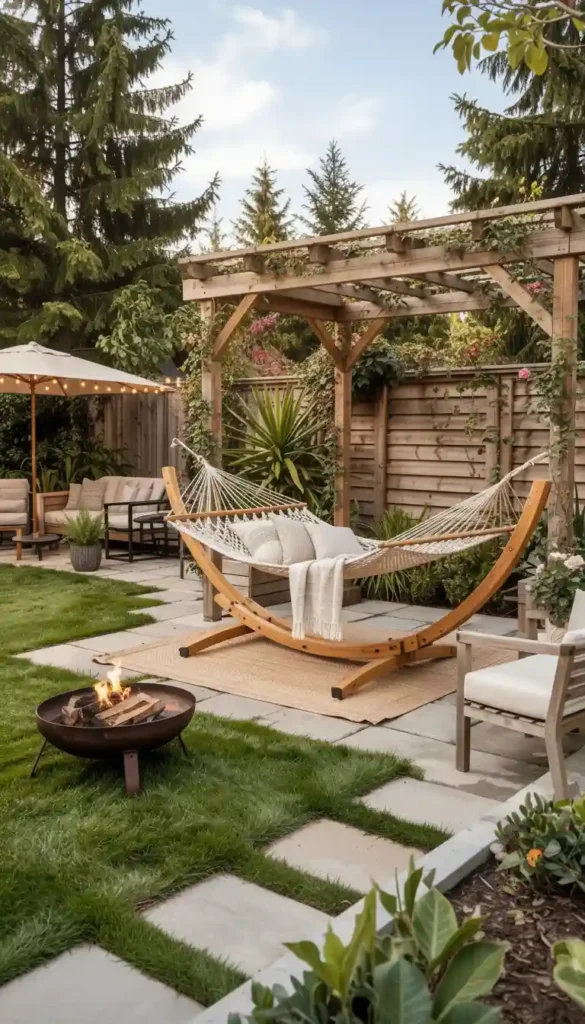
Closing Principle
A well-planned hammock garden does not just look good on day one. It works well, stays safe, and improves with age. Plan carefully, build thoughtfully, and the space will reward you for years.
Cozy Hammock Gardens In Small Backyard Areas
Small backyards are not a limitation. They are an invitation to design more intentionally. Some of the most beautiful hammock gardens in the world exist in spaces no larger than a parking spot. The key is knowing how to make every inch count.
In 2026, small-space hammock garden design is one of the most exciting areas in outdoor living. Here is how to do it right.
Reframe the Small Space Mindset
The first step to designing a great small hammock garden is changing how you see the space.
- Small does not mean cramped — it means intimate and focused
- Compact spaces force editing, which almost always produces better design
- A small hammock garden that works perfectly is more valuable than a large one that feels chaotic
- Think of it as designing a capsule wardrobe for your yard — fewer pieces, all essential, all beautiful
The constraint is the creative direction.
Hammock Selection for Small Spaces
Size and style choices matter even more in tight spaces.
- Choose a single hammock (not a double) to preserve movement space
- Lightweight cotton or nylon hammocks without bulky frames are ideal for compact areas
- A hammock chair (a hanging chair rather than a full-length hammock) can work beautifully in spaces under 10 feet
- Neutral or soft tones visually recede and make small spaces feel larger
Avoid hammocks with large, rigid spreader bars in very small yards — they require more clearance and look proportionally oversized.
Diagonal Placement Strategy
One of the most effective tricks for small hammock gardens is simple geometry.
- Hanging a hammock diagonally across a corner uses the longest available span in a small space
- This creates a sense of visual depth — the eye follows the diagonal line and perceives more space
- It also frees up the center of the yard for movement and other uses
- Corner placement naturally frames a private nook without requiring additional screening
A 45-degree shift can change everything in a small space.
Pin this Small Space Design Idea! 📌
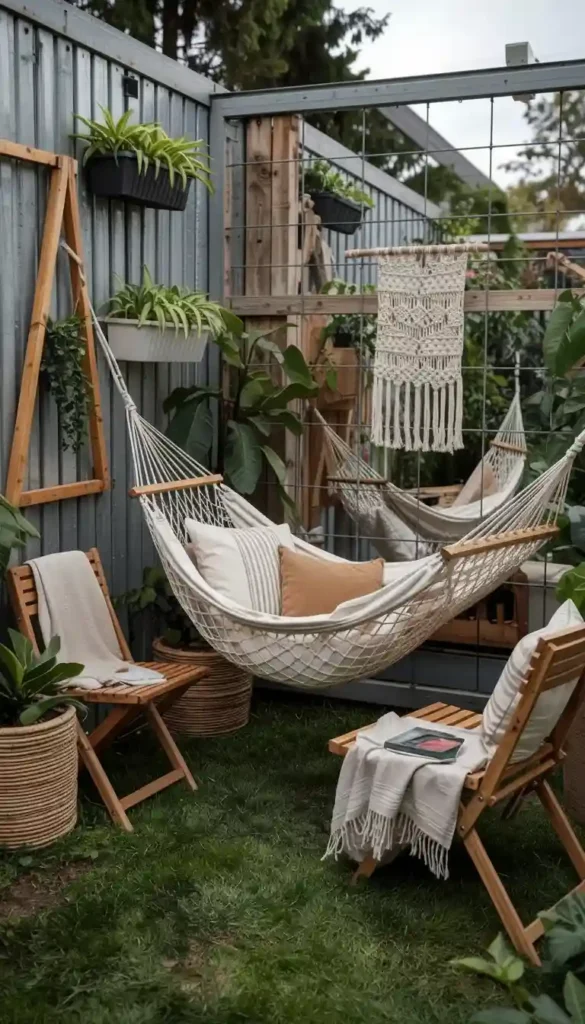
Vertical Space Utilization
In a small yard, vertical space is your biggest untapped asset.
- Vertical planters on walls or fences bring greenery up without taking up floor space
- Wall-mounted shelves hold lanterns, small pots, and accessories without a side table
- Climbing plants on a trellis or fence create a lush green backdrop that makes the space feel larger
- Hanging lanterns above the hammock draw the eye upward and create a sense of height
Think of the vertical plane as extra square footage. Use it.
Light Colors to Expand the Space
Color psychology plays a powerful role in small outdoor spaces.
- White, soft beige, and pale sage reflect light and visually push boundaries outward
- Avoid dark, heavy tones for the primary hammock and main textiles — they compress the space
- One bold accent color in a small accessory (a cushion, a planter, a rug border) adds personality without weight
- Mirrored or reflective surfaces on a fence panel can double the apparent depth of a small yard
Light colors do not just look good — they make the space feel bigger, airier, and more relaxing.
Multi-Functional Furniture for Small Hammock Gardens
Every piece of furniture in a small space must earn a double shift.
- A storage bench provides seating, a surface for accessories, and hidden storage for cushions
- A small folding side table that tucks away when not in use keeps the space flexible
- Stackable chairs allow you to host guests without permanently sacrificing space
- Built-in planter boxes along the fence perimeter add greenery without taking up floor area
Multi-function is not a compromise. In small spaces, it is the highest form of smart design.
Save this Small Backyard Hammock Strategy! 📌
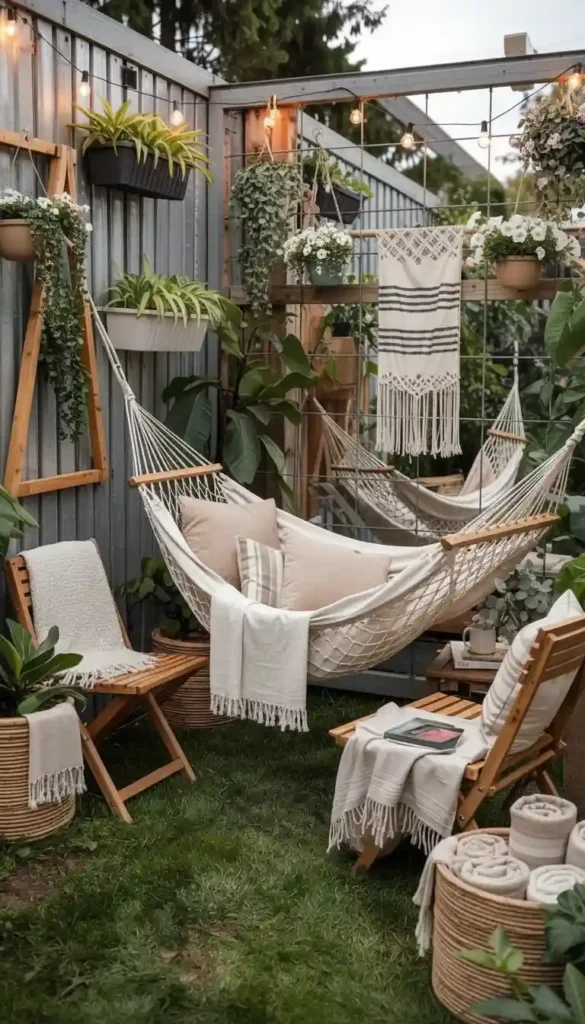
Closing Principle
Small spaces reward careful thinking. Every choice either opens the space up or shuts it down. Choose lightness, simplicity, and functionality — and even the tiniest backyard becomes a place you never want to leave.
Hidden Hammock Garden Corner Ideas For Private Relaxation
Privacy changes everything. The difference between a hammock in the middle of an open yard and a hammock tucked into a secluded corner is the difference between feeling observed and feeling free. A hidden hammock garden corner creates the psychological safety that makes true relaxation possible.
Here is how to design a private retreat that feels like a secret garden — even in a suburban backyard.
Why Privacy Matters in Hammock Garden Design
Before diving into how, it is worth understanding why privacy enhances the hammock experience so dramatically.
- When we feel unseen, our nervous system down-regulates — heart rate slows, muscles relax
- Enclosed spaces trigger a primal sense of shelter and safety that open spaces cannot replicate
- A private corner signals to your brain: this space is for you, not for performing
- Research in environmental psychology consistently shows that partial enclosure (not full walls) produces the most restorative outdoor experiences
Designing for privacy is designing for genuine rest.
Using Natural Plants as Privacy Screens
Plants are the most beautiful privacy solution available — and they improve with age.
- Dense ornamental grasses (pampas grass, maiden grass) grow 5–8 feet tall and sway gently in the breeze
- Bamboo in containers provides instant height and a tropical feel without invasive root spread
- Evergreen shrubs like boxwood, arborvitae, or photinia maintain screening year-round
- Climbing vines on a trellis (jasmine, wisteria, climbing roses) create a fragrant, living wall
Layer plants at different heights — ground-level, mid-height, and tall — for the most natural and effective screen.
Structural Privacy Elements
Sometimes plants alone are not enough — or you need privacy faster than a plant can grow.
- Wooden pergolas with a simple roof structure define the space and support climbing plants
- Bamboo or reed privacy screens attached to an existing fence provide instant screening
- Slatted wooden panels offer privacy while allowing airflow — far better than solid walls
- A rustic wooden arch at the entry to the corner creates a threshold that signals transition into a private space
The best structural elements look like they were always meant to be there.
Pin this Hidden Garden Corner Idea! 📌
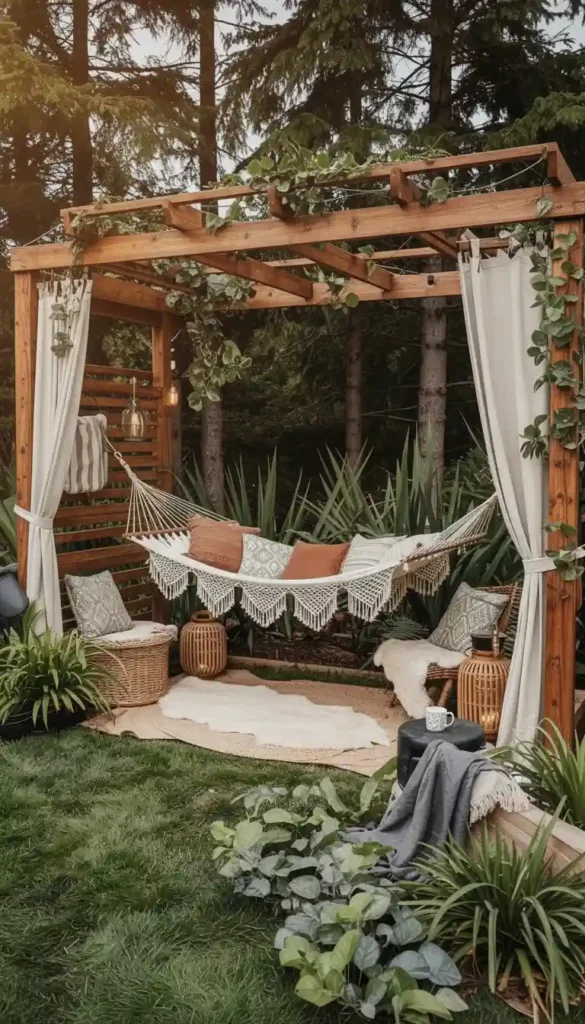
Fabric Curtains for Softness and Flexibility
Outdoor curtains are one of the most underused tools in hammock garden design. They add privacy, texture, and elegance simultaneously.
- Choose sheer outdoor fabric in white or natural linen for softness and light diffusion
- Hang curtains from a simple tension rod or pergola beam — no drilling required in many setups
- Allow curtains to puddle slightly on the ground for a relaxed, romantic effect
- In windy climates, use weighted hem curtains or tie-backs to prevent constant movement
Curtains change the feel of a space instantly. They transform a corner into a room.
Ground Level Details That Complete the Sanctuary
The ground beneath and around the hammock is often overlooked, but it contributes enormously to the feeling of the space.
- Ground cover plants like creeping thyme, moss, or clover soften hard edges and add a lush, wild quality
- An outdoor rug in a natural fiber (sisal, jute, or outdoor cotton) anchors the space and adds warmth
- Stepping stones leading into the corner create a sense of arrival — you are entering somewhere special
- Pea gravel or smooth river stones around the perimeter add texture and excellent drainage
The ground completes the room. Do not neglect it.
Sensory Design: Scent, Sound, and Touch
A truly private retreat engages all the senses, not just sight.
- Fragrant plants near the hammock — jasmine, lavender, gardenia — create an olfactory anchor that signals relaxation
- A small water feature (a tabletop fountain or a simple bubbling urn) masks ambient noise from neighbors or traffic
- Wind chimes in a light material (bamboo, copper) add gentle auditory texture without intrusion
- Textured cushions and throws in soft, natural fabrics invite touch and reinforce comfort
When all five senses are engaged, the brain fully commits to the experience of rest.
Save this Private Retreat Design Strategy! 📌
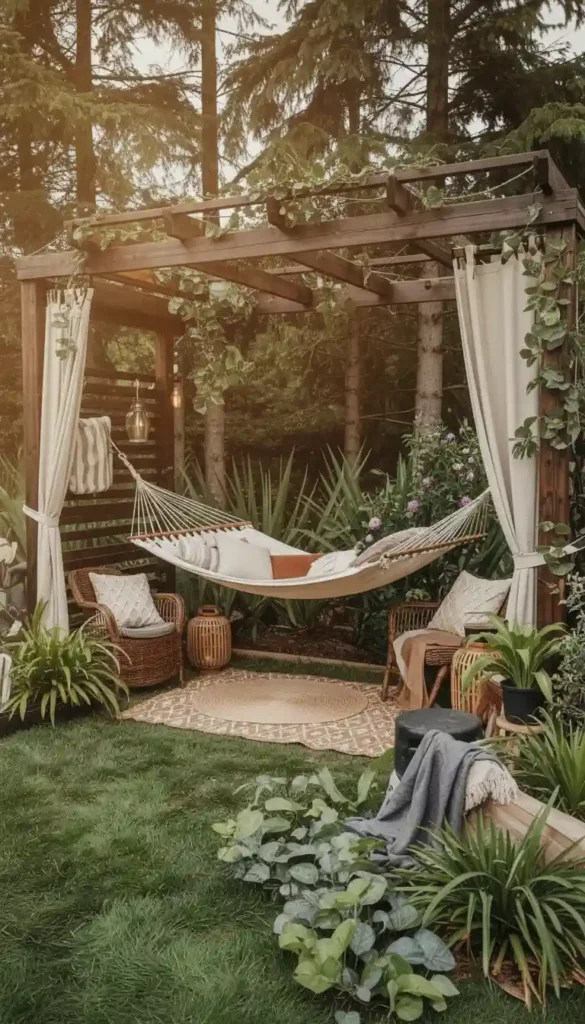
Closing Principle
A hidden hammock garden corner is not about hiding from the world. It is about creating a space where the world cannot follow unless invited. Design that corner with care, and it will become the most used, most loved spot in your entire home.
Conclusion
Your backyard is not just outdoor space. It is an extension of how you live, how you rest, and how you take care of yourself. A thoughtfully designed hammock garden — whether sweeping and open or tucked into a private corner — gives you a place to decompress that is entirely your own. In 2026, the best outdoor designs are not the most expensive ones. They are the ones that feel most true to the person who created them.
Start with one idea from this guide. Pick the concept that made you pause and picture yourself there. That feeling is your design compass. Follow it, build intentionally, and you will create a hammock garden that does not just look beautiful — it changes how you feel every single day you come home.

“I share simple, beautiful and affordable home decor ideas to help you style every corner of your home with ease.