

There is a moment — maybe you know it — when you walk outside and feel everything slow down. The noise fades. Your shoulders drop. You breathe differently. That feeling does not come from a fancy renovation or an expensive landscape designer. It comes from intention. It comes from a space that was built to hold stillness. That is what a Japanese garden does, and it does it better than almost anything else you can create at home.
The truth is, you do not need a large property, a big budget, or years of gardening experience. You need the right ideas, a clear starting point, and the courage to leave some space empty. Whether your backyard is enormous or barely the size of a parking spot, whether you have a rooftop in a city or a narrow side yard between two fences, the Japanese garden principles work. Here are five ideas that will genuinely transform how your outdoor space feels in 2026.
Japanese Garden Ideas for Small Backyard Spaces — Creating Calm When Every Inch Counts
Small backyards are where Japanese garden design truly earns its reputation. The philosophy of restraint, negative space, and deliberate placement was practically invented for tight footprints. When you stop trying to fill every corner and start designing around one clear focal point, the space opens up in a way that feels almost impossible given its size.
The secret most people miss is this: a small backyard does not need more plants or more features. It needs better decisions.
Start With One Main View
Before you buy anything or move a single stone, stand at your back door or patio and look out. That sightline is your canvas.
- Identify the single most visible spot from inside your home
- Design your focal point — one stone grouping, one lantern, one basin — to land exactly there
- Everything else in the garden should support that view, not compete with it
- Keep the foreground clear so the focal point reads without distraction
This one decision will change everything about how the space feels.
Choose a Two-Material Ground Plane
Most small backyards look cluttered because the ground plane is a mix of grass, pavers, pots, and random textures. Simplify it dramatically.
- Use fine gravel or decomposed granite as your primary surface
- Add one contrasting element: flat stepping stones or a narrow band of dark pebbles
- Install a clean edging border — steel, timber, or stone — to keep materials separated
- A weed barrier underneath gravel saves you endless maintenance hours
Why it works: The eye has less to process, which creates an instant feeling of calm.
The Three-Element Rule
In a small backyard, limit yourself to exactly three intentional elements:
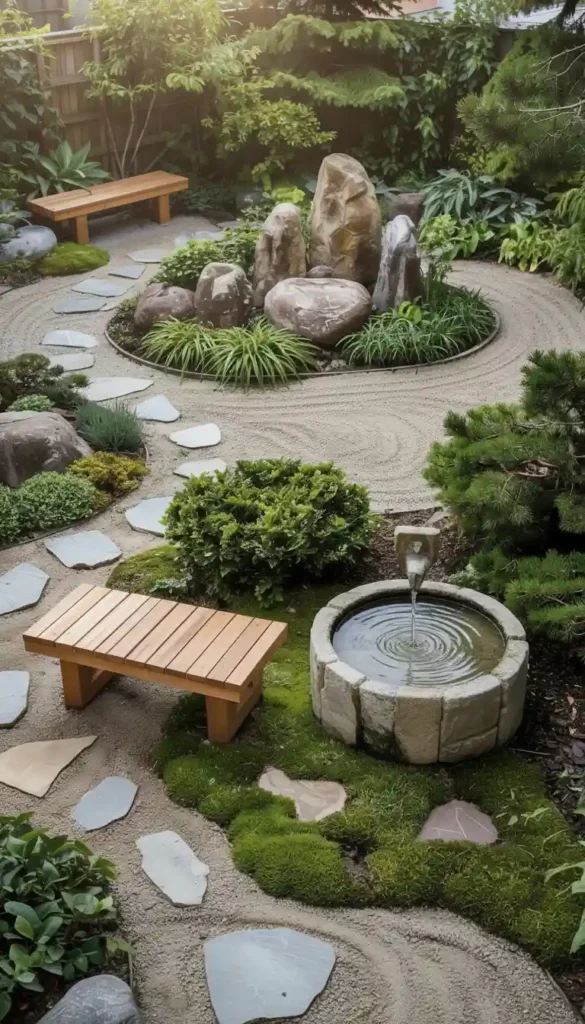
- A stable path — stepping stones that slow your pace and give you somewhere to walk
- A grounded focal point — one stone composition, lantern, or water bowl
- A place to sit — a low cedar bench, a dark metal frame with wood slats, or even a wide flat stone
These three things create a complete, purposeful scene. Resist the urge to add a fourth.
📌 Pin this small backyard Zen strategy! 📌
Add Sound Without the Maintenance Headache
Water features terrify people because they imagine pumps, algae, and weekend repairs. Keep it simple:
- A compact recirculating fountain or stone basin with a hidden submersible pump
- No pond, no waterfall, no complex plumbing
- The sound of water covers street noise and makes the garden feel twice its size
- In cold climates, drain it for winter — takes 20 minutes
Use Negative Space Like a Design Tool
This is the concept that separates a pretty backyard from a Zen retreat.
- The open gravel areas are not “empty” — they are breathing room that makes your focal point feel significant
- Resist the urge to plant in every gap
- A wide gravel expanse with one well-placed stone grouping is more powerful than a bed packed with plants
- Ask yourself before adding anything: does this addition make the whole stronger, or just busier?
Plant With Control, Not Collection
Your planting plan for a small backyard should be written in three lines:
- One evergreen structure (upright, architectural shape)
- One mounding or textural shrub (lower, softening)
- One groundcover (moss-like, fine-textured)
That is the whole plant palette. One seasonal accent — a single grass or a compact Japanese maple in a container — can rotate through, but the base stays the same year-round.
Lighting for Evening Calm
- Low-glare path lights along stepping stones
- One soft spotlight aimed at the focal stone grouping
- Warm white only — cool light breaks the mood completely
- Solar options work well here; no electrician required
📌 Save this backyard transformation guide! 📌
The Maintenance Plan That Actually Works
The garden only stays beautiful if you maintain it without dreading the task.
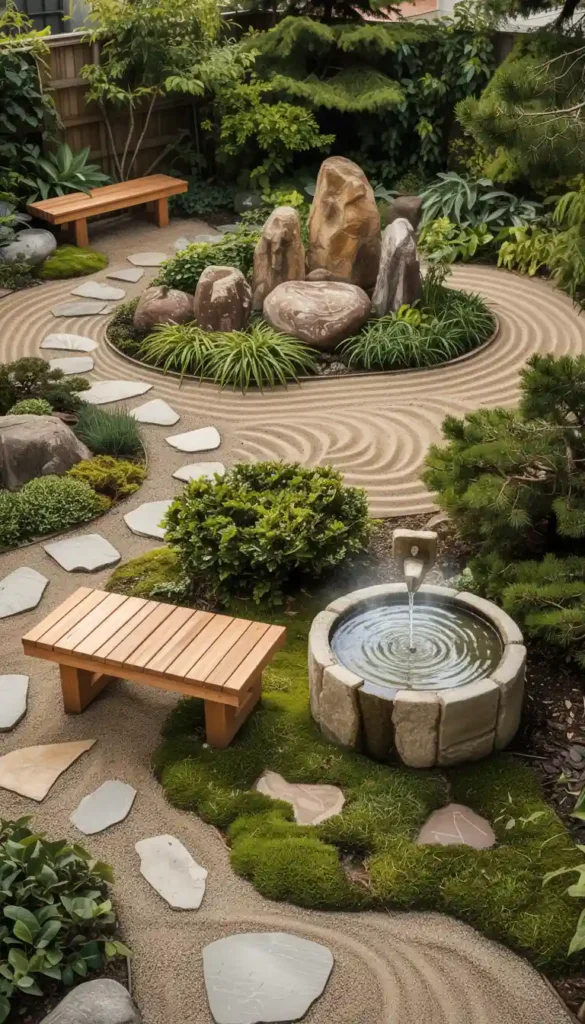
- Rake gravel patterns once a week — takes five minutes and becomes a calming ritual
- Prune evergreens for shape twice a year, not for size
- Clean the water basin monthly
- Edge the gravel border whenever it looks soft — this single task keeps the whole design looking sharp
Japanese Garden Ideas DIY for Small Spaces and Narrow Side Yards — Budget-Friendly Builds With Big Impact
The DIY version of a Japanese garden is not a compromise. Done with intention, it can be more authentic than a professionally installed landscape because you choose every element, place every stone, and understand every decision. The process itself becomes part of the practice.
Narrow side yards and tight corners are actually ideal for this approach because the small scale makes decisions easier and mistakes cheaper.
Treat the Space Like a Composed Room
Before any digging starts, think of your narrow or small area as a room with walls, a floor, and a focal point.
- The fence or hedge is your wall — keep it consistent and simple
- The ground plane is your floor — choose one material and commit
- The focal point is your artwork — one element that earns the viewer’s attention
- Every other addition is furniture — useful, placed with purpose, removable if needed
The Fastest DIY Wins
If you want visual impact this weekend, these three projects deliver:
- Gravel ground plane with edging: Clear the area, lay weed barrier, install edging, pour gravel. One weekend, completely transforming results.
- Stepping stone path: Set flat stones into the gravel at a comfortable stride distance. Immediately makes the space feel designed.
- Bamboo or slatted screen panel: Mount one panel as a backdrop. Suddenly the garden has depth and enclosure.
These three steps cost very little but completely change how the space feels.
📌 Pin this DIY Zen garden starter guide! 📌
Narrow Side Yard Specific Strategy
Narrow spaces — those passages between houses, along fence lines, under eaves — have unique design rules:
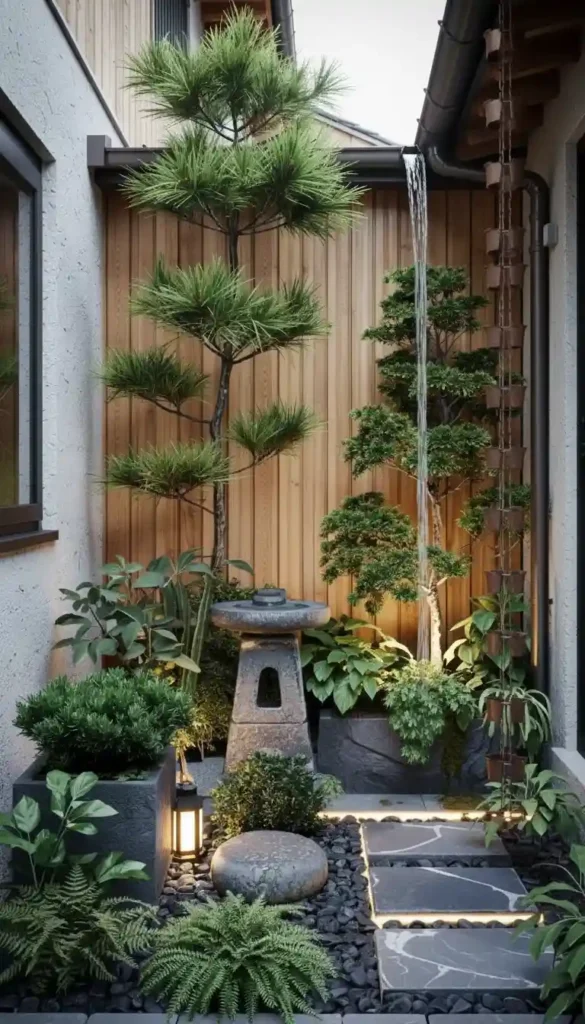
- Use one side as a continuous texture (gravel or dark pebbles) to visually widen the corridor
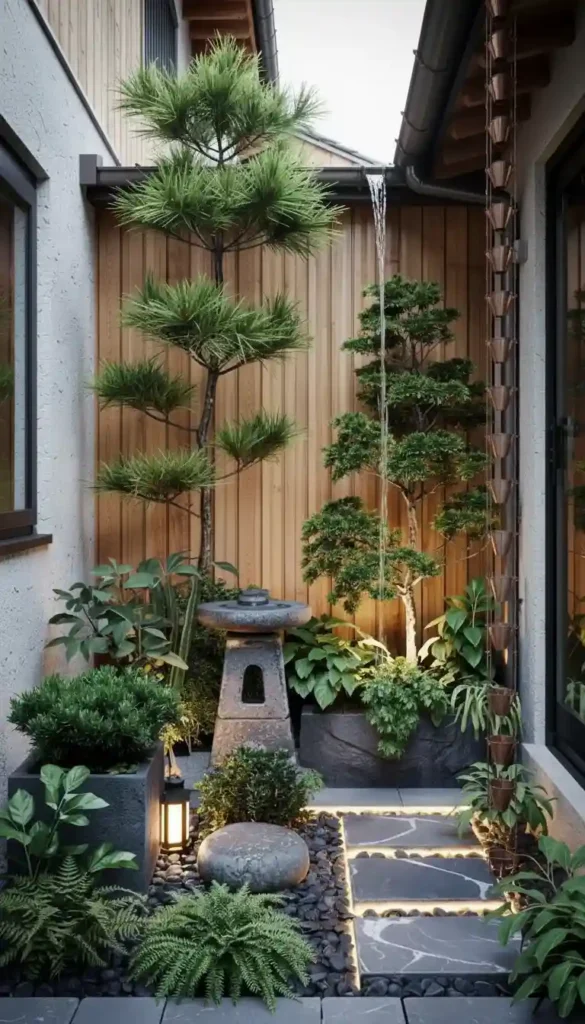
- Keep plants upright and controlled: clumping bamboo in containers, narrow evergreens, pruned shrubs
- Avoid large curves that waste usable area — use gentle angles instead
- A linear path of stepping stones set into gravel lengthens the space visually
- One focal moment at the far end — a water basin, a stone, a small lantern — gives the eye a destination
Recommended path dimensions: Stepping stones at 18–24 inches on center, path width 24–30 inches minimum for comfortable walking.
Slim Elements That Pack a Strong Japanese Cue
You do not need bulk to signal Japanese design. These lightweight elements do the work:
- A narrow bamboo water spout over a stone basin
- A compact cedar screen (2–3 feet wide) as a vertical accent
- A single stone lantern — small scale, placed precisely
- A modular planter with one evergreen and one groundcover
Borrowing Scenery in a Tiny Space
Even in a narrow yard, there is usually something worth borrowing: a mature tree beyond the fence, a textured wall, the sky above.
- Orient your focal point so borrowed scenery sits in the background
- Use a partial screen with a deliberate opening — it creates mystery and pulls the eye through
- Frame the view, do not just block the neighbors
Budget Material Swaps That Still Look Authentic
- Pea gravel instead of specialty Japanese stone
- Cedar instead of exotic hardwood
- Standard timber for edging instead of cut stone borders
- Salvaged flat pavers as stepping stones
- Bamboo screening panels instead of custom fencing
Drainage and Safety Checklist for Small Builds
- Check that gravel areas drain away from the house foundation
- Stepping stones must be stable — no wobble, ever
- On balconies and rooftops, confirm weight limits before adding stone or large planters
- Use weed barrier consistently — skipping it is the most common regretted shortcut
📌 Save this narrow side yard solution! 📌
Build in Stages, Not All at Once
The garden that looks best after two years is the one built carefully over two years.
- Stage 1: Ground plane, edging, path
- Stage 2: Focal stone or lantern, screen or bamboo fence
- Stage 3: Plants, water element, lighting
This sequence keeps the design readable at every stage and prevents over-decoration. It also lets your budget breathe.
Japanese Garden Ideas for UK Climate — Designing for Rain, Grey Skies, and Real British Gardens
Here is what nobody says loudly enough: the UK climate is actually perfect for Japanese garden design. Rain deepens the color of stone. Damp air makes moss lush. Grey skies make gravel glow. The Japanese aesthetic was built around an acceptance of weather, not a fight against it. British gardeners just need to stop apologizing for the rain and start designing for it.
Start With Structure, Not Flowers
UK gardens that try to follow a flower-forward Japanese style always look good in June and abandoned by November. Flip the approach entirely.
- Design with hardscape first: gravel, stone paths, edging, screens
- Choose evergreen structure as your plant backbone
- Add seasonal accents as a secondary layer, not the star
- The garden should look intentional on a grey January day — that is your design standard
Plant Palette for UK Conditions
These plants give Japanese garden character and actually thrive in British weather:
- Hardy evergreens: Dwarf conifers, clipped box alternatives, Sarcococca, Skimmia
- Ferns: Dryopteris, Polystichum — they love shade and moisture
- Grasses: Hakonechloa (Japanese forest grass), Carex — movement without fuss
- Groundcovers: Moss (naturally occurring), Ajuga, Pachysandra
- Bamboo: Fargesia varieties (clumping, non-invasive, fully hardy)
📌 Pin this UK Japanese garden plant guide! 📌
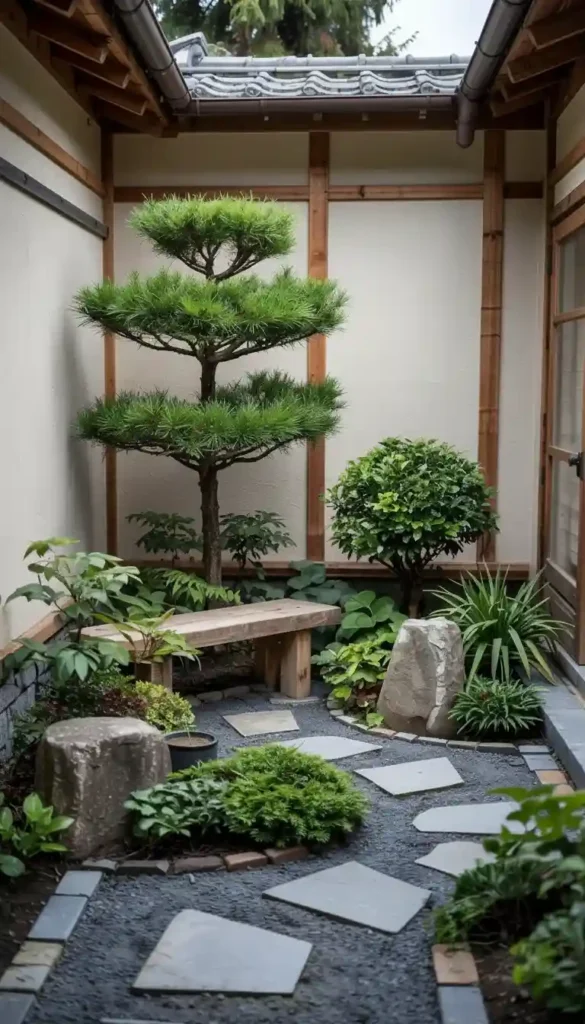
Materials That Hold Up in Wet Conditions
Choosing the wrong materials in a damp climate means replacing everything in three years.
- Paving: Frost-safe natural stone or porcelain — avoid cheap imported sandstone that flakes
- Timber: Treated softwood, cedar, or charred wood (Shou Sugi Ban) for screens and benches
- Bamboo fencing: Choose rigid bamboo panels over loose rolled canes — they last longer in wet conditions
- Stone edging: More durable than timber in consistently damp soil
Water Features in UK Gardens
The good news: water features look spectacular in British gardens. The practical reality:
- Use a recirculating pump system — no mains water connection needed
- Make sure the pump is easy to access for annual cleaning
- Install an easy-to-reach shutoff for winter — water features that freeze crack stone basins
- Choose a frost-resistant basin material: granite, cast stone, or glazed ceramic
Designing for the View From Inside
In the UK, you will spend more time looking at the garden through a window than sitting in it. Design for that reality.
- Identify the key window — kitchen, living room, or study
- Place the focal point in direct sightline from that window
- Keep the foreground simple so the main feature reads clearly from 20 feet away
- Evergreen structure means the garden is always composed, not just in growing season
Algae and Moisture Management
Damp conditions mean algae on stone and stone basins. Here is how to manage it:
- Seal stone surfaces with a breathable stone sealer — slows algae without changing the look
- Annual brush-down with a diluted white vinegar solution keeps stone clean naturally
- Keep water moving in basins — static water encourages growth
- A gravel strip at the base of fences and walls prevents soil splash staining
Wind Protection for Exposed Uk Sites
Many UK gardens — especially rooftops, coastal sites, and open suburbs — need wind planning:
- Use dense evergreen planting as a primary windbreak (Eleagnus, Yew, Prunus laurocerasus)
- Timber screens with horizontal slats filter wind better than solid panels
- Bamboo fence panels need a solid timber frame to resist British winter gusts
- A simple canopy or pergola over a seating area extends usable time by months
📌 Save this UK weather-ready Zen garden approach! 📌
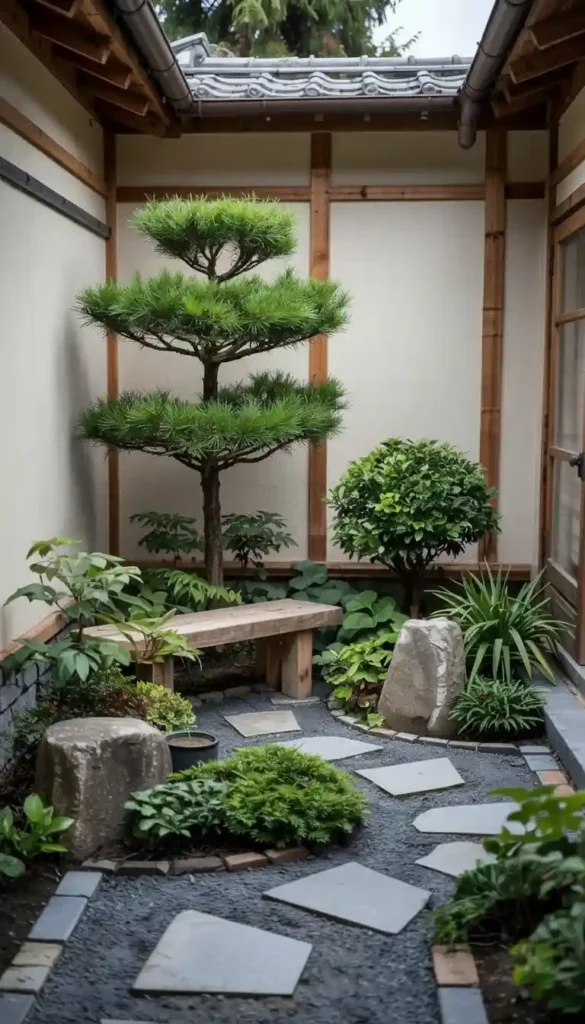
The Rain-as-Asset Mindset
The most experienced UK garden designers all say the same thing: design for rain, not despite it.
- Wet stone changes color and reveals texture — choose stone that looks better damp
- Raked gravel patterns become more defined and crisp when damp
- Moss fills in naturally in shaded damp areas — let it, it is a gift
- A garden that holds up in November is a garden you will be proud of in June
Japanese Garden Ideas for Front Yard and Zen Moon Gate — Creating Arrival, Privacy, and Powerful First Impressions
Your front yard is doing a job every single day whether you designed it or not. Right now it is probably giving an impression you did not intend. A Japanese-inspired front yard — disciplined, calm, and quietly beautiful — changes the experience of arriving home. And nothing does that more dramatically than a well-placed Zen moon gate.
Design for First Impressions and Daily Maintenance
The front yard has one rule that the backyard does not: it has to look good every single day.
- Choose plants that are evergreen, slow-growing, and easy to prune for shape
- Avoid anything that drops messy leaves near a gravel entry
- The composition should look complete in every season, not just peak summer
- Every material must be durable and easy to clean
The Front Yard Layout That Works Every Time
This layout works for narrow townhouse frontages and wider suburban entries:
- Ground plane: Gravel or dark mulch — easier than lawn, always looks sharp
- Entry path: Stepping stones or large flat pavers leading clearly to the door
- Focal point: One boulder, one compact lantern, or one sculptural tree near the walkway turn
- Screening layer: Low vertical wood slats, clipped shrubs, or a slim bamboo panel to hide bins and utilities
📌 Pin this front yard Japanese garden layout! 📌
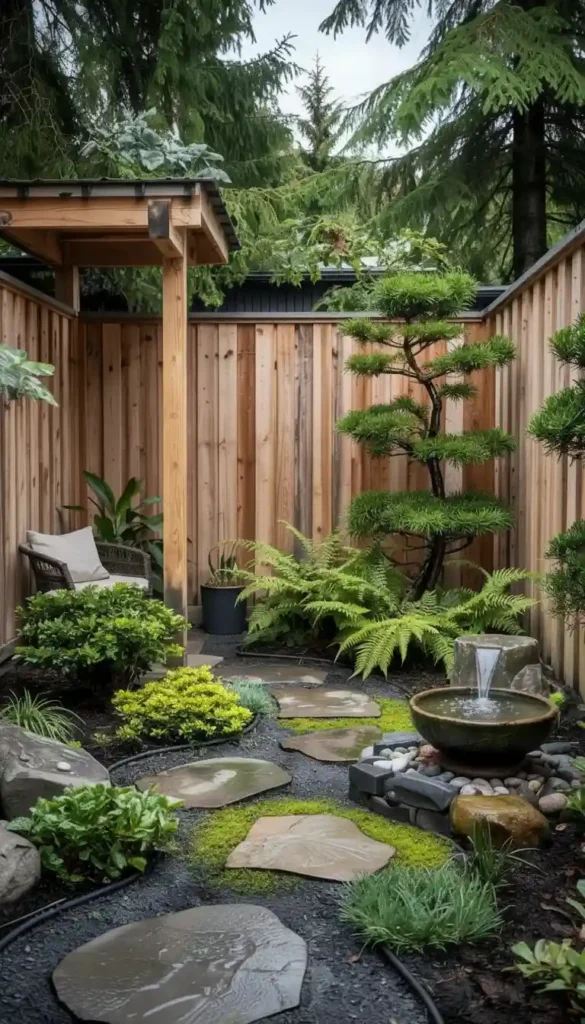
Layered Planting for Curb Appeal
Even in a small frontage, three plant layers create a professional result:
- Low layer near the sidewalk: Groundcover or low mounding shrubs (Ophiopogon, Ajuga, compact Festuca)
- Mid layer: Medium compact shrubs pruned for shape (dwarf Pieris, Skimmia, slow-growing Euonymus)
- Hero layer: One sculptural tree — a Japanese maple where climate allows, or a cloud-pruned evergreen alternative
The Zen Moon Gate — What It Is and Why It Works
A moon gate is a circular opening in a wall or screen that frames a view and signals a transition into a quieter space. Even in a small garden, it is one of the most powerful design moves available.
- Positions you as the viewer before you even step through
- Creates a moment of pause — you slow down, look through, then walk
- Makes the space beyond feel like a destination
- Works in front yards to frame an entry path, in backyards to separate zones
Why it works psychologically: The circular frame focuses attention and creates anticipation. Your brain shifts gear before your body does.
Designing a Moon Gate That Works in Your Space
- Proportion is everything: The opening should be wide enough to walk through comfortably — minimum 30 inches clear width
- Material options: Rendered masonry wall (classic), dark-stained timber frame (modern), prefab steel ring insert into a timber panel (budget-friendly)
- What to place beyond it: Keep the scene simple — one stone composition, a small tree, or a water bowl. The frame adds drama; the scene should be quiet.
- Lighting: A soft ground light grazing the curve makes it sculptural at night — one fixture, low glare
Planting the Moon Gate Surround
The planting around a moon gate should support the opening, not compete with it:
- Keep plants low and controlled on either side — the circular opening must remain the hero
- One small evergreen (compact Fatsia, Sarcococca, or a clipped sphere) on each side
- A soft groundcover at the base to frame the structure
- Avoid climbers that will obscure the circle
Modern Front Yard Finish Details
Curb appeal at a professional level comes down to these specifics:
- Stepping stones set into gravel — not wobbling, not raised — flush and stable
- Gravel properly contained with steel or stone edging, never spilling onto paving
- One lighting element near the focal point — warm white, low glare
- Dark gravel + pale stepping stones + warm wood = the most consistently elegant modern palette
📌 Save this moon gate and front yard design strategy! 📌
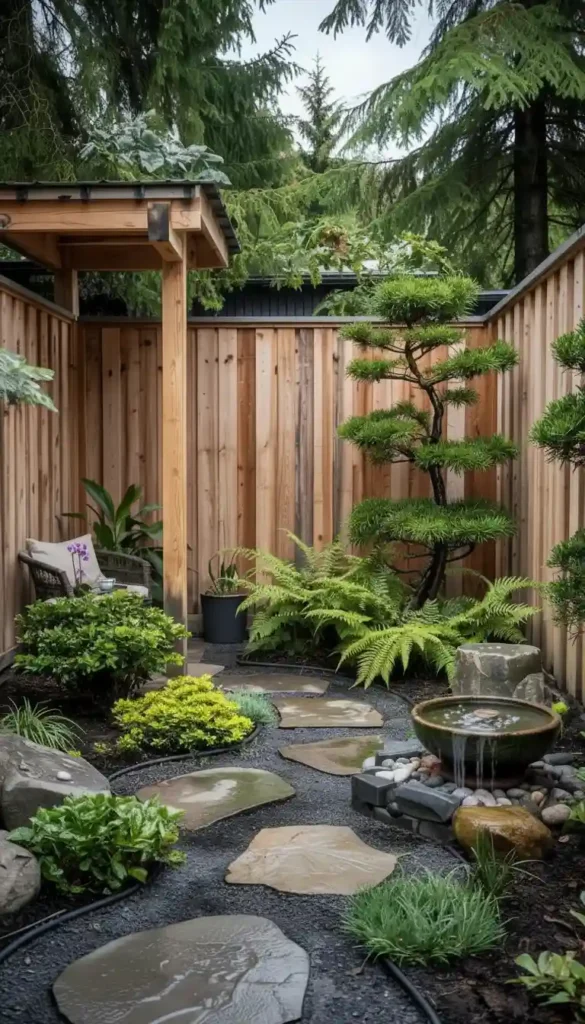
Practical Notes on Fencing, Screening, and Local Rules
Before building any front yard screen or moon gate structure:
- Check local height regulations for front yard fencing — these vary significantly by municipality and HOA
- A partial screen (not a full enclosure) typically avoids permit requirements
- Bamboo fence panels used as a backdrop behind planting rarely trigger restrictions
- If in doubt, keep the structure under 3 feet in the front yard setback zone
Modern Japanese Garden Ideas, ACNH-Inspired Layouts, and Bamboo Fence Design — Complete Zen Style for 2026
This final section brings together three ideas that are defining Japanese garden design in 2026: the shift toward clean modern minimalism, the influence of Animal Crossing’s layout clarity, and the remarkable versatility of bamboo fence design. Together, they form a design language that is fresh, functional, and unmistakably Zen.
Modern Japanese Garden Design — Minimalism Meets Outdoor Living
The modern Japanese garden in 2026 is not trying to recreate a traditional temple garden. It is taking the principles — restraint, negative space, intentional placement — and applying them to contemporary architecture and daily life.
- Strong geometry: rectangular gravel courts, floating deck sections, large-format pavers
- Limited palette: two stone types maximum, one wood tone, one plant texture category
- One hero feature only: a single boulder, one lantern, or one tree with sculptural branching
- Everything else is in service to that one feature
The biggest modern mistake: adding too many statement pieces. Pick one. Make it count.
The Modern Material Palette for 2026
These combinations are producing the strongest modern Japanese results right now:
- Dark palette: Black/charcoal gravel + pale limestone stepping stones + charred timber screen
- Warm palette: Honey-toned cedar + buff gravel + grey granite boulders
- Cool palette: White gravel + concrete pavers + matte black metal screens + dark green evergreens
Choose one palette and apply it everywhere. Consistency is what makes a garden look designed.
📌 Pin this 2026 modern Japanese garden palette guide! 📌
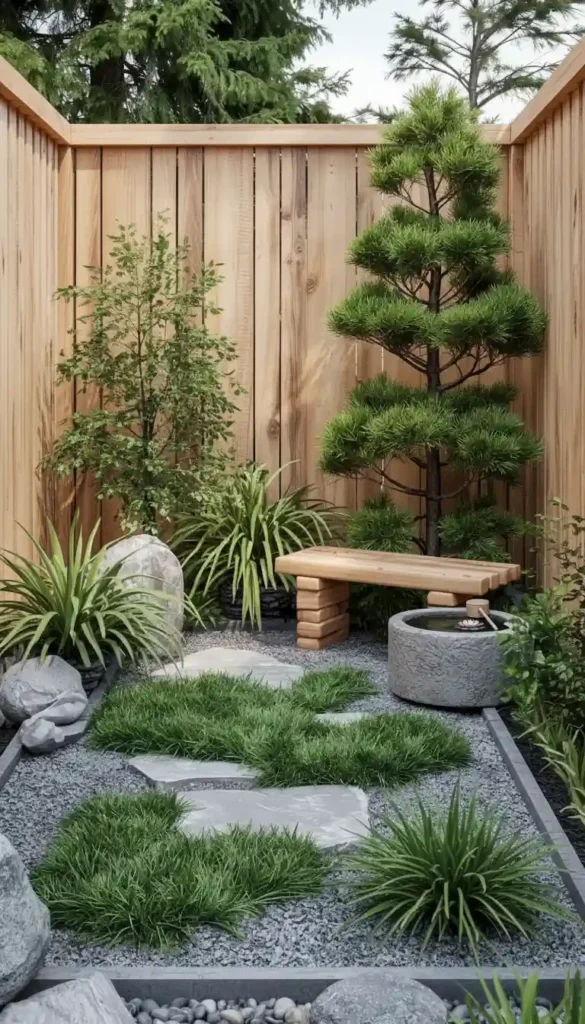
Water Features for the Modern Garden
The traditional koi pond has a modern replacement for smaller spaces:
- Water blade: A thin sheet of water falling into a rectangular basin — sleek, contemporary, no pond needed
- Wall-mounted spout: A simple bamboo or copper spout into a stone basin
- Rectangular reflecting basin: Still water reflecting the sky — simple, powerful, very easy to maintain
- All of these work on balconies, rooftops, and small courtyards
Animal Crossing — How ACNH Layout Logic Makes Real Gardens Better
If you have played Animal Crossing: New Horizons, you already understand something about Japanese garden design that most adults forget: clarity is beautiful. The game’s island aesthetic — clear paths, repeated textures, small composed vignettes — is essentially Japanese garden design made approachable.
The translation to real life is more direct than you might think:
- Tile logic: Think of your garden in zones, like the game’s grid. Each zone has one purpose and one aesthetic.
- Path logic: Every path goes somewhere. It is not decorative — it has a destination.
- Vignette logic: Three elements make a scene: a surface, a focal object, and one plant. That is all.
- Repetition logic: Repeat the same stone, same plant, same timber to create cohesion — just like placing the same custom pattern across your island
Building the ACNH-Inspired Real Garden
Start with what makes ACNH designs satisfying — clarity, neatness, discovery — and build that in real materials:
- Stepping stone path in decomposed granite, spaced at comfortable stride distance
- Bamboo fence or short screen panels creating distinct “rooms” — a tea corner, a gravel Zen area, a seating spot
- Stone lantern as the real-world version of the iconic in-game item
- Low bench facing a stone grouping — the reward at the end of the path
What to avoid: Novelty items, themed ornaments, anything that looks like it came from a garden center clearance rack. The game’s charm is in its restraint, not its decoration.
Planning Like ACNH: The Grid Method
Before you move a single stone, do this:
- Sketch your space on grid paper — one square equals two feet
- Mark zones: path zone, gravel zone, planting zone, seating zone, focal feature zone
- Look at it from above — if it reads clearly on paper, it will read clearly in the garden
- Remove one zone. Then look again. Often the garden gets better when you take something away.
📌 Save this ACNH-inspired garden planning method! 📌
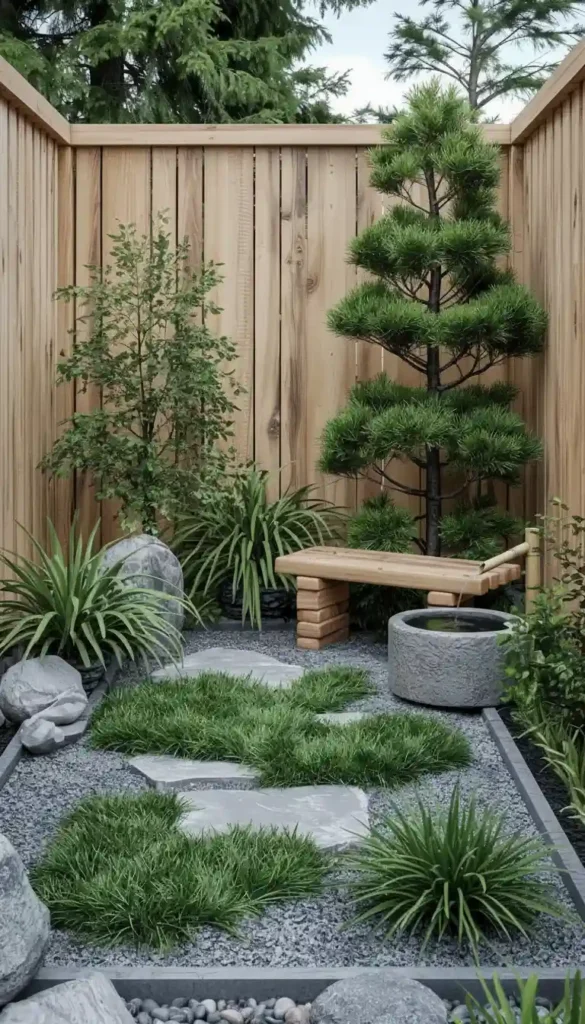
Bamboo Fence Design — Natural Privacy That Elevates Everything Around It
A bamboo fence is not just a boundary. It is a backdrop, a texture, a mood-setter. Get the bamboo fence right and everything in front of it looks better. Get it wrong and it undermines the whole garden.
The key decisions:
- Panel vs. individual cane: Rigid bamboo panels are faster, more consistent, and more durable. Individual cane with twine lashing is more traditional and allows custom sizing.
- Frame matters more than the bamboo: A solid timber frame keeps the fence straight, resists wind, and makes it look professional. Skimping on the frame is the most common DIY mistake.
- Post depth: Set posts at least 18 inches deep in stable soil, 24 inches in loose or sandy ground.
- Cap rail: A horizontal cap rail prevents rain from sitting on top of the bamboo, which is the primary cause of premature degradation.
Bamboo Fence in Different Spaces
- Backyard privacy screen: Full-height panels on a solid frame, gravel strip at the base to prevent mud splash
- Small corner backdrop: One or two panels creating a backdrop for a stone lantern or water basin
- Narrow side yard: Slim slatted fence that filters light and adds privacy without making the corridor feel closed
- Balcony or rooftop: Panel system with secure structural fixings — wind loading on elevated structures is significant
Bamboo Fence Maintenance That Keeps It Looking Great
Most bamboo fences fail not because bamboo is weak, but because maintenance is skipped.
- Seal the bamboo with a UV-resistant exterior oil or sealer annually — this one step doubles lifespan
- Keep the base clear of soil contact and leaf debris
- In the UK and damp climates, seal end grain before installation — this is where moisture enters fastest
- Expected lifespan with good maintenance: 10–15 years for quality panels
Night Lighting for Bamboo Fence and Modern Gardens
The evening version of your Japanese garden can be its best version:
- Low warm path lights aimed at the fence texture — not the sky
- One uplight on the focal tree or boulder — single fixture, positioned to create shadow play
- Avoid bright fixtures completely — the goal is glow, not illumination
- Solar options are improving fast; for key focal lighting, use low-voltage wired fixtures for reliability
Conclusion
You started reading this because something in you already knows what calm feels like and wants more of it. A Japanese garden is not a style trend. It is a decision to surround yourself with intention — to choose what stays and what goes, to let space breathe, and to find beauty in simplicity. Whether you build a full backyard Zen retreat or just lay a stepping stone path through a corner you have been ignoring, you are making that choice.
Start with one section. One material. One focal point. Do it carefully and do it well. The garden will teach you the rest. And every morning you step outside — or just glance through the window — you will feel exactly what you came here looking for.

“I share simple, beautiful and affordable home decor ideas to help you style every corner of your home with ease.