

You stepped outside last summer and felt it — that quiet frustration. The yard was there, but nothing worked. The kids were tripping over patio chairs. The grill was jammed in a corner. There was nowhere to just sit and breathe. You wanted a space that felt like home, but it felt like a jumble of good intentions that never came together.
That feeling is more common than you think. Most families don’t need more space — they need a smarter layout. In 2026, the best backyards aren’t the biggest ones. They’re the ones designed around real life: morning coffee, after-school chaos, weekend barbecues, and quiet evenings. This guide gives you five practical, beautiful layout ideas that actually work for modern families — no matter how big or small your yard is.
The Modern Outdoor Room Layout: Treat Your Backyard Like an Interior Space
The biggest mistake families make is designing the backyard as an afterthought. The most functional yards in 2026 are designed exactly like indoor living rooms — with clear zones, defined furniture arrangements, and intentional flow from the house outward.
Think of your back door as the front door to a second living room. Everything you place outside should serve that idea.
Start With Sightlines From the House
Before you move a single piece of furniture, stand at your back door or kitchen window and look out. What do you see? What do you want to see?
- Identify the two or three main views from inside the house
- Design the yard so those views land on something beautiful and organized
- Avoid placing clutter, storage sheds, or play equipment directly in the primary sightline
- Use a focal point — a pergola, a fire feature, or a statement planter — to anchor the view
This single step transforms how the yard feels, even before you change anything physically.
Create One Unified Outdoor Room
The goal is to make the yard read as one cohesive space, not a collection of random items.
- Stick to two hardscape materials maximum (example: concrete pavers plus gravel, or wood decking plus brick border)
- Choose one main wood tone for furniture and structures
- Use the same or complementary colors across cushions, planters, and accessories
- Avoid mixing too many styles — pick modern, farmhouse, coastal, or transitional and commit
When the finishes are consistent, even a modest yard looks polished and intentional.
Position Zones by Frequency of Use
The closer something is to the back door, the more you’ll use it. That’s just human nature.
- Place your primary seating zone directly off the door — within 10 to 15 feet
- Put the dining and grill area on the same level as the house when possible
- Push louder activity zones (play areas, trampolines, ball games) to the far end of the yard
- Keep a clear, debris-free path connecting all zones
This arrangement means daily use requires zero effort. You open the door and you’re already there.
📌 Pin this outdoor room layout strategy! 📌
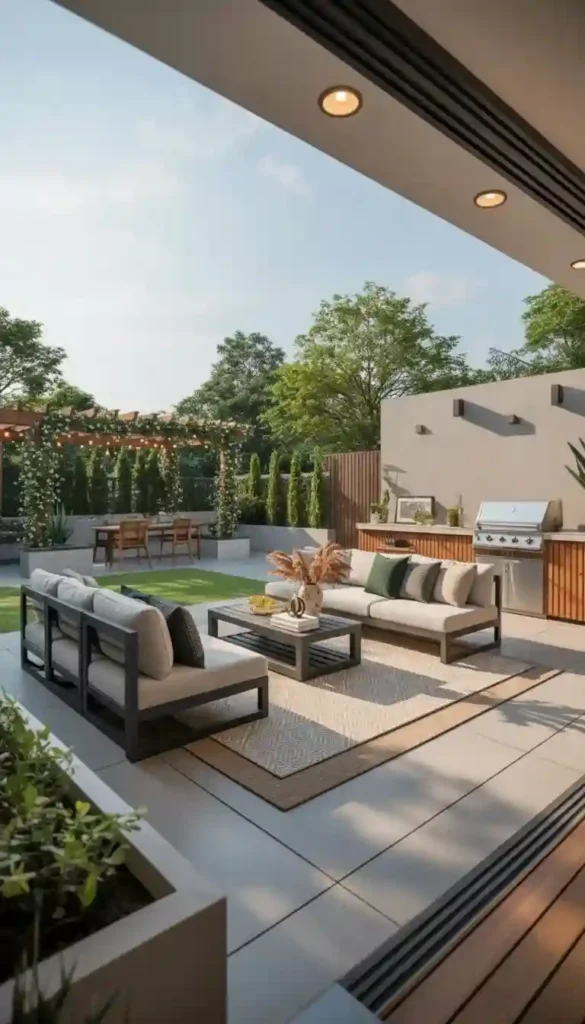
Choose the Right Furniture for Flow
Low-profile furniture keeps the yard feeling open and spacious, even in smaller lots.
- Use a modular outdoor sectional as the anchor — it can be rearranged for different occasions
- Add a small dining set that expands when needed and contracts for everyday use
- Include at least one nesting or folding coffee table for flexible surface space
- Choose stackable chairs so you can clear space quickly
Avoid bulky, oversized pieces that block sightlines or force people to walk around them constantly.
Define Zones Without Hard Walls
You don’t need fences or walls to create separation between zones.
- Use planters as natural dividers between the lounge and play area
- Install slatted privacy screens to buffer the seating zone from windy sides
- Use a pergola or narrow awning to define the lounge without adding visual weight
- Change the paving material at zone transitions — it signals a shift without a physical barrier
This approach keeps the yard feeling open while giving each area its own identity.
Light Every Zone With Purpose
Lighting is what makes a backyard usable after 6 p.m. — and most families skip it entirely.
- Use path lights along walking routes for safety
- Add warm ambient string lights or lanterns in the seating area
- Install a task light near the grill — something bright enough to see what you’re cooking
- Use solar-powered stake lights in garden beds for low-maintenance glow
Zone your lighting just like you zone your space. Different areas deserve different moods.
Add a Designated Drying and Drop Zone
This is one of the most underrated additions to any family backyard.
- Set up a small area near the door with hooks for towels, hats, and bags
- Add a bucket or bin for pool floats, wet gear, and muddy shoes
- Install a weatherproof storage cabinet or bench for outdoor dishes and games
- Include a hose station or outdoor spigot nearby for quick rinse-offs
When wet and dirty items have a designated home, they stop migrating into the house.
📌 Save this family-friendly outdoor room guide! 📌
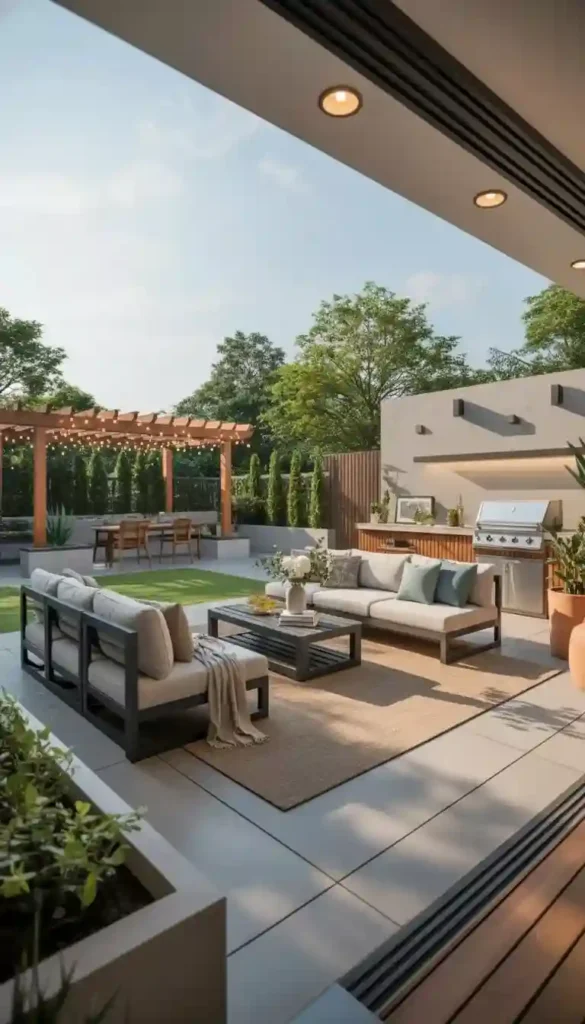
The Core Principle
A modern outdoor room layout works because it eliminates decisions. When every zone has a purpose and a clear boundary, families stop avoiding the yard and start defaulting to it. The yard becomes part of the home — not a project waiting to happen.
The Three-Zone Functional Layout: Active, Social, and Service
The most practical backyard layout for families with kids is built around three distinct zones: a zone for active play, a zone for social living, and a zone for service and storage. When these three areas are clearly defined and properly placed, the yard runs itself.
This isn’t complicated. It’s just intentional.
Zone One: Active Play Area
The active zone is where energy lives. It’s where kids run, jump, tumble, and spend most of their time outdoors.
- Place this zone at the far end of the yard, away from the house
- Use soft surfaces: synthetic turf, rubber play tiles, or deep wood mulch
- These materials are comfortable on bare feet, safe for falls, and easy to maintain
- Add a low weatherproof toy box or storage unit so cleanup takes 60 seconds, not 20 minutes
Keep the surface consistent within this zone so it reads as one defined area, not a scattered mess.
Why Soft Surfaces Matter
Hard surfaces like stone or concrete are beautiful — but not in a play zone.
- Rubber tiles absorb impact and reduce injury from falls
- Synthetic turf stays green and clean year-round without watering or mowing
- Deep mulch (4 to 6 inches) is the most budget-friendly soft option
- All three options drain well and dry faster than grass after rain
Choosing the right surface here is one of the most safety-conscious decisions you’ll make.
Zone Two: Social Living Area
This is your outdoor living room. It’s where adults sit, eat, talk, and watch the kids from a comfortable distance.
- Place this zone closest to the back door for easy access
- Anchor it with a dining table that expands for guests and contracts for weekday dinners
- Include comfortable seating — deep cushions, not just chair-style outdoor furniture
- Use a sturdy outdoor rug to define the space and soften the hard surface underfoot
The social zone should always have a clear sightline to the active play zone. You should be able to sit and watch without craning your neck.
📌 Pin this three-zone family backyard plan! 📌
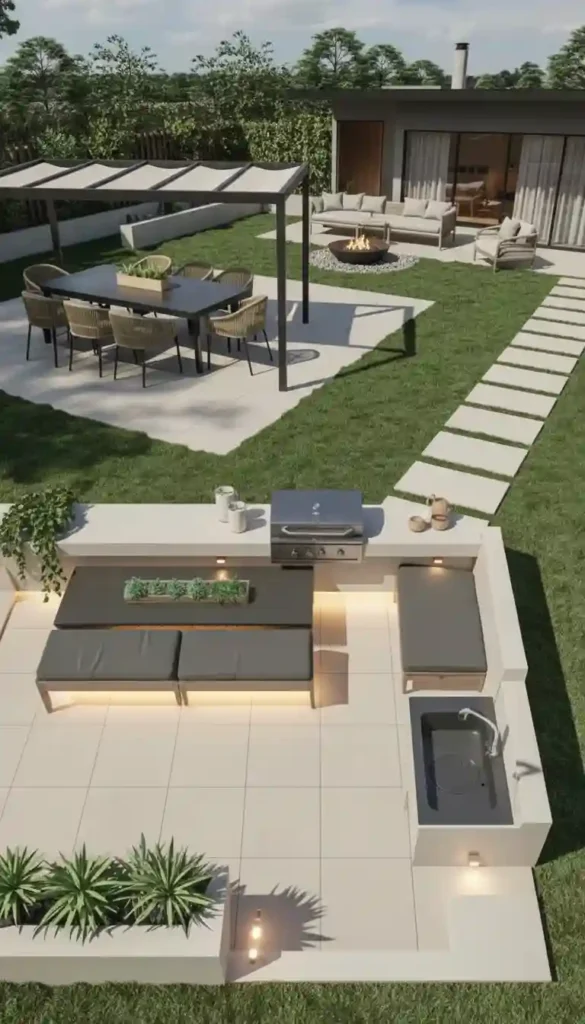
The Dining Setup That Actually Works
Most outdoor dining tables are either too big or too rigid for everyday family life.
- Choose a table with a leaf insert so it fits four on weekdays and eight on weekends
- Look for chairs that stack or fold — they’re practical and storage-friendly
- Add a side surface near the grill: a prep counter, a small cart, or even a built-in ledge
- Keep the grill on a straight wall run with weatherproof storage for tools and fuel
The grill and dining table should be close but not cramped. Aim for 5 to 6 feet of clearance between the two.
Zone Three: Service and Storage
This zone is the unsung hero of a functional backyard. Without it, everything ends up everywhere.
- Place a slim shed or storage wall along a fence line — out of sightlines but easy to access
- Include a concealed storage bench in the social zone for cushions and small items
- Add a narrow cabinet for outdoor games, sports gear, and lawn tools
- Install a hydration point: a small outdoor sink, a hose station, or even just a spigot with good drainage
When storage is built into the layout from the start, the yard stays organized without any extra effort.
Create a Noise Buffer Between Zones
Sound travels, especially with kids. A screaming match under the trampoline sounds different from 50 feet away versus 10 feet away.
- Use tall grasses, thick shrubs, or nontoxic hedges as a natural sound buffer
- A low fence section between the social and active zones adds physical separation without blocking visibility
- Avoid placing loud equipment (trampolines, ball play areas) directly next to the seating zone
- The buffer doesn’t need to be tall — even 3 to 4 feet of planting absorbs a surprising amount of sound
This small investment in greenery pays dividends in adult sanity every single weekend.
The Circulation Path Is Everything
The biggest mistake in backyard layouts isn’t the zones — it’s how you move between them.
- Map out the three most common daily paths: door to grill, door to seating, door to play area
- Make sure these paths never force anyone to walk through the active play zone
- Create one main circulation loop that connects all three zones without dead ends
- Clear this path of toys, furniture legs, and tripping hazards — it should feel automatic
When the path feels natural, the yard gets used more. When it feels awkward, people stop going outside.
📌 Save this three-zone backyard layout strategy! 📌
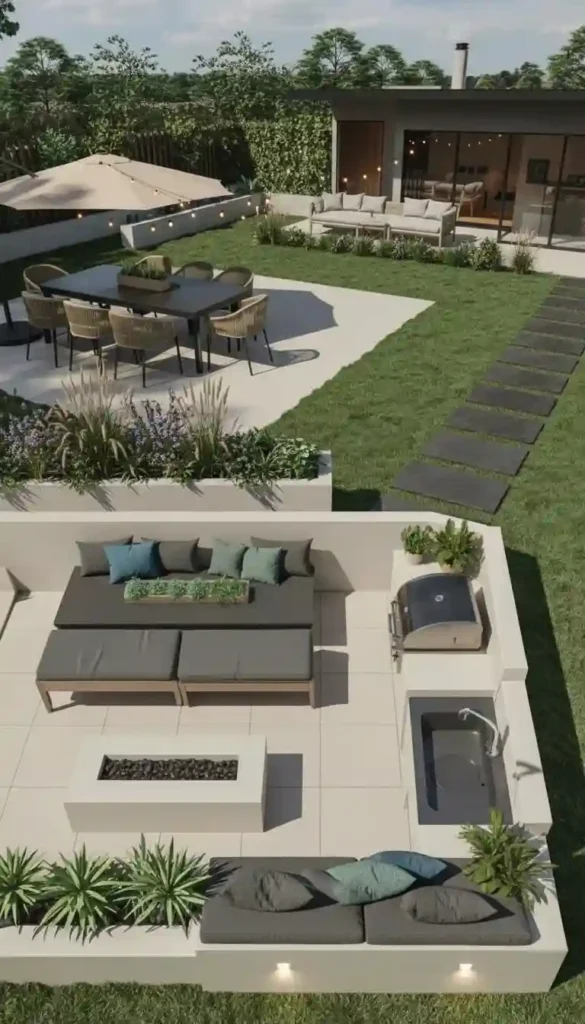
The Core Principle
The three-zone layout works because it handles conflict before it starts. Play doesn’t bleed into dining. Storage doesn’t create clutter. Adults can relax and supervise simultaneously. When the zones are open and well-defined, the whole family uses the yard more — and enjoys it more.
Family Backyard Layouts for Every Property Size
You don’t need a large yard to have a great one. The principles of good layout scale up and down without losing their power. The key is adapting — not copying a large-yard plan into a small space and wondering why it doesn’t work.
Small Yards: Every Square Foot Has a Job
In a compact yard, multi-use and vertical are your two best friends.
- Install a built-in bench along a fence line — choose one with a hinged lid for hidden storage
- Use a fold-down dining table mounted to the wall instead of a permanent table that eats up space
- Mount storage for outdoor games, gardening tools, or sports gear on the wall or fence
- Go vertical with planters and trellises to add greenery without sacrificing floor area
The goal in a small yard is to eliminate anything that only does one thing.
The Pergola Trick for Small Spaces
A slim pergola does something remarkable to a small backyard: it creates the feeling of an outdoor room without adding physical walls.
- Even a simple 8-by-10-foot pergola visually stretches the space upward
- It signals to the brain that this is a defined, purposeful area — not just a patio with furniture
- Add string lights overhead for evening use
- Use it to hang a small fan, a pendant light, or a shade sail for sun protection
A pergola is one of the highest-value additions for a small yard, per square foot.
📌 Pin this small backyard layout idea! 📌
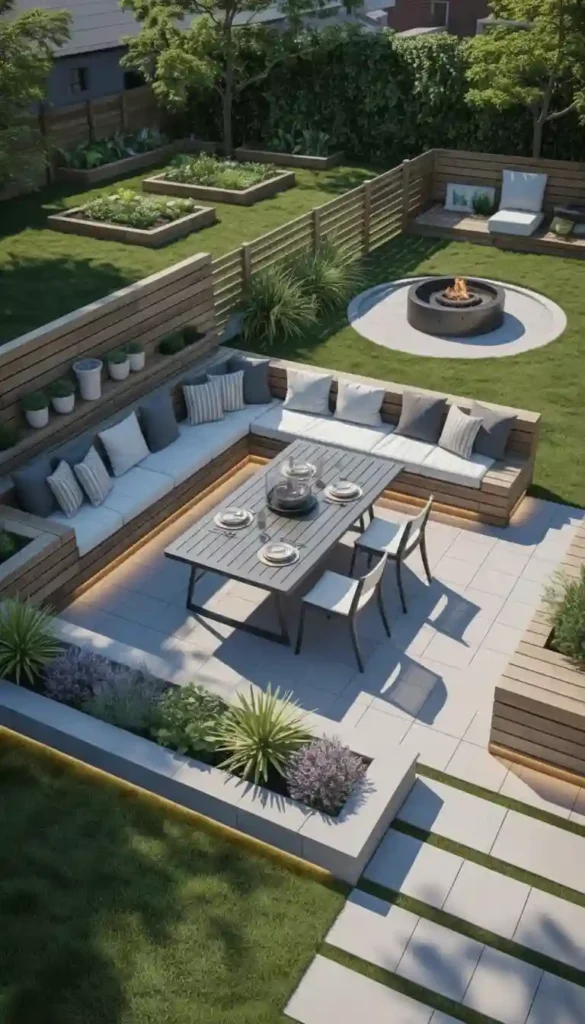
Large Yards: Fill the Distance With Intention
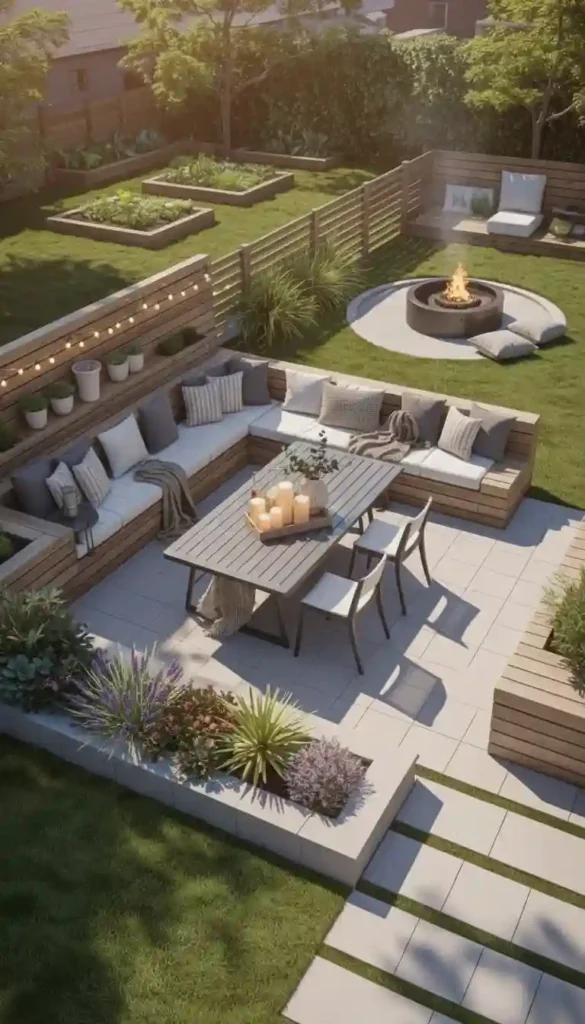
A big yard with too much empty space feels abandoned — not luxurious. The solution is to create multiple destinations, not just one big area.
- Design a primary social zone near the house as your anchor
- Add a second destination farther out: a fire pit circle, a hammock garden, an allee of trees, or a bocce court
- Connect the two areas with a defined path — pavers, stepping stones, or a mown grass strip
- Use raised garden beds in areas that receive eight or more hours of full sun
The second destination gives the yard a reason to walk all the way to the back. It makes the space feel used, not wasted.
Raised Beds for Any Size Yard
If you have full sun, a raised bed garden is one of the most rewarding additions to a family backyard.
- Space beds at least 18 inches apart so they’re easy to water and maintain
- Orient rows to maximize sun exposure — generally north to south
- Use consistent bed heights (12 to 16 inches is ideal for most families) so they look intentional
- Add a small potting surface nearby so garden care feels like part of daily life, not a separate chore
Kids engage with gardens more than almost any other outdoor feature. It teaches patience, responsibility, and the simple joy of growing something.
Use Edging to Keep Play Zones Contained
In any size yard, toys have a way of spreading until they occupy every available surface. Edging solves this.
- Use metal, stone, or rubber edging to create a clear boundary around the play zone
- A change in surface material — like turf inside the boundary and pavers outside — reinforces the zone visually
- When kids know where the play zone begins and ends, they tend to respect it
- Parents spend less time redirecting and more time relaxing
This is a small detail with an outsized impact on daily yard management.
Design Around One Primary Activity
The most successful family backyards are built around one primary activity — not ten.
- If you want a trampoline, plan a minimum 6-foot safety buffer on all sides and position it away from the primary view
- If you want a garden, plan access paths that stay dry and stable after rain — no mud-season closures
- If you want a pool, plan the equipment location before you dig so it doesn’t become an afterthought
- Pick one and design the rest of the yard around supporting it
This focused approach works at every scale. It keeps the layout coherent and prevents the yard from feeling like a catalog of features that don’t belong together.
📌 Save this backyard sizing and zoning guide! 📌
The Core Principle
Whether you’re working with 400 square feet or 4,000, the same idea applies: cluster activity, define zones, and give every area a clear purpose. Scaling a concept is always more effective than forcing a plan that was designed for a different space.
Everyday Living Layout: Designing for Weekday Habits, Not Just Weekend Parties
Most backyard designs are built for the party, not for the Tuesday morning coffee. That’s why so many families end up with beautiful yards they barely use. The everyday living layout flips the priority: design for your most common use cases first, and the weekend will take care of itself.
Think Weekday Habits First
Before you pick furniture or plan plantings, write down what your family does outside on a normal day.
- Morning coffee before school drop-off
- After-school snack in fresh air
- Quick play break before dinner
- A calm seat for reading or decompressing after work
These moments happen more than any party. Design the yard to make them effortless and they’ll happen every single day.
Build the Near-House Zone for Daily Use
The zone closest to the back door is the most important one in any everyday layout.
- This zone should feel like an extension of your living room — comfortable, inviting, and low-setup
- Use deep seating with washable cushion covers so a muddy hand isn’t a crisis
- Add a robust outdoor rug to soften the hard surface and define the space
- Include a sturdy surface that can handle crafts, homework, snacks, and real use
This is not the zone for your best outdoor furniture. It’s the zone for your most-used outdoor furniture.
📌 Pin this everyday backyard living layout! 📌
Prioritize One Shaded Seat
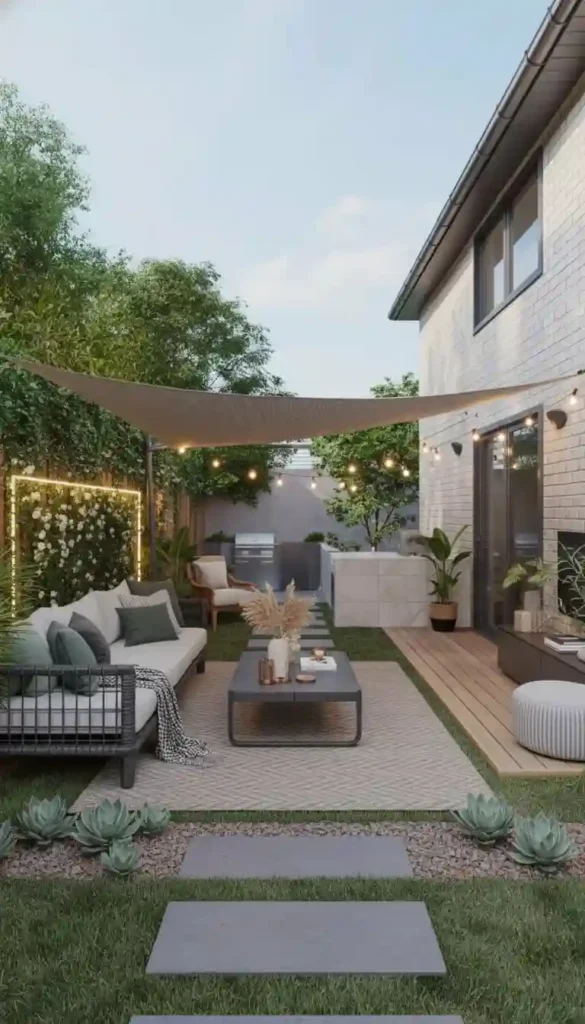
A shaded seat changes everything. If the only comfortable spot in your yard is in direct sun at 3 p.m., you won’t use it.
- Identify when your yard gets the most use — afternoon after school, evening after dinner
- Check your sun path and ensure the main seating zone is shaded during those peak hours
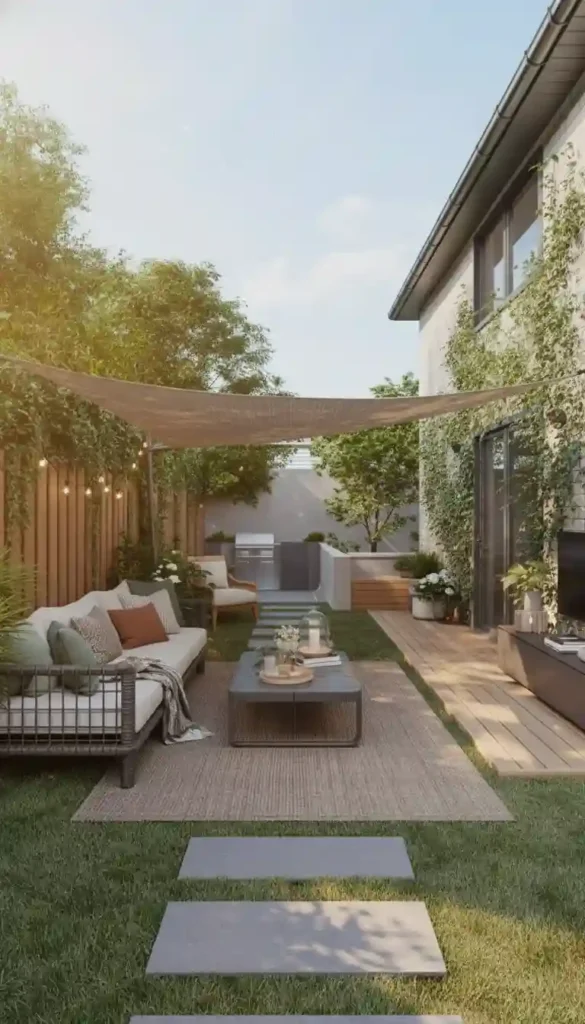
- Options: a pergola with a shade sail, a large market umbrella, a retractable awning, or a mature shade tree
- Even partial shade — dappled light through an overhead structure — is dramatically more comfortable than direct sun
This one check, done before you design anything, saves years of underusing your yard.
Protect the Zone From Wind
Wind is the other invisible comfort killer that most families overlook.
- Identify the prevailing wind direction in your yard (usually from the west or north)
- Use slatted panels, dense planting, or a low fence to buffer wind from the main seating area
- You don’t need a full enclosure — even a 4-foot screen on the windward side makes a huge difference
- Combine wind protection with privacy screening for double benefit along a property line
A calm, shaded seat becomes your default outdoor spot. A windy, sunny one gets ignored.
The Outdoor Drop Zone Changes Daily Life
An exterior drop zone is one of the most practical things you can add to any family backyard.
- Mount hooks near the door for hats, bags, towels, and jackets
- Add a bucket or bin at ground level for beach toys, pool floats, and sports balls
- Include a small outdoor mat or grate for muddy shoes
- Position a hose station or outdoor faucet nearby for quick rinse-offs before entering the house
Families who add a drop zone consistently report that clutter inside the house drops dramatically. It’s not magic — it’s friction removal.
Built-In Storage Is Better Than Add-On Storage
Storage that’s designed into the layout works better than storage that’s bolted on afterward.
- Use benches with hinged lids in the social zone — they seat people and store cushions simultaneously
- Install a narrow wall-mounted cabinet for outdoor dishes, games, and extras
- Add a fold-down surface on the wall near the door for a landing spot without a permanent table
- Consider a concealed bin area behind a slatted panel for a clean, uncluttered look
Every storage solution that requires dragging something from another location adds friction — and friction stops daily use.
Plan for Evening Use From the Start
The hours between dinner and bedtime are some of the best outdoor hours of the day. Plan for them.
- Install pathway lighting along main circulation routes — solar-powered is fine here
- Add a brighter task light near the grill for safe cooking after dark
- Use warm ambient lighting (2700K to 3000K) in the seating zone for a relaxed mood
- Wire an outdoor outlet near the seating area for speakers, fans, and phone charging
Don’t treat lighting as a finishing touch. It’s as structural as the layout itself.
📌 Save this weekday backyard living strategy! 📌
Build a Simple Weather Plan
A yard that requires 20 minutes of setup every time it rains gets abandoned fast.
- Choose a deck box or storage bench that lives outside year-round for cushion storage
- Keep a waterproof cover on the grill — one that snaps on in 10 seconds
- Plan drainage for heavy rain: ensure paved areas slope slightly away from the house (1 to 2 percent grade)
- In muddy seasons, add a simple paver path to the most-used areas so wet grass isn’t a barrier
This plan doesn’t need to be elaborate. It just needs to exist.
The Core Principle
Everyday living layouts work because they match the design to actual behavior. When the yard requires no setup, no effort, and no planning to use — you use it. That’s the goal. Not a yard that photographs well. A yard you live in.
Kid-Friendly Safety Zones: Supervision, Soft Landings, and Smart Design
A kid-friendly backyard isn’t a playground. It’s a yard where children can play freely and adults can supervise comfortably without giving up a functional space. The best family yards serve both groups at the same time.
Safety Starts With Placement, Not Products
You don’t need expensive safety equipment to build a safe yard. You need smart placement.
- Put the kid zone in direct sightline from the main adult seating area
- Never tuck the play area behind tall hedges, a shed, or a structure that blocks the view
- Keep it visible from the grill, dining table, and main lounge seat
- If the sightline isn’t natural, adjust the layout before you add any equipment
Supervision is the first line of safety. Everything else is secondary.
Separate Active Play From Hazardous Zones
This is non-negotiable in any family yard with children.
- Create a hard boundary between kid zones and the grill, fire feature, and tool storage
- Use planters, edging, or a low fence to mark the separation clearly
- Never place the play area downhill or downwind from a grill area
- Keep sharp tools, chemicals, and garden equipment in a locked or closed area separate from the play zone
The boundary doesn’t need to be dramatic. It just needs to be consistent.
Choose Soft Landing Surfaces
Falls happen. The surface determines whether a fall is a laugh or a trip to urgent care.
- Synthetic turf: modern, low-maintenance, comfortable on bare feet, and safe for falls
- Rubber play tiles: excellent impact absorption, available in interlocking squares, easy to install and replace
- Deep mulch (4 to 6 inches): most affordable option, good drainage, natural look
- Avoid stone, concrete, or tile in the active play zone — they look great but hurt
Choose the surface based on your climate, maintenance preference, and budget. All three options are dramatically safer than hard surfaces.
📌 Pin this kid-safe backyard zone layout! 📌
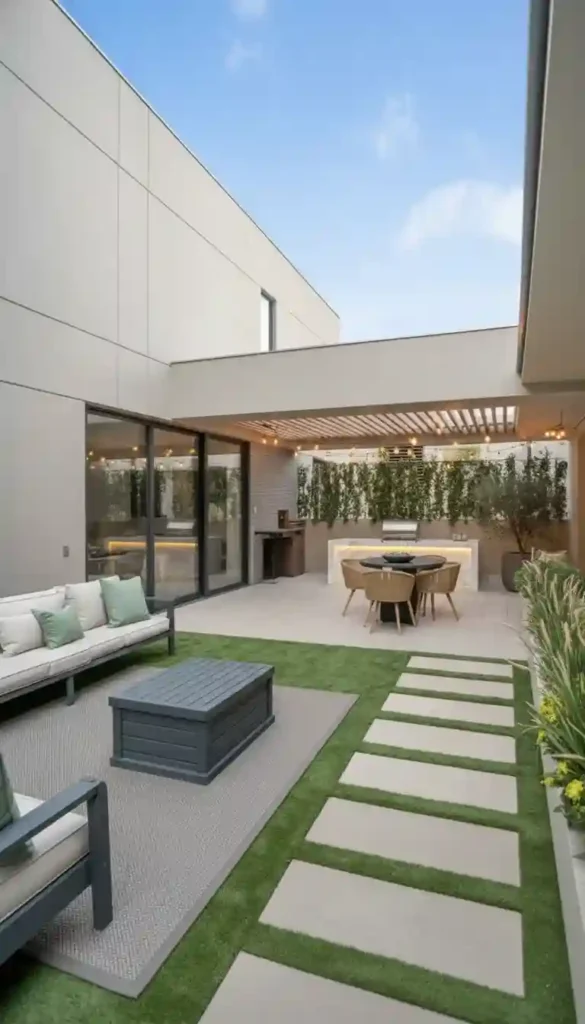
Design for the Age Range You Have Now
A 4-year-old and a 12-year-old need very different things from an outdoor space.
- Younger children need enclosed, visible spaces close to the house
- Older children need more room to run, a clear ball-play area, and some independence
- Design for the age group you have now, but leave one zone adaptable as kids grow
- A simple grass lawn with edged borders can be a running space, a ball field, or a future garden bed
Don’t lock in permanent features for a single age group. Build flexibility into the layout from the start.
The Swing Set Placement Most People Get Wrong
Most families place their swing set wherever there’s space. That’s how injuries happen.
- Orient the swing set so the direction of swing travel runs parallel to fence lines — not toward them
- Allow a minimum of 6 feet of clearance behind the highest swing point
- Keep the front clearance (the direction kids jump off) free of obstacles for at least 8 feet
- Position it so the swing travel direction doesn’t aim toward the seating area or dining table
This one placement decision can prevent the most common swing set injuries in a family yard.
Add a Quiet Shaded Nook for Kids
Not every child wants to run at full speed every minute. A small quiet zone gives kids a place to shift gears.
- Add a kid-size table under a small shade structure or tree canopy
- Make it available for drawing, snacks, puzzles, and low-energy play
- Keep it distinct from the main lounge — kids feel ownership over a space that’s theirs
- Stock a weatherproof bin nearby with art supplies, chalk, or quiet-activity toys
This nook tends to be used more than expected, especially in mixed-age groups where younger kids want a calm escape.
Use Planting as a Soft Buffer — Not a Hard Barrier
Thick grasses, low shrubs, and non-toxic plants can define zone edges without creating an institutional feel.
- Use ornamental grasses along the boundary between social and play zones — they’re soft, safe, and beautiful
- Choose non-toxic plants near play areas: no foxglove, no oleander, no thorny roses
- Avoid plants with sharp edges, toxic berries, or thorns within reach of children
- A low hedge or dense ornamental grass border removes the “playground vibe” while keeping the fun fully intact
This is one of the most elegant solutions in family backyard design — natural boundaries that feel intentional, not defensive.
Add a Safety Checklist to Your Layout Process
Before finalizing any kid-friendly layout, walk through a quick physical check.
- Gate check: are all access points to hazardous areas latched and secured?
- Splinter check: run your hand along all wood structures — benches, fences, play frames
- Shade check: is there shade available during peak afternoon sun hours in the play zone?
- Pool barrier check: if there’s a pool, does the barrier meet local safety code requirements?
Do this check twice a year — once in spring before heavy use begins, and once in fall before seasonal changes bring new hazards.
📌 Save this kid-friendly backyard safety layout! 📌
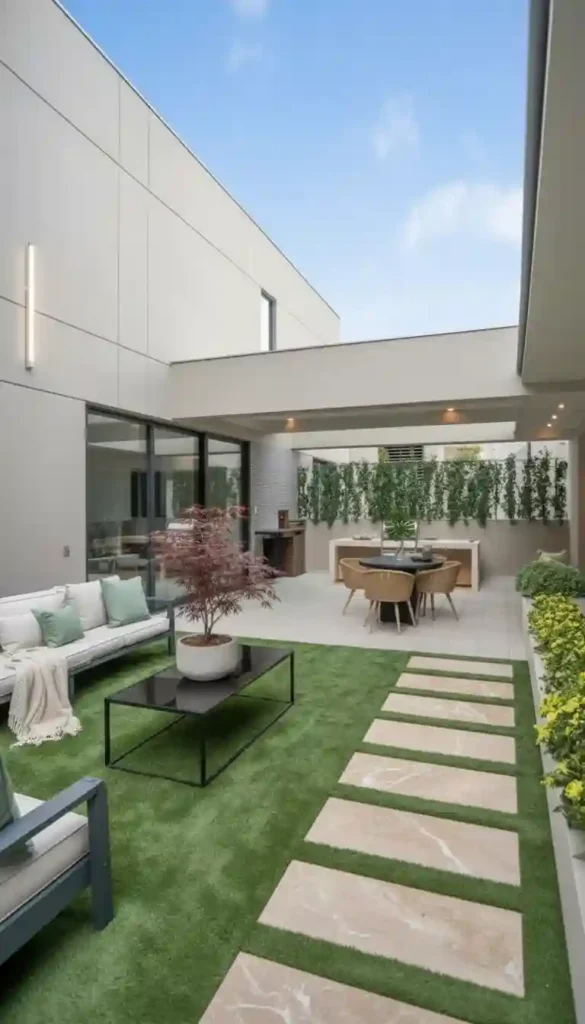
Pool Safety Deserves Its Own Plan
If a pool is part of your backyard, safety planning can’t be an afterthought.
- Install a compliant barrier (fence or wall with self-closing, self-latching gate) around all sides
- Keep pool equipment in an enclosed area that’s inaccessible to children
- Add a poolside hose station or rinse shower to reduce wet tracked into the house
- Plan for a towel drying area adjacent to the pool — hooks, a low rod, or a small drying structure
Check your local codes before building or modifying any pool barrier. Requirements vary by municipality and are legally enforceable in most jurisdictions.
The Core Principle
A kid-friendly backyard layout isn’t about maximizing fun features. It’s about removing risks without removing freedom. When kids can move and explore within a well-designed, well-supervised space, they thrive — and parents can actually relax while watching them do it.
Conclusion
A great family backyard in 2026 doesn’t happen by accident. It happens when you stop designing for photos and start designing for the way your family actually lives — the Tuesday afternoons, the muddy shoes, the after-dinner gatherings that turn into two extra hours outside because nobody wants to go in.
The five layout ideas in this guide — the modern outdoor room, the three-zone plan, the scalable size-based approach, the everyday living layout, and the kid-safe zone design — all come back to one idea: intentional space makes for a better life. Pick one idea that fits where you are right now. Start small. Test it. Then build. Your backyard is waiting.

“I share simple, beautiful and affordable home decor ideas to help you style every corner of your home with ease.